Why Do I Keep Getting Ants in My Kitchen Every Summer?
Table of Contents
Understanding Why Ants Invade Homes and How to Prevent Them
Why Do I Keep Getting Ants in My Kitchen Every Summer? | Complete Homeowner’s Guide
Discover why ants invade kitchens every summer, what attracts them, common ant species, prevention tips, and how to stop recurring infestations before they grow.
Introduction
If you find yourself asking, “Why do I keep getting ants in my kitchen every summer?”, you’re certainly not alone. Every year, homeowners across Calgary and many other parts of Canada notice long trails of ants appearing on countertops, around sinks, inside cupboards, and along baseboards as temperatures begin to rise. Although these tiny insects may seem to appear overnight, their arrival is rarely random. Ants are highly organized social insects that constantly search for food, water, and shelter, and kitchens provide all three.
Summer is the peak season for ant activity because warmer temperatures accelerate colony growth and increase the need for worker ants to forage. Understanding why ants enter your kitchen, what attracts them, and how they communicate can help you prevent recurring infestations before they become difficult to manage.
Why Are Ants More Active During the Summer?
Ants become significantly more active during warm weather because their metabolism increases with temperature. During spring and summer, colonies expand rapidly as queens lay more eggs and thousands of new worker ants emerge to gather food for the growing colony.
Unlike winter, when many ant species become less active or remain inside their nests, summer is dedicated to finding resources. Worker ants travel long distances searching for food and water, making residential kitchens one of their favourite destinations.
Why Kitchens Attract Ants
Your kitchen contains nearly everything ants need to survive. Even homes that appear spotless can provide small amounts of food and moisture that attract foraging ants.
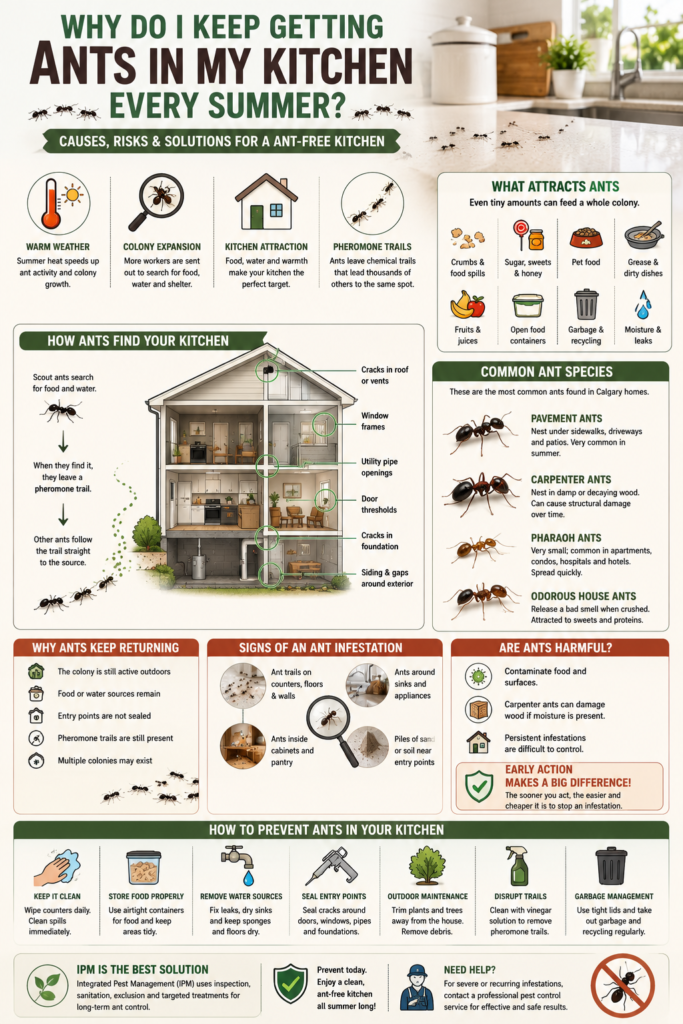
Common attractants include:
- Crumbs under appliances
- Sugar spills
- Honey and syrup
- Pet food
- Dirty dishes
- Grease residue
- Fresh fruit
- Bread crumbs
- Open food containers
- Recycling bins
- Garbage cans
Because ants require very little food, even a few unnoticed crumbs can support an entire trail of worker ants.
Water Is Just as Important as Food
Many homeowners focus only on food, but water is equally important to ants.
Common moisture sources include:
- Leaking faucets
- Wet sponges
- Sink drains
- Condensation around pipes
- Pet water bowls
- Dishwasher leaks
- Refrigerator drip trays
Some ant species actively seek moisture before searching for food, especially during hot, dry weather.
How Ants Find Your Kitchen
One of the most fascinating characteristics of ants is their communication system.
When a worker ant discovers food, it returns to the colony while leaving behind a pheromone trail. This invisible chemical pathway guides hundreds—or even thousands—of other ants directly to the food source.
This is why you often notice ants traveling in long, organized lines rather than randomly wandering through your kitchen.
Unless the pheromone trail is removed, more ants will continue following the same route.
Where Do Ants Enter the House?
Ants are capable of entering through surprisingly small openings.
Common entry points include:
- Cracks in foundations
- Window frames
- Door thresholds
- Utility pipe openings
- Gaps around electrical conduits
- Basement walls
- Expansion joints
- Exterior siding
- Roof penetrations
Tree branches and shrubs touching your home can also provide bridges that allow ants to enter more easily.
Common Ant Species Found in Calgary Homes
Several ant species commonly invade homes throughout Calgary.
Pavement Ants
Pavement ants often build nests beneath sidewalks, driveways, patios, and concrete slabs. During summer they frequently enter homes searching for food.
Carpenter Ants
Unlike termites, carpenter ants do not eat wood. Instead, they excavate damp or decaying wood to build their nests. Finding carpenter ants indoors may indicate moisture problems that should be investigated.
Pharaoh Ants
Pharaoh ants are extremely small and are commonly associated with apartment buildings, hospitals, hotels, and condominiums. They spread rapidly between units and require specialized management because disturbing the colony can cause it to split into multiple colonies.
Odorous House Ants
These ants release a distinctive unpleasant smell when crushed and commonly invade kitchens looking for sugary foods.
Why Ants Keep Returning
Many homeowners wonder why ants disappear after cleaning, only to return days later.
Several factors contribute to recurring infestations:
- The colony remains active outdoors.
- Food sources continue to be available.
- Entry points have not been sealed.
- Moisture problems remain unresolved.
- Pheromone trails are still present.
- Multiple colonies exist around the property.
Simply killing the visible ants rarely eliminates the colony itself.
Are Ants Harmful?
Most household ants are more of a nuisance than a direct health hazard. However, they can still create problems inside the home.
Potential concerns include:
Food Contamination
As ants travel across floors, garbage areas, and outdoor surfaces, they may contaminate food preparation areas and stored food.
Property Damage
Most ants do not damage structures, but carpenter ants can weaken wood that has already been affected by moisture by excavating galleries for nesting.
Persistent Nuisance
Large numbers of ants inside kitchens can become frustrating and difficult to control without addressing the source of the infestation.
How to Prevent Ants in Your Kitchen
The best way to prevent ants is to make your kitchen less attractive to foraging workers.
Helpful prevention tips include:
- Wipe countertops daily.
- Clean food spills immediately.
- Store food in airtight containers.
- Sweep and vacuum regularly.
- Empty garbage frequently.
- Clean behind appliances.
- Repair leaking faucets and pipes.
- Keep pet food sealed when not in use.
- Trim vegetation touching the house.
- Seal cracks around doors and windows.
Removing both food and water sources makes it much harder for ants to establish consistent trails.
Should You Spray Ants?
Many homeowners reach for aerosol insecticides when they see ants. While sprays may kill the ants that are visible, they often fail to eliminate the colony.
For certain species, such as Pharaoh ants, indiscriminate spraying can actually worsen the problem by causing colonies to split into multiple new colonies, a process known as budding.
Integrated Pest Management (IPM), which combines sanitation, exclusion, monitoring, and targeted control methods, is generally considered the most effective long-term approach.
Why Early Action Matters
Ant infestations rarely resolve on their own. The longer ants have access to food and water, the more established their foraging trails become.
Early identification of entry points, elimination of attractants, and prompt management can prevent a few scouting ants from becoming a persistent household problem.
Frequently Asked Questions (FAQ)
Why do ants suddenly appear in my kitchen every summer?
Warmer temperatures increase ant activity, and worker ants begin searching for food and water to support their expanding colonies.
Why do ants keep coming back after I clean?
Cleaning removes visible ants but may not eliminate pheromone trails, entry points, or the colony itself. If food or moisture remains available, new ants may return.
Does one ant mean there are more?
Usually, yes. A single ant often serves as a scout searching for food. If it finds a food source, it may leave a pheromone trail that attracts many more workers.
What smells keep ants away?
Strong scents such as vinegar, citrus, peppermint, and certain essential oils may temporarily disrupt ant trails, but they generally do not eliminate established colonies.
Should I kill the ants I see?
Removing visible ants may reduce immediate activity, but long-term control usually requires addressing food sources, entry points, and the colony.
Can ants damage my home?
Most household ants do not damage structures. However, carpenter ants can excavate damp or decaying wood to build nests, potentially contributing to structural concerns if moisture problems are left unresolved.
Why are ants mostly found in the kitchen?
Kitchens provide abundant food, water, warmth, and shelter, making them one of the most attractive areas of a home for foraging ants.
How do ants communicate?
Ants use chemical signals called pheromones to mark trails leading to food sources. Other workers follow these invisible trails, creating the organized lines commonly seen indoors.
Can ants survive Calgary winters?
Yes. Many ant species survive winter by remaining inactive in underground nests or protected areas until temperatures warm again in the spring.
Final Thoughts
Recurring ant activity during the summer is a natural result of seasonal changes and the resourceful behaviour of ant colonies. Kitchens provide the food, water, and shelter that foraging ants need, making them one of the most common places for infestations to occur. By understanding why ants are attracted to your home, recognizing the conditions that encourage their activity, and practicing good sanitation and home maintenance, you can greatly reduce the likelihood of recurring infestations.
Rather than focusing solely on the ants you see, addressing the underlying causes—such as food sources, moisture, entry points, and pheromone trails—offers the most effective long-term strategy for keeping your kitchen ant-free throughout the summer.