Common Ants Found in Alberta: Identification, Habits, and When to Take Action
Table of Contents
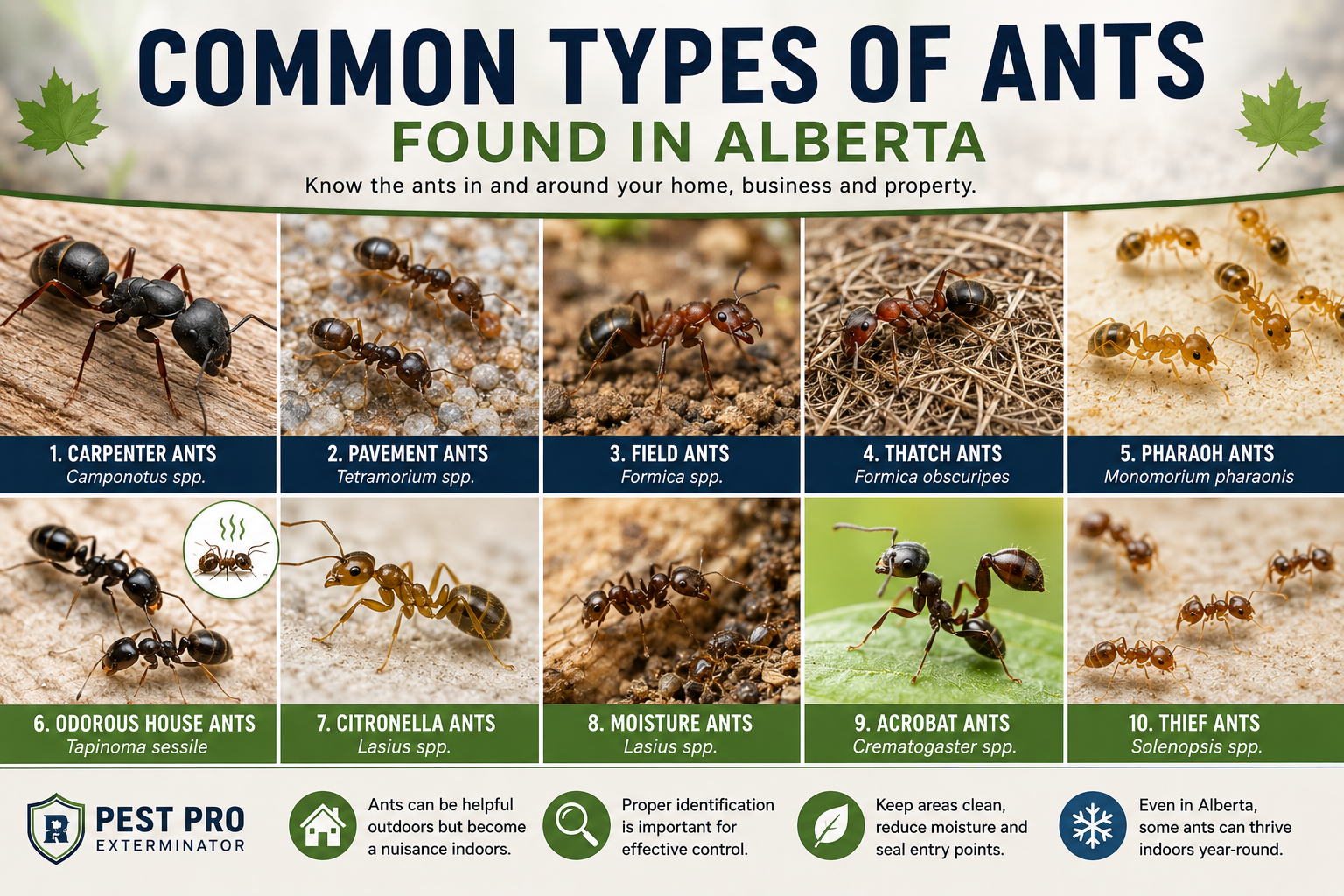
Common Ants Found in Alberta
Ants are among the most common insects found throughout Alberta. While many species are beneficial to the environment, others can become persistent household pests by invading kitchens, damaging wood, or establishing large colonies inside buildings.
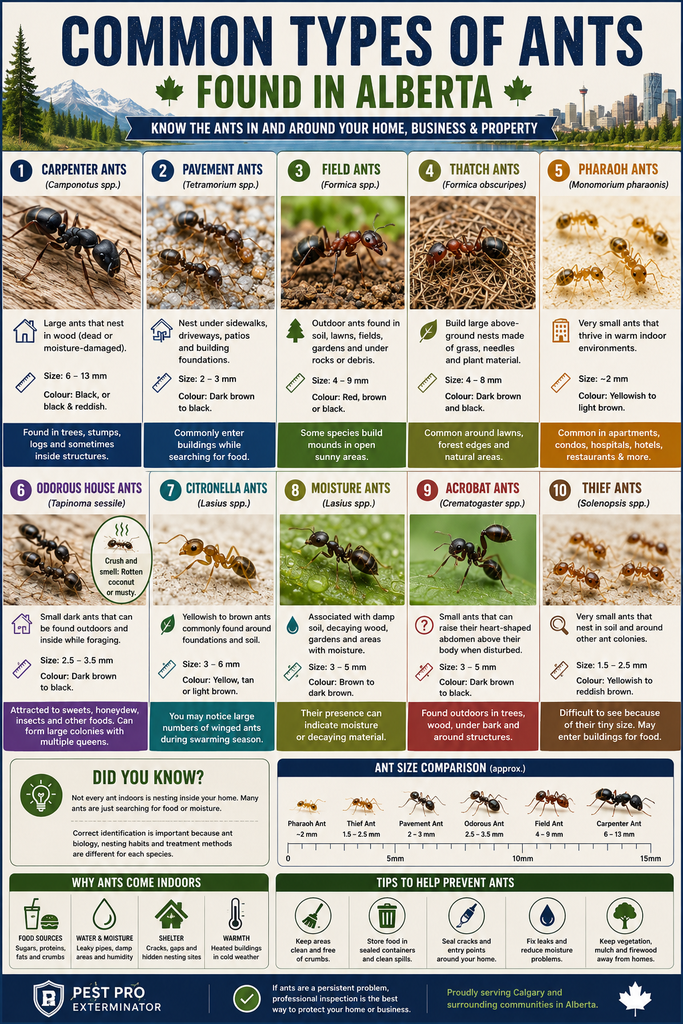
Understanding which ant species you’re dealing with is the first step toward effective control. This guide explains the most common ants found in Alberta, their appearance, nesting habits, and whether they pose a risk to your home.
Why Are Ants So Common in Alberta?
Alberta’s climate experiences long winters followed by warm springs and summers. During the warmer months, ants become highly active as they search for food, water, and nesting sites.
Urban development also provides excellent habitats, including:
- House foundations
- Sidewalk cracks
- Lawns
- Gardens
- Tree stumps
- Landscaping rocks
- Wall voids
- Crawl spaces
Many ant species become more noticeable from April through September, with activity peaking during warm weather.
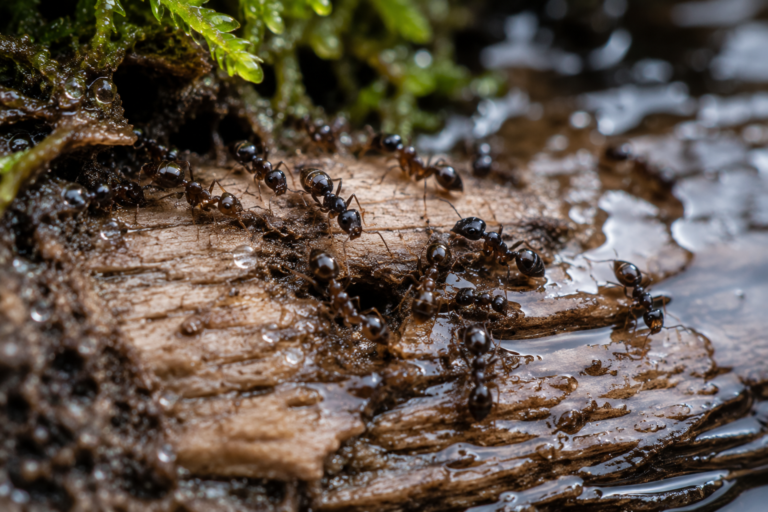
1. Carpenter Ants (Camponotus spp.)
Carpenter ants are Alberta’s largest and one of the most concerning ant species for homeowners.
Identification
- Length: 6–13 mm
- Black, reddish-black, or dark brown
- Large rounded thorax
- One waist node
- Elbowed antennae
Where They Nest
Carpenter ants prefer moist or decaying wood and commonly nest in:
- Tree stumps
- Dead trees
- Firewood piles
- Decks
- Roof structures
- Wall voids
- Window frames
Unlike termites, carpenter ants do not eat wood. Instead, they excavate galleries to create nests.
Signs of Infestation
- Rustling sounds inside walls
- Sawdust-like wood shavings (frass)
- Large black ants indoors
- Winged ants during spring
2. Pavement Ants (Tetramorium immigrans)
Pavement ants are among the most frequently encountered nuisance ants in Alberta cities.
Identification
- 2.5–4 mm long
- Brown to dark brown
- Fine grooves on the head and thorax
- Two waist nodes
Common Nesting Areas
- Sidewalk cracks
- Driveways
- Foundations
- Concrete slabs
- Patio stones
Foods They Prefer
- Sugary foods
- Grease
- Dead insects
- Pet food
- Bread crumbs
These ants often invade kitchens during summer.
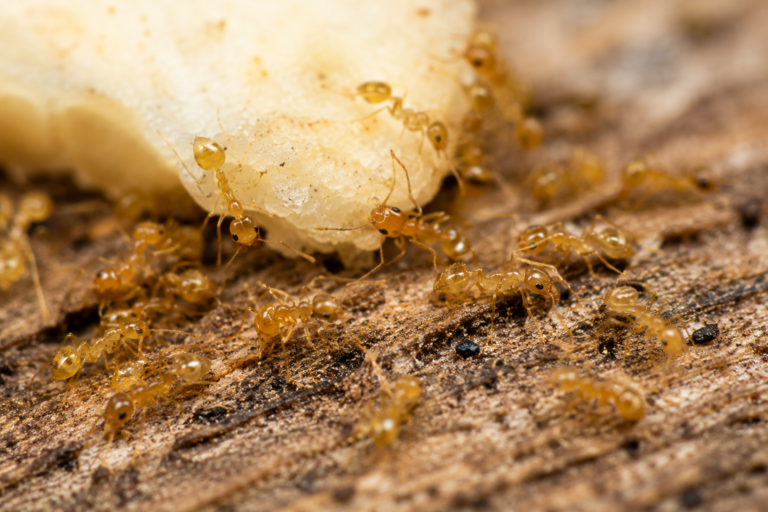
3. Pharaoh Ants (Monomorium pharaonis)
Pharaoh ants are one of the most difficult ants to eliminate and are common in heated apartment buildings, hospitals, hotels, and condominiums.
Identification
- 1.5–2 mm long
- Yellow to light brown
- Dark abdomen
- Very small
Nesting Locations
- Wall voids
- Electrical outlets
- Ceiling spaces
- Appliances
- Behind cabinets
Why They’re Problematic
Pharaoh ants form multiple queens and multiple nests.
Improper spraying often causes colonies to split into many new colonies, making infestations significantly worse.
Professional baiting programs are usually the most effective solution.
4. Thief Ants (Solenopsis molesta)
Thief ants are among the smallest ants found in Alberta.
Identification
- 1–2 mm
- Pale yellow
- Tiny eyes
- Two waist nodes
Favorite Foods
- Grease
- Meat
- Cheese
- Oils
- Dead insects
Because of their tiny size, they often enter homes through extremely small cracks.
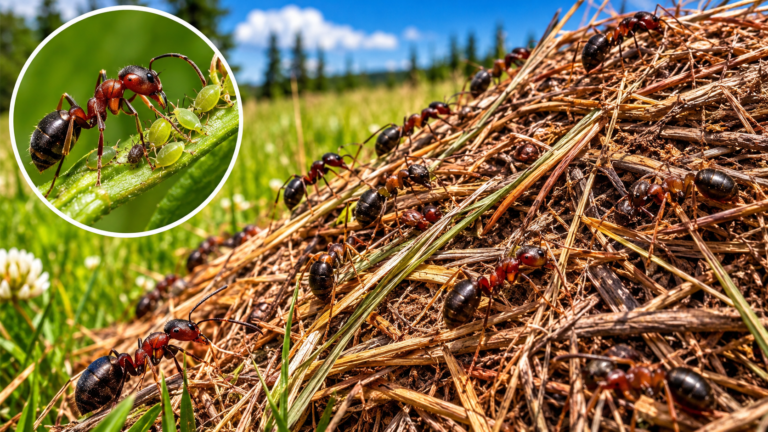
5. Field Ants (Formica spp.)
Field ants are common in rural Alberta and suburban lawns.
Identification
- 4–8 mm
- Black, red, or mixed colors
- Larger than pavement ants
Nesting Areas
- Lawns
- Gardens
- Open fields
- Forest edges
Many species build visible soil mounds.
Are They Dangerous?
Not usually.
Some species may bite or spray formic acid if disturbed, but they rarely invade homes.
6. Cornfield Ants (Lasius alienus and related species)
Cornfield ants commonly live in lawns and gardens.
Identification
- 3–5 mm
- Brown to black
- Smooth shiny body
Interesting Behavior
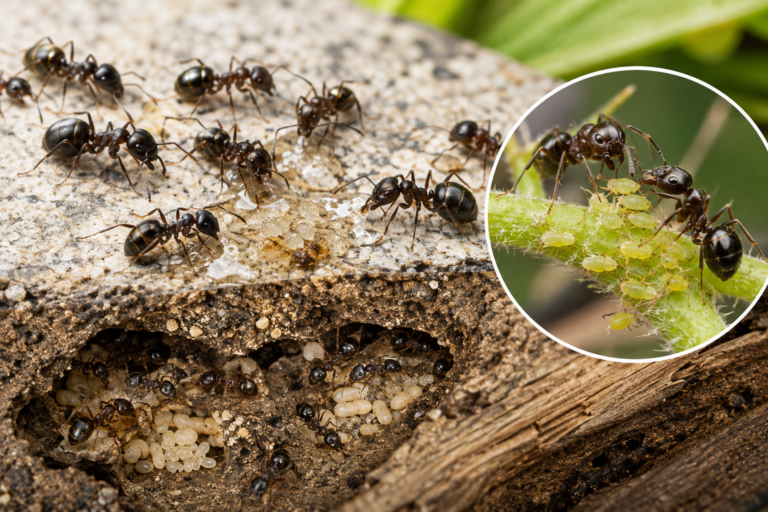
These ants “farm” aphids by protecting them and feeding on the honeydew they produce.
Large populations may indicate aphid infestations nearby.
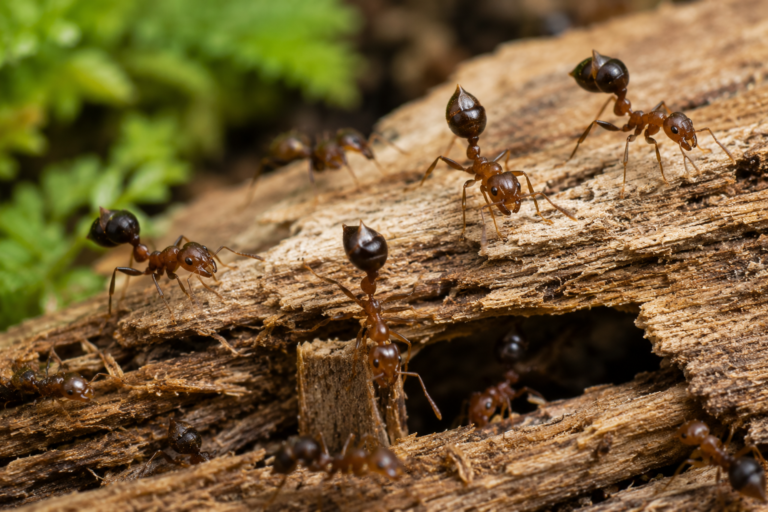
7. Citronella Ants (Lasius interjectus and related species)
Citronella ants are often mistaken for termites because of their yellow color.
Identification
- Yellow to orange
- 4–5 mm
- Smell like lemons or citronella when crushed
Nesting Areas
- Soil
- Under rocks
- Basements
- Crawl spaces
These ants rarely infest homes but may swarm indoors.
8. Acrobat Ants (Crematogaster spp.)
Although less common, acrobat ants can occasionally be found in Alberta.
Identification
- Heart-shaped abdomen
- Brown to black
- Raise abdomen when disturbed
Nesting Locations
- Dead trees
- Rotten wood
- Wall voids
- Insulation
Which Ants Are the Biggest Concern?
The following species are most likely to require professional treatment:
| Ant Species | Invades Homes | Structural Risk | Difficult to Eliminate |
|---|---|---|---|
| Carpenter Ant | ✅ Yes | High | High |
| Pharaoh Ant | ✅ Yes | No | Very High |
| Pavement Ant | ✅ Yes | Low | Moderate |
| Thief Ant | ✅ Yes | Low | Moderate |
| Acrobat Ant | Occasionally | Moderate | Moderate |
| Field Ant | Rarely | Low | Low |
| Cornfield Ant | Occasionally | Low | Low |
| Citronella Ant | Rarely | Low | Low |
How to Prevent Ant Infestations
Preventing ants starts with reducing access to food, moisture, and shelter.
Some effective prevention tips include:
- Seal cracks around foundations and windows.
- Store food in airtight containers.
- Clean kitchen counters regularly.
- Repair plumbing leaks promptly.
- Trim shrubs and tree branches touching your home.
- Remove wood debris and old tree stumps.
- Keep firewood elevated and away from the house.
- Empty garbage frequently.
When Should You Call a Pest Control Professional?
Professional help is recommended if:
- You continue seeing ants after treatment.
- Winged ants appear indoors.
- Ants are nesting inside walls.
- Carpenter ants are damaging wood.
- Pharaoh ants are spreading throughout an apartment or condominium.
- Multiple colonies are present around your property.
Correct identification is essential because different ant species require different treatment methods. Using the wrong insecticide can sometimes worsen the infestation, especially with species like Pharaoh ants.
Frequently Asked Questions (FAQ) – Common Ants Found in Alberta
1. What are the most common ants found in Alberta?
The most common ant species in Alberta include carpenter ants, pavement ants, pharaoh ants, field ants, thief ants, cornfield ants, citronella ants, and acrobat ants. Each species has different nesting habits and requires different control methods.
2. Which ants are most likely to invade homes in Alberta?
Carpenter ants, pavement ants, pharaoh ants, and thief ants are the species most commonly found inside Alberta homes, apartments, and commercial buildings. They typically enter while searching for food, water, or suitable nesting sites.
3. Are carpenter ants dangerous to my home?
Yes. Carpenter ants can cause structural damage by tunneling through damp or decaying wood to build their nests. Although they do not eat wood like termites, large colonies can weaken wooden structures over time.
4. How do I identify carpenter ants?
Carpenter ants are among the largest ants in Alberta, measuring approximately 6–13 mm long. They are usually black or reddish-black, have elbowed antennae, one waist node, and a smoothly rounded thorax.
5. What attracts ants into my house?
Ants are attracted to:
- Food crumbs and sugary spills
- Grease and pet food
- Water leaks and moisture
- Garbage and recycling bins
- Easy entry points around doors, windows, and foundations
6. Why do I suddenly have ants in my kitchen?
Ants often appear in kitchens because they are searching for food and water. Even small crumbs, sugary drinks, fruit, or pet food can attract scout ants, which then leave scent trails for the rest of the colony.
7. Are pharaoh ants difficult to eliminate?
Yes. Pharaoh ants are one of the most challenging household pests because they have multiple queens and interconnected colonies. Using the wrong spray insecticide can cause the colony to split into several new colonies, making the infestation worse.
8. Can I use store-bought ant spray to get rid of ants?
Store-bought sprays may kill visible ants but often do not eliminate the colony. For species like pharaoh ants and carpenter ants, professional treatment and targeted baiting are usually more effective for long-term control.
9. When are ants most active in Alberta?
Ants are most active from April through September, with peak activity occurring during late spring and summer when temperatures are warm and food is abundant.
10. How can I prevent ants from entering my home?
To reduce the risk of ant infestations:
- Keep food sealed in airtight containers.
- Clean up crumbs and spills promptly.
- Repair leaking pipes and faucets.
- Seal cracks around windows, doors, and foundations.
- Trim vegetation touching your home.
- Store firewood away from the house.
11. Are ants beneficial to the environment?
Yes. Many outdoor ant species help aerate soil, recycle organic matter, disperse seeds, and prey on other insects. Most ants become pests only when they invade homes or businesses.
12. How do I know if I need professional ant control?
You should contact a pest control professional if:
- Ants continue to return after treatment.
- You find winged ants indoors.
- You suspect carpenter ants in walls or wood.
- The infestation is spreading throughout your home.
- You cannot locate the nest.
13. Do ants bite in Alberta?
Most ants found in Alberta are harmless and rarely bite. However, field ants and carpenter ants may bite if disturbed, and some field ants can spray a mild formic acid as a defense mechanism.
14. What is the difference between carpenter ants and termites?
Carpenter ants excavate wood to build nests but do not consume it. Termites feed on wood as their primary food source, causing different types of structural damage.
15. Why do ants keep coming back after treatment?
Recurring infestations usually mean the main colony was not eliminated, multiple colonies are present, or attractive food and moisture sources remain available. Proper species identification and treating the nest—not just the visible ants—is essential for lasting control.
Conclusion
Alberta is home to a diverse range of ant species, from beneficial outdoor ants to persistent household invaders. Identifying the species is the key to choosing the right control method. While many ants are simply a nuisance, carpenter ants can damage wood, and Pharaoh ants can become extremely difficult to eliminate without a comprehensive baiting program.
By practicing good sanitation, reducing moisture, sealing entry points, and addressing infestations early, homeowners can significantly reduce the risk of ant problems. If ants continue to return despite your efforts, a professional inspection can help locate hidden nests and implement the most effective long-term solution.