Moisture Ants in Alberta: Biology, Identification, Life Cycle, Habitat and Nesting Habits
Table of Contents
Moisture ants are a common name used for several small ant species, particularly ants in the genus Lasius, that are associated with moist soil, damp environments, rotting wood, and water-damaged areas. In Alberta, one species reported from water-damaged homes is Lasius pallitarsis. Because “moisture ant” is a group name rather than a single species, accurate identification of the worker ants is important.
For homeowners in Calgary and throughout Alberta, finding moisture ants inside a building can be an important clue that there may be an underlying leak, condensation problem, damp foundation area, or decaying wood. These ants are generally not considered primary structural pests, but their nesting activity can contribute to the deterioration of wood that is already damaged or decaying.
What Are Moisture Ants?
The term moisture ants describes a group of ants that prefer damp or moisture-associated nesting environments. Several Lasius species are known by this common name.
Unlike carpenter ants, moisture ants generally do not seek out sound, healthy structural wood. They are more strongly associated with rotting or water-damaged wood and other protected moist locations.
This makes moisture ants particularly interesting from a pest-management perspective: the ants may be less of a primary cause of structural damage and more of an indicator that moisture and wood deterioration already exist.
Moisture Ant Identification
Moisture ants are generally small ants, with appearance varying between species. Some commonly encountered forms are yellowish, yellow-brown, light brown, or darker brown.
Because “moisture ant” includes multiple species, size and colour should not be used alone for identification. The structure of the antennae, thorax, waist, body hairs, nesting location, and behaviour can all help with identification.
In Alberta, the Edmonton area specifically identifies Lasius pallitarsis as one moisture-ant species that may be recovered from homes experiencing water damage.
Why Are They Called Moisture Ants?
The name comes from their strong association with moist environments.
Moisture ants may establish nests in:
- Water-damaged wood
- Rotting logs
- Tree stumps
- Damp soil
- Areas beneath rocks
- Moist areas near foundations
- Decaying organic material
- Other protected, humid locations
Their presence around a building can therefore provide an important biological clue about the local moisture conditions.
Where Do Moisture Ants Nest?
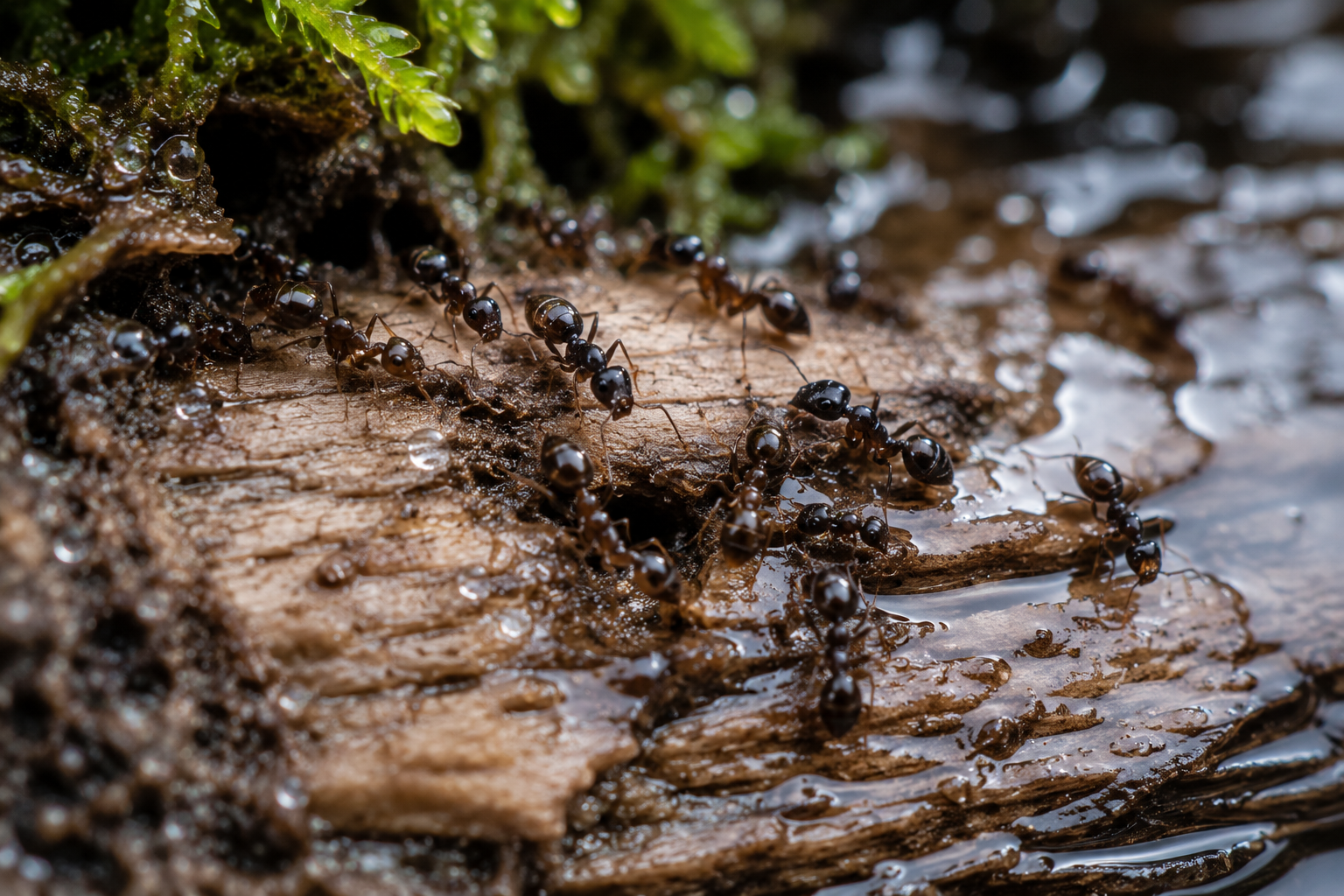
In natural environments, moisture ants may nest in rotting logs, tree stumps, damp soil, and beneath rocks. Around buildings, they may take advantage of areas where moisture has created suitable nesting conditions.
Potential locations include:
- Around leaking plumbing
- Near damp foundations
- In water-damaged wall areas
- Beneath flooring
- Around poorly drained areas
- Near condensation
- In decaying wood
- Under slabs or other protected areas
Moisture ants are often secretive, which means a colony can remain hidden for some time before workers or winged reproductive ants become obvious.
Moisture Ants and Water-Damaged Wood
One of the most important characteristics of moisture ants is their association with wood that is already deteriorating.
These ants can tunnel through decayed or water-damaged wood while creating nesting galleries. They generally do not consume wood as food. Instead, their excavation can further disturb material that has already been weakened by moisture and decay.
This distinction is important when comparing moisture ants with carpenter ants.
Moisture Ants vs. Carpenter Ants
Carpenter ants can excavate galleries in wood and may establish nests in structures. Moisture ants are more closely associated with already damp, decaying, or water-damaged materials.
Therefore, discovering moisture ants inside a building should prompt an inspection for the source of moisture, rather than assuming the ants themselves are the original cause of the wood problem.
Moisture Ant Colony Structure
Like other ants, moisture ants are social insects that live in organized colonies. Colonies include workers and reproductive ants, with queens responsible for producing eggs.
Workers perform essential tasks such as:
- Foraging
- Caring for brood
- Maintaining the nest
- Moving food
- Defending the colony
- Expanding or modifying nesting areas
Some moisture-ant species can form colonies containing multiple queens, although colony structure varies among species grouped under the moisture-ant name.
Moisture Ant Life Cycle
Moisture ants undergo complete metamorphosis, developing through four stages:
Egg → Larva → Pupa → Adult
The queen produces eggs, which develop into larvae. Worker ants care for and feed the larvae. The larvae eventually pupate and emerge as adult ants.
Adult workers then perform different jobs according to the needs of the colony.
This life cycle allows colonies to maintain a continuous population of workers while producing reproductive ants when the colony reaches the appropriate stage of development.
Moisture Ants and Winged Ants
One of the most noticeable signs of a mature moisture-ant colony can be the sudden appearance of winged reproductive ants, also known as alates.
These winged ants are reproductive males and females. Their appearance can be surprising because homeowners may have seen very few ants before the swarm occurs.
Moisture ants can produce winged ants during late summer and autumn, depending on the species and local conditions.
Seeing winged ants indoors does not automatically prove that the colony is inside the building, but it can justify investigating nearby nesting areas and possible moisture problems.
What Do Moisture Ants Eat?
Moisture ants are generally omnivorous and opportunistic feeders. Their diet can include sugary food sources and protein.
Some moisture ants forage for:
- Honeydew
- Sugary plant secretions
- Small insects
- Dead insects
- Other organic food sources
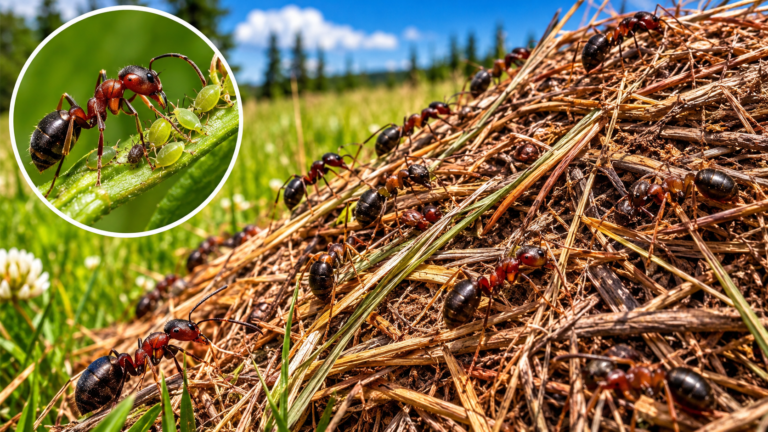
Moisture ants can also interact with aphids, scale insects, and mealybugs, collecting honeydew produced by these plant-feeding insects.
Moisture Ants and Aphids
The relationship between ants and honeydew-producing insects is an important part of ant biology.
Aphids and related insects feed on plants and excrete a sugary substance called honeydew. Ants can collect this substance as a carbohydrate-rich food source.
In some situations, ants protect honeydew-producing insects from predators in exchange for access to their secretions.
This behaviour can explain why moisture-ant activity may sometimes be associated with vegetation around a building.
Moisture Ants in Calgary and Alberta
Moisture ants are relevant to Alberta pest identification because several species occur in the region and some have been documented in homes affected by water damage. Edmonton’s municipal pest information specifically notes Lasius pallitarsis in water-damaged homes.
In Calgary, moisture-associated ants may be encountered around:
- Foundations
- Basements
- Crawlspaces
- Landscaping
- Damp wood
- Tree stumps
- Garden areas
- Water-damaged building materials
The exact species should be confirmed before making a pest-management decision.
Are Moisture Ants a Structural Pest?
Moisture ants are generally not considered a primary structural pest in the same way carpenter ants can be.
However, they can tunnel through wood that has already been weakened by decay or water damage. Their activity may therefore accelerate deterioration of material that is already compromised.
The bigger warning sign is often the moisture problem itself.
If moisture ants are found inside a wall, basement, crawlspace, or other concealed area, investigating for leaks, condensation, drainage problems, or water-damaged materials is important.
Signs of Moisture Ant Activity
Possible signs include:
- Small ants around damp areas
- Ants emerging from damaged wood
- Ant activity around foundations
- Winged ants appearing indoors
- Ants near plumbing or condensation
- Fine soil or nesting material around wall voids
- Ant activity near rotting wood
- Repeated ant activity after rain or periods of high moisture
Because moisture ants are secretive, visible workers may represent only a portion of the colony.
Why Moisture Control Matters
One of the most important lessons from moisture-ant biology is that controlling the underlying moisture condition is an important part of long-term management.
If a leak, condensation problem, or water-damaged area remains unresolved, the environment may continue to provide suitable nesting conditions.
Municipal pest-management guidance recommends correcting the moisture problem and replacing damaged wood with sound material when moisture ants are associated with water-damaged structures.
Frequently Asked Questions About Moisture Ants
What are moisture ants?
Moisture ants are a common name for several ant species, particularly some Lasius species, that are associated with damp soil, rotting wood, and moisture-damaged environments.
Are moisture ants found in Alberta?
Yes. Moisture ants occur in Alberta, and municipal pest information identifies species such as Lasius pallitarsis in homes with water damage.
Are moisture ants common in Calgary?
Moisture-associated ants can occur in Calgary and other parts of Alberta, particularly where suitable damp soil, decaying wood, or water-damaged materials are present.
Do moisture ants eat wood?
No. Moisture ants do not generally eat wood as their food source. They can excavate or tunnel through rotting or water-damaged wood to create nesting areas.
Do moisture ants damage houses?
They are not generally considered primary structural pests, but their nesting activity can contribute to deterioration of wood that is already damaged by moisture or decay.
What attracts moisture ants?
Moisture ants are strongly associated with damp environments. Leaks, condensation, wet soil, decaying wood, and other moisture conditions can create suitable nesting habitat.
Can moisture ants live inside walls?
Yes. When moisture has affected building materials, colonies can establish in concealed areas such as wall voids or other protected locations.
Why am I seeing winged moisture ants inside my house?
Winged ants are reproductive ants produced by mature colonies. Their appearance can indicate a nearby colony, although the colony may be inside or outside the structure.
What do moisture ants eat?
They can feed on sweet substances, honeydew, insects, and other available food sources. Some species forage for honeydew from aphids and other plant-feeding insects.
Are moisture ants the same as carpenter ants?
No. Moisture ants are a group of ants associated with damp or decaying environments, while carpenter ants are Camponotus species that excavate nesting galleries in wood. Proper identification is important because their biology and management considerations differ.
Are moisture ants dangerous to people?
Moisture ants are generally considered a nuisance rather than a dangerous pest. The more important concern when they occur inside a building is often the underlying moisture or wood-decay condition.
How do I know if moisture is causing an ant problem?
Look for signs such as water staining, condensation, plumbing leaks, damp wood, musty areas, drainage problems, or repeated ant activity near moisture sources.
Conclusion
The biology of moisture ants in Alberta is closely connected to their preference for damp and deteriorating environments. These ants are fascinating soil- and wood-associated insects that can live in natural habitats such as rotting logs and tree stumps, but they may also establish themselves around buildings where moisture has created suitable conditions.
For Calgary homeowners, the discovery of moisture ants inside a structure should be viewed as more than simply an ant problem. It can be an indicator of water damage, excessive moisture, condensation, or deteriorating wood. Correct species identification and investigation of the surrounding environment are therefore important steps in understanding the problem.