Acrobat Ants in Alberta: Biology, Identification, Life Cycle and Nesting Habits
Table of Contents
Acrobat ants are small ants belonging to the genus Crematogaster. They are named for their unusual defensive behavior: when disturbed, workers may raise or curl their abdomen over their thorax, almost as if they are performing an acrobatic maneuver. Their distinctive body shape and behavior make them an interesting species to include in an Alberta ant-identification guide.
Acrobat ants are primarily outdoor ants associated with dead or decaying wood, tree stumps, logs, branches, and other protected nesting locations. They can occasionally enter buildings, especially when suitable nesting conditions exist around damaged wood or wall voids.
What Are Acrobat Ants?
The name acrobat ant refers to ants in the genus Crematogaster. They are generally small to medium-sized ants, with workers commonly around 3 mm (about 1/8 inch) long.
Their bodies may range from yellow-brown and reddish-brown to dark brown or nearly black, depending on the species. Because Crematogaster contains multiple species, colour and size can vary.
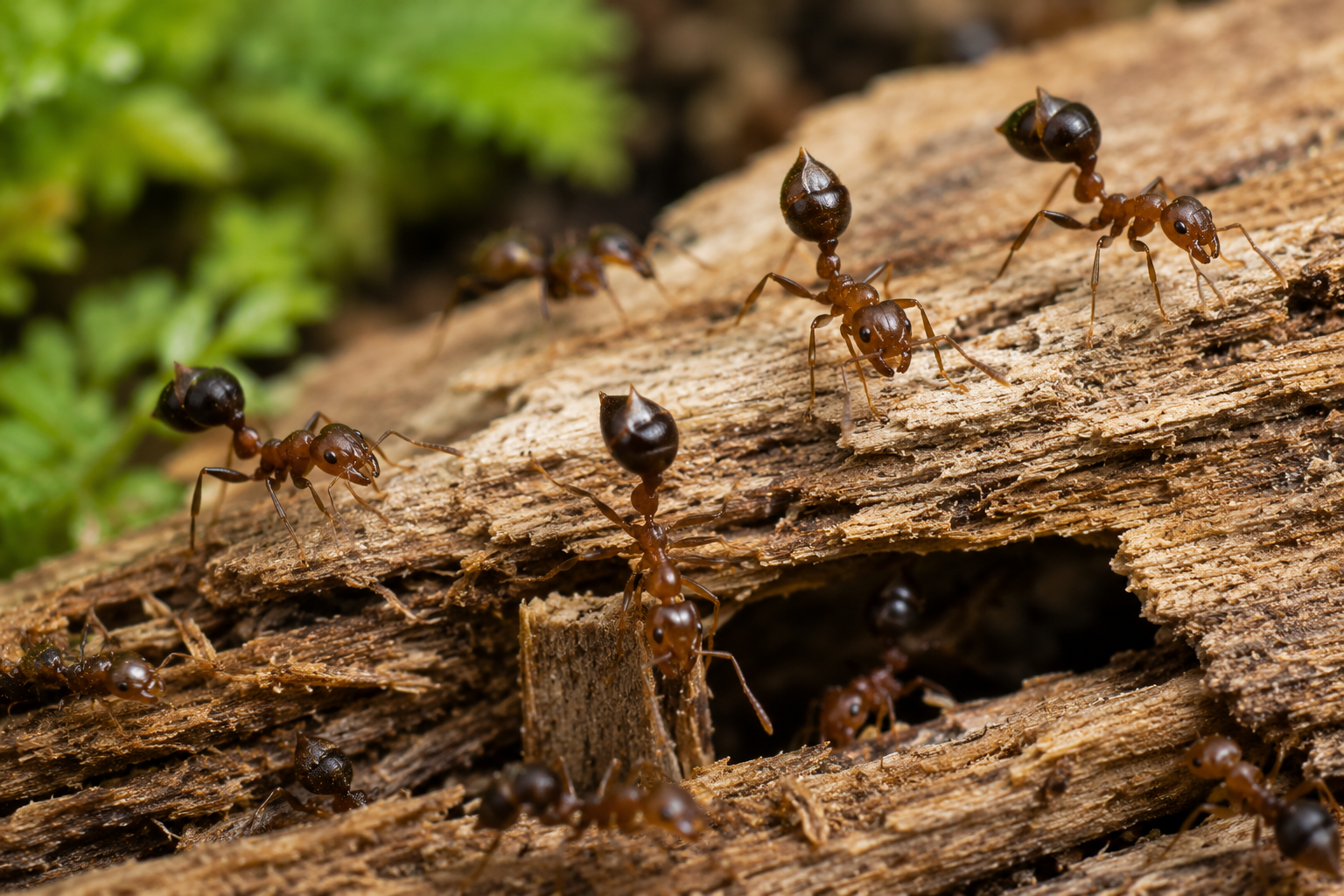
One of their most useful identification characteristics is their heart-shaped abdomen, which tapers toward the tip. Their abdomen is also attached to the thorax in a way that allows the ant to raise it dramatically when disturbed.
Why Are They Called Acrobat Ants?
Acrobat ants get their common name from their unusual posture.
When a worker is disturbed or feels threatened, it can raise its abdomen above its body and sometimes over its head. This behavior is particularly noticeable when workers are defending their nest.
The flexible abdomen is not simply an unusual appearance—it is part of the ant’s defensive behavior and helps explain why Crematogaster is commonly called the acrobat ant.
How to Identify Acrobat Ants
Several characteristics can help distinguish acrobat ants from other common ants.
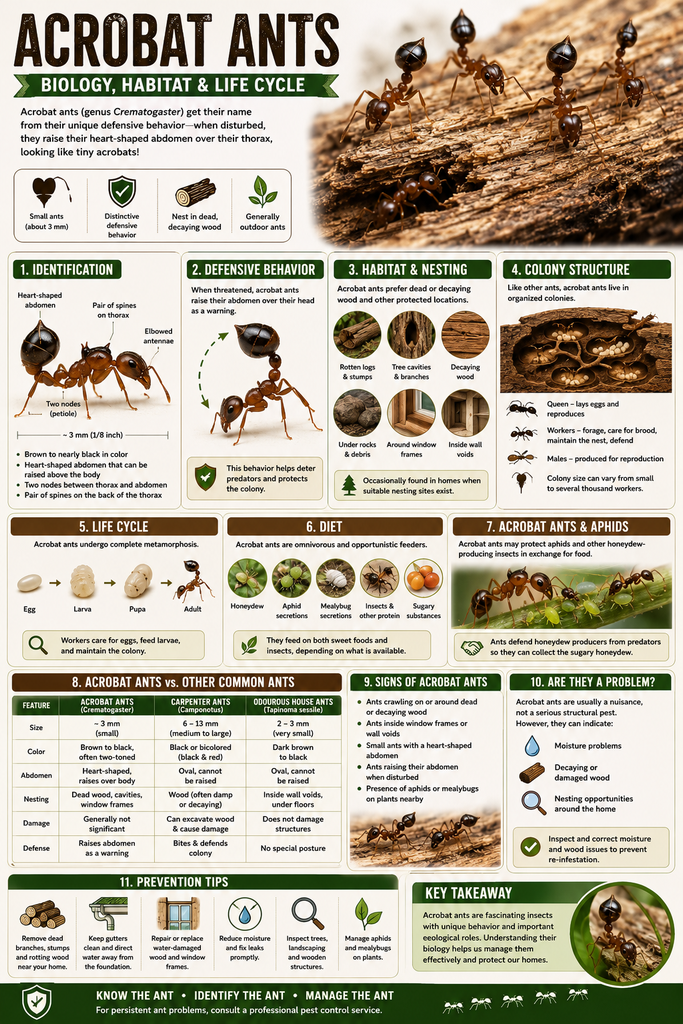
Key identification characteristics:
- Small workers, commonly around 3 mm
- Brown to nearly black coloration depending on species
- Two nodes between the thorax and abdomen
- Distinctive heart-shaped abdomen
- Pair of spines on the back of the thorax
- Abdomen can be raised over the thorax
- Workers may move rapidly when disturbed
Because several ant species can look similar, identification should consider body structure, nesting location, behavior, and colony characteristics, rather than colour alone.
Acrobat Ant Anatomy
The acrobat ant has the basic body structure of other ants:
Head → Thorax → Petiole → Abdomen
However, the abdomen is particularly distinctive. It is heart-shaped and can be positioned upward when the ant is alarmed.
The thorax also has a pair of noticeable spines, another useful feature for distinguishing Crematogaster from some other small ants.
Their antennae are elbowed, and their mandibles allow workers to manipulate food, nesting materials, and other objects.
Where Do Acrobat Ants Nest?
Acrobat ants are strongly associated with dead and decaying wood.
Natural nesting locations can include:
- Rotten logs
- Tree stumps
- Dead branches
- Decaying wood
- Tree cavities
- Old wood galleries
- Areas beneath rocks
- Other protected outdoor locations
They may sometimes occupy abandoned galleries created by other wood-nesting insects when the conditions are suitable.
Acrobat Ants Around Buildings
Acrobat ants occasionally become a household nuisance when suitable nesting material is located near or inside a structure.
Potential locations can include:
- Decaying window frames
- Damaged wood
- Wall voids
- Areas around windows
- Moisture-affected materials
- Other concealed spaces
The University of Minnesota Extension notes that acrobat ants can occur in rotting wood in homes, particularly around window frames, but they generally do not cause significant structural damage.
This is an important difference between acrobat ants and carpenter ants.
Do Acrobat Ants Damage Wood?
Acrobat ants can nest in rotting or damaged wood, but they are not considered major structural wood-destroying ants.
Their presence may therefore be an indication that suitable decaying or moisture-affected wood already exists.
If acrobat ants are repeatedly found around a window, soffit, deck, wall, or other wooden component, it is worthwhile to investigate whether moisture or decay is contributing to the nesting conditions.
Acrobat Ant Colony Structure
Acrobat ants are social insects that live in organized colonies. Colonies contain workers and reproductive individuals, including queens and males.
Workers perform most of the colony’s daily activities, including:
- Foraging
- Caring for eggs and larvae
- Maintaining the nest
- Defending the colony
- Collecting food
- Caring for reproductive members
Like other ants, the colony functions as a coordinated social system in which individual workers perform tasks that contribute to the survival of the entire colony.
Acrobat Ant Life Cycle
Acrobat ants undergo complete metamorphosis.
Their life cycle consists of:
Egg → Larva → Pupa → Adult
The queen produces eggs inside the colony. Worker ants care for the developing brood and provide food and protection.
The larvae eventually develop into pupae before emerging as adult ants.
Adult workers then participate in colony activities such as foraging, brood care, nest maintenance, and defense.
What Do Acrobat Ants Eat?
Acrobat ants are omnivorous and opportunistic feeders.
Their diet can include:
- Sugary substances
- Honeydew
- Aphid secretions
- Mealybug secretions
- Other insects
- Dead insects
- Protein-rich food
- Other available organic materials
They can therefore exploit both plant-associated food sources and animal-based food.
Acrobat Ants and Aphids
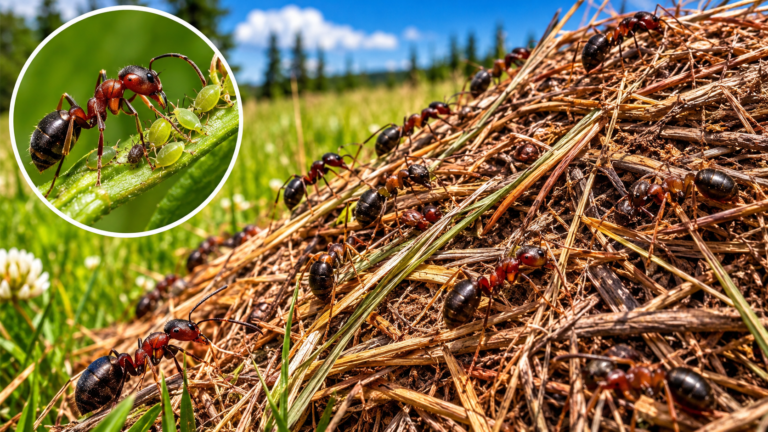
One fascinating aspect of acrobat ant biology is their relationship with aphids and mealybugs.
These plant-feeding insects can produce honeydew, a sugary liquid that ants use as a food source.
Acrobat ants may protect honeydew-producing insects from predators in exchange for access to this sugary food.
This relationship can lead to increased ant activity around plants where aphids or other honeydew-producing insects are present.
Acrobat Ants as Predators
Acrobat ants are not exclusively dependent on honeydew. They can also feed on insects and other protein sources.
This makes them both scavengers and predators within their environment.
By consuming insects and scavenging organic material, they participate in natural food webs and contribute to nutrient cycling.
Acrobat Ant Defensive Behavior
When disturbed, an acrobat ant may raise its abdomen over its thorax and head.
This behavior is one of its most recognizable characteristics.
The ant can also become defensive when its colony is threatened. Workers may rapidly move around the nest and respond to disturbances.
Their unusual posture can therefore be considered both an identification feature and part of their defensive behavior.
Acrobat Ants in Alberta
Acrobat ants are one of the ant groups that can be encountered in Alberta’s diverse outdoor environments, although the exact species present can vary by location.
They are most relevant around properties where there is:
- Dead wood
- Tree stumps
- Decaying branches
- Moisture-damaged wood
- Landscaping debris
- Old wooden structures
Because Crematogaster contains multiple species, professional identification may be useful when an ant infestation cannot be confidently identified from appearance alone.
Acrobat Ants vs. Carpenter Ants
Acrobat ants and carpenter ants are sometimes confused because both can be associated with wood.
However, they are biologically different.
| Feature | Acrobat Ants | Carpenter Ants |
|---|---|---|
| Genus | Crematogaster | Camponotus |
| Typical size | About 3 mm | Often much larger |
| Abdomen | Heart-shaped | Rounded/oval |
| Nesting | Decaying wood, cavities, protected areas | Wood, especially damp or decaying wood |
| Wood damage | Generally insignificant | Can excavate extensive galleries |
| Defensive behavior | Raises abdomen | Bites/defends colony |
| Food | Honeydew, insects, sweets | Insects, honeydew, sweets and other foods |
Carpenter ants are an important structural pest in Alberta. Alberta Health Services notes that carpenter ants can damage wooden structures by excavating tunnels for nesting.
Acrobat Ants vs. Odorous House Ants
Odorous house ants (Tapinoma sessile) are also small ants that can enter buildings, but they have several important differences.
Odorous house ants generally have a dark brown to black coloration and are known for the odor they produce when crushed. Acrobat ants have a distinctive heart-shaped abdomen and are associated more strongly with decaying wood and protected nesting locations.
Correct identification matters because the ants may have completely different nesting locations and behaviors.
Frequently Asked Questions About Acrobat Ants
What are acrobat ants?
Acrobat ants are ants in the genus Crematogaster. They are small ants known for their heart-shaped abdomen and their ability to raise their abdomen over their body when disturbed.
Why are they called acrobat ants?
They are called acrobat ants because workers can raise and curl their abdomen over their thorax and sometimes over their head when threatened.
What do acrobat ants look like?
Acrobat ants are usually small, around 3 mm long, and can range from yellow-brown to dark brown or nearly black. They have a heart-shaped abdomen and a pair of spines on the thorax.
Where do acrobat ants nest?
They commonly nest in dead or rotting wood, including logs, stumps, dead branches, and other protected locations. They can occasionally nest in wall voids or decaying wood around buildings.
Do acrobat ants damage houses?
They generally do not cause significant structural damage. However, their presence inside a building can indicate the availability of rotting or moisture-damaged wood.
Do acrobat ants eat wood?
No. Wood is used primarily as a nesting environment rather than as a food source.
What do acrobat ants eat?
They can eat honeydew, sugary substances, insects, and other available food sources. They may also associate with aphids and mealybugs for access to honeydew.
Do acrobat ants eat aphids?
They generally do not rely on aphids as food. Instead, they may collect honeydew produced by aphids and sometimes protect the aphids in exchange.
Are acrobat ants dangerous?
Acrobat ants are generally considered a nuisance pest rather than a serious threat to people or structures.
Can acrobat ants enter homes?
Yes. They can occasionally enter buildings, particularly when suitable nesting conditions exist around damaged or decaying wood. Window frames and wall voids can be potential locations.
Are acrobat ants the same as carpenter ants?
No. Acrobat ants belong to Crematogaster, while carpenter ants belong to Camponotus. Carpenter ants are significantly more important as structural wood-nesting pests.
What is the life cycle of an acrobat ant?
Acrobat ants undergo complete metamorphosis: egg → larva → pupa → adult.
Why are acrobat ants around my trees?
Dead branches, decaying wood, tree cavities, aphids, and other food sources can provide suitable habitat for acrobat ants.
When are acrobat ants most active?
They are generally more noticeable during warmer months. Acrobat ants found in homes are particularly associated with summer activity.
Conclusion
Acrobat ants are fascinating small ants in the genus Crematogaster that are easily recognized by their heart-shaped abdomen and unusual ability to raise their abdomen when disturbed. Their biology is closely associated with decaying wood, natural nesting sites, insects, and honeydew-producing aphids and mealybugs.
For homeowners in Alberta, finding acrobat ants does not automatically mean that a structure has serious wood damage. However, repeated activity around window frames, wall voids, dead branches, stumps, or decaying wood can indicate that the property contains a suitable nesting environment.
Proper ant identification is the first step in understanding whether the insects are simply part of the outdoor ecosystem or whether their presence is connected to a moisture or wood-decay problem around the building.