Thief Ants in Alberta: Biology, Identification, Life Cycle, Habitat and Feeding Behavior
Table of Contents
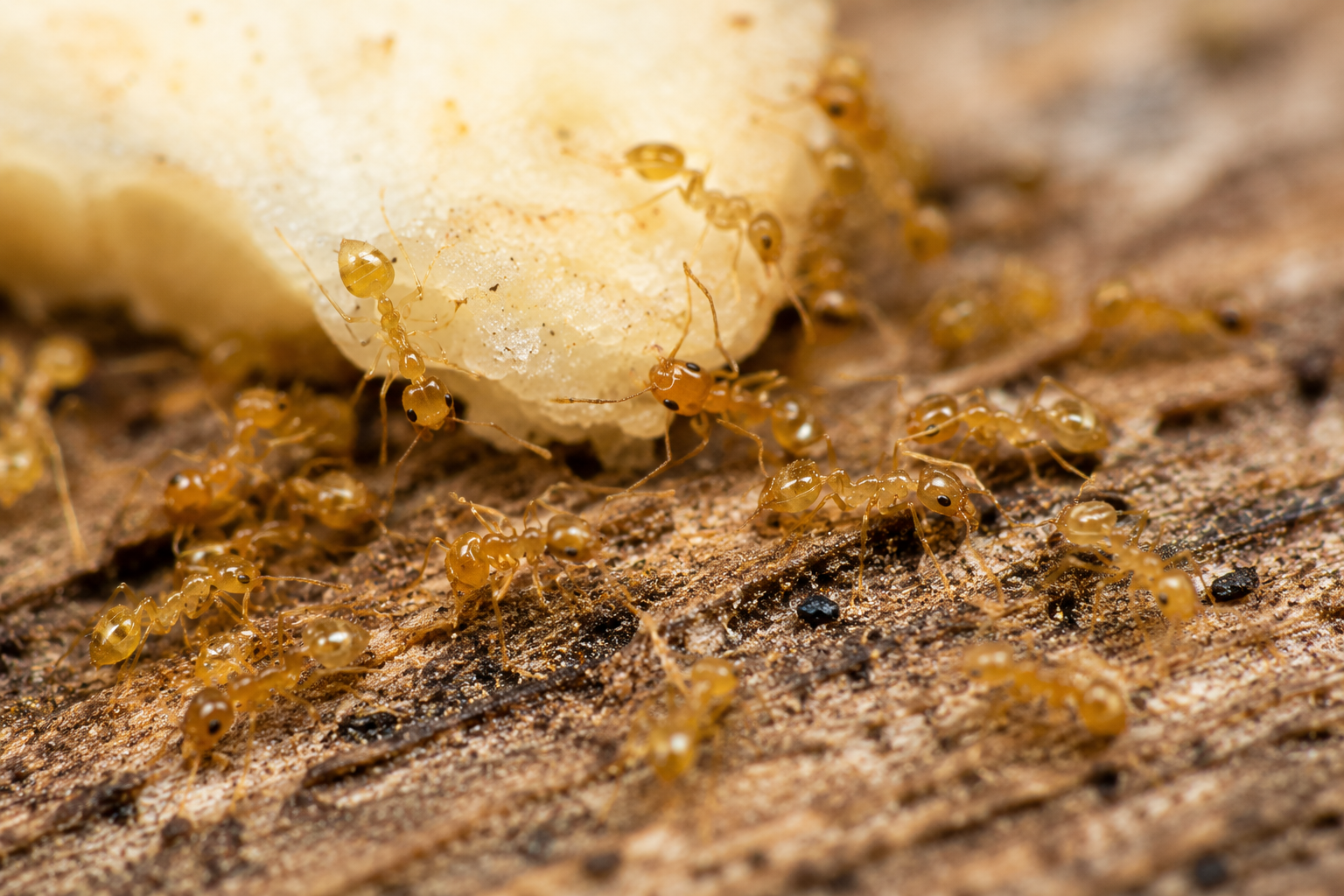
Thief ants (Solenopsis molesta) are among the smallest ants that can be encountered around homes and other buildings in Canada. They are sometimes called grease ants because they have a strong preference for protein-rich and greasy foods. Their extremely small size allows them to enter tiny cracks, food containers, wall voids, cabinets, and other concealed spaces.
Despite their name, thief ants are not dangerous household pests. Their unusual name comes from their natural behavior of nesting near other ant colonies and sometimes stealing brood, such as larvae and pupae, from neighboring ants. This behavior is one of the most fascinating aspects of thief ant biology.
What Are Thief Ants?
The thief ant, scientifically known as Solenopsis molesta, belongs to the family Formicidae. It is a very small ant species that can live outdoors but may enter buildings while searching for food.
Thief ants are particularly successful because of their small body size and flexible nesting habits. They can exploit tiny spaces that are inaccessible to many larger ant species.
In Canada, Health Canada lists thief ants among the ant species that can invade homes.
Why Are They Called Thief Ants?
The name thief ant comes from their unusual relationship with other ants.
Thief ants may establish nests close to colonies of larger ants and enter those colonies to take developing brood. This can include ant larvae and pupae.
This behavior gives Solenopsis molesta its common name and makes it biologically different from many household ants that simply forage for food.
What Do Thief Ants Look Like?
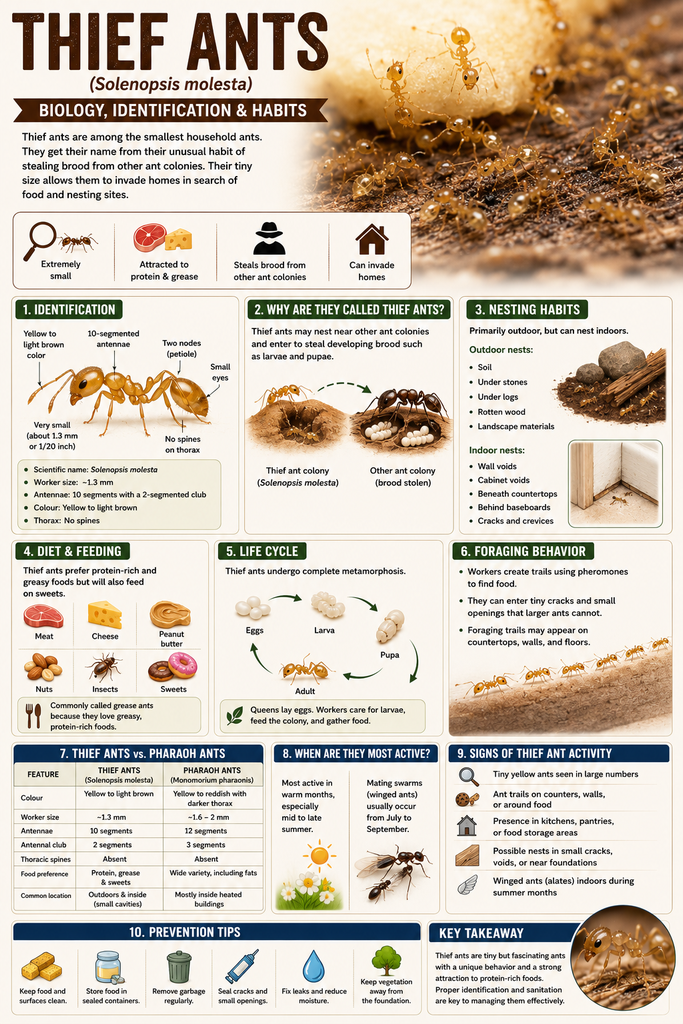
Thief ants are extremely small. Workers are approximately 1.3 mm (about 1/20 inch) long and are generally yellow to light brown.
Important identification characteristics include:
- Extremely small body size
- Yellow to light-brown coloration
- Two nodes between the thorax and abdomen
- No spines on the thorax
- 10-segmented antennae
- Two-segmented antennal club
- Relatively small compound eyes
Thief ants are easily confused with Pharaoh ants, which are also extremely small and can have similar coloration. Careful identification is therefore important.
Thief Ants vs. Pharaoh Ants
Thief ants and Pharaoh ants are among the most commonly confused tiny household ants.
| Feature | Thief Ant | Pharaoh Ant |
|---|---|---|
| Scientific name | Solenopsis molesta | Monomorium pharaonis |
| Colour | Yellow to light brown | Yellow to reddish with darker thorax |
| Worker size | About 1.3 mm | About 1.6–2 mm |
| Antennal segments | 10 | 12 |
| Antennal club | 2 segments | 3 segments |
| Thoracic spines | Absent | Absent |
| Food preference | Protein, grease and sweets | Wide variety, including fats |
| Typical nesting | Soil, rotting wood, small cavities | Frequently inside heated buildings |
Because these ants can look extremely similar, professional identification may be necessary, particularly when choosing an appropriate pest-management approach.
Where Do Thief Ants Nest?
Thief ants are primarily associated with outdoor nesting, although they can occasionally establish colonies indoors.
Outdoor nesting locations can include:
- Soil
- Beneath stones
- Under logs
- Rotten wood
- Landscaping materials
- Protected areas around buildings
Inside structures, thief ants can occupy very small concealed spaces such as:
- Wall voids
- Cabinet voids
- Spaces beneath countertops
- Behind baseboards
- Cracks and crevices
- Other protected cavities
Their tiny size makes these nesting locations particularly difficult to detect.
Thief Ants Around Homes in Alberta
Thief ants can become noticeable around homes when colonies are located close to foundations or when workers discover accessible food.
Because they are so small, they can travel through very narrow openings around windows, doors, foundations, cabinets, plumbing penetrations, and other structural gaps.
They may be especially noticeable during warmer periods when outdoor colonies are actively foraging.
What Do Thief Ants Eat?
Thief ants have a strong preference for protein-rich and greasy foods, although they are not restricted to these foods.
Their diet can include:
- Meat
- Cheese
- Peanut butter
- Nuts
- Greasy foods
- Insects
- Animal-based food
- Sweets
Their small bodies allow them to enter many food containers and reach food sources that larger ants cannot easily access.
Why Are Thief Ants Sometimes Called Grease Ants?
The term grease ant is another common name for thief ants.
This name reflects their attraction to greasy and protein-rich foods. A home may therefore experience thief-ant activity around kitchens, food storage areas, garbage containers, pet food, and other locations where food residues are available.
However, food preference alone cannot reliably identify the species because other ants can also be attracted to greasy foods.
Thief Ant Colony Structure
Like other ants, thief ants live in organized colonies.
A colony can contain:
- Queen or queens
- Worker ants
- Males
- Developing brood
Workers perform most of the colony’s daily tasks, including:
- Foraging
- Caring for larvae
- Feeding developing ants
- Maintaining the nest
- Defending the colony
- Searching for new food sources
Ant colonies operate as coordinated societies in which individual workers perform different tasks according to the needs of the colony.
Thief Ant Life Cycle
Thief ants undergo complete metamorphosis, meaning their development occurs through four stages:
Egg → Larva → Pupa → Adult
The queen produces eggs inside the colony. Worker ants care for the developing larvae and provide food and protection.
Larvae eventually become pupae and then emerge as adult ants.
Adult workers subsequently participate in colony activities such as foraging, nest maintenance, brood care, and defense.
Thief Ants and Other Ant Colonies
One of the most interesting aspects of thief ant biology is their relationship with larger ants.
Thief ants may build their nests near the nests of larger ants. Workers can enter neighboring colonies and remove developing brood.
This behavior provides the thief ants with a source of protein and explains why they are described as “thieves.”
Their ability to exploit other ant colonies demonstrates how different ant species can interact competitively within the same environment.
Thief Ant Foraging Behavior
Thief ants can create well-defined trails between their nest and food sources.
Workers use chemical pheromone trails to communicate with other members of the colony. Once a worker discovers a suitable food source, other workers can follow the trail.
This coordinated behavior allows a large number of tiny ants to exploit food sources efficiently.
Thief Ants and Food Contamination
Although thief ants are generally considered nuisance pests, their ability to enter food containers and move through kitchens can make them undesirable around food-storage areas.
Because they are so small, they can enter containers and packages through extremely small openings.
This is one reason accurate identification and appropriate sanitation measures are important when thief ants are repeatedly found in kitchens or food-handling areas.
Thief Ants in Summer
Thief ants can become particularly noticeable during mid- to late summer when workers are actively foraging and may enter buildings from outdoor colonies.
The University of Minnesota Extension notes that thief ants are commonly found in homes during summer and can become a temporary nuisance.
Thief Ants and Winged Reproductives
Mature colonies produce reproductive ants, including winged males and females.
Thief ants are reported to have mating swarms primarily from July through September.
Finding winged ants can therefore provide evidence that a mature colony is nearby.
However, the location where winged ants are discovered does not always identify the exact location of the colony.
Are Thief Ants Dangerous?
Thief ants are generally considered nuisance pests rather than dangerous ants.
They do not have the structural wood-damaging behavior associated with carpenter ants. Their primary concern is their ability to enter food-storage areas and establish concealed nests.
Health Canada lists thief ants among the ant species that may invade Canadian homes.
Thief Ants vs. Carpenter Ants
Thief ants and carpenter ants are dramatically different in size and biology.
Carpenter ants are among the largest ants commonly found around Canadian homes and can excavate galleries in wood. Thief ants are tiny ants that generally nest in soil, rotting wood, or small cavities.
If a homeowner sees very small yellowish ants around food, thief ants may be one possibility. If large ants are associated with wood or sawdust-like material, carpenter ants should also be considered.
Thief Ants vs. Odorous House Ants
Odorous house ants are generally much larger than thief ants and are typically dark brown to black. They are also recognized by the distinctive odor they can release when crushed.
Thief ants are yellow to light brown and extremely small, often measuring only around 1.3 mm.
Because ant colour can vary and tiny ants are difficult to identify visually, professional identification is useful when the species is uncertain.
Frequently Asked Questions About Thief Ants
What is a thief ant?
A thief ant is a very small ant species scientifically known as Solenopsis molesta. It is also commonly called a grease ant.
Why are thief ants called thief ants?
They are called thief ants because they may nest near larger ant colonies and steal developing brood such as larvae and pupae.
What do thief ants look like?
Thief ants are extremely small, usually yellow to light brown, and workers are approximately 1.3 mm long. They have two nodes and 10-segmented antennae.
Are thief ants found in Canada?
Yes. Health Canada lists thief ants among the ant species that can invade homes in Canada.
Are thief ants found in Alberta?
Thief ants can occur in Canada and may be encountered in Alberta. Because tiny yellow ants can be difficult to distinguish from other species, species-level identification is recommended when accuracy matters.
What attracts thief ants into houses?
Thief ants are attracted to accessible food, particularly greasy, protein-rich foods and sweets. Kitchens and food-storage areas can therefore provide attractive foraging opportunities.
Do thief ants eat grease?
Yes. Greasy and protein-rich foods are among their preferred food sources, which is why they are sometimes called grease ants.
Can thief ants live inside walls?
Yes. They can establish nests in very small indoor spaces, including wall voids, cabinet voids, areas beneath countertops, and behind baseboards.
Do thief ants damage wood?
Thief ants are not considered wood-destroying ants like carpenter ants. They may nest in rotting wood, but they do not have the same structural wood-excavation significance as carpenter ants.
Are thief ants the same as Pharaoh ants?
No. They are different species. Thief ants are Solenopsis molesta, while Pharaoh ants are Monomorium pharaonis. Their small size and similar coloration can make them difficult to distinguish.
What is the life cycle of a thief ant?
Thief ants undergo complete metamorphosis: egg, larva, pupa, and adult.
When are thief ants most active?
They are commonly noticed during mid- to late summer, when workers are actively foraging and may enter buildings.
When do thief ants swarm?
Thief ants are reported to have mating swarms from approximately July through September.
Are thief ants dangerous to people?
They are generally considered nuisance ants rather than dangerous household pests.
Why are tiny yellow ants appearing in my kitchen?
Thief ants are one possibility, particularly when the ants are extremely small and are attracted to greasy or protein-rich foods. Pharaoh ants and other small species can look similar, so identification is important.
Conclusion
The thief ant (Solenopsis molesta) is a fascinating but often overlooked household ant. Its extremely small size, preference for greasy and protein-rich foods, ability to nest in tiny spaces, and unusual habit of stealing brood from neighboring ant colonies make it biologically distinctive.
For homeowners in Alberta, identifying tiny yellow ants correctly is especially important because thief ants can easily be confused with Pharaoh ants and other small ant species. Their nesting habits and food preferences are different, so simply treating visible ants without understanding the species may not address the underlying problem.
Understanding thief ant biology, colony behavior, life cycle, nesting habits, and feeding preferences provides a much better foundation for identifying why these tiny ants are appearing in a home or commercial building.