The Biology of Carpenter Ants: Understanding Their Life Cycle, Behavior, and Nesting Habits
Table of Contents
The Biology of Carpenter Ants
Carpenter ants are among the largest and most fascinating ant species in North America. Belonging to the genus Camponotus, these social insects are highly organized and live in complex colonies with distinct castes and specialized roles. While carpenter ants play an important ecological role by recycling decaying wood in forests, they can become significant structural pests when they establish colonies inside homes and buildings.
Understanding the biology of carpenter ants helps homeowners identify infestations early and choose effective management strategies before structural damage becomes extensive.
Classification
Carpenter ants belong to the following scientific classification:
| Classification | Name |
|---|---|
| Kingdom | Animalia |
| Phylum | Arthropoda |
| Class | Insecta |
| Order | Hymenoptera |
| Family | Formicidae |
| Genus | Camponotus |
There are over 1,000 species of carpenter ants worldwide, with several species commonly found throughout Canada and Alberta.
Physical Characteristics
Carpenter ants are considerably larger than most household ants.
Worker Ants
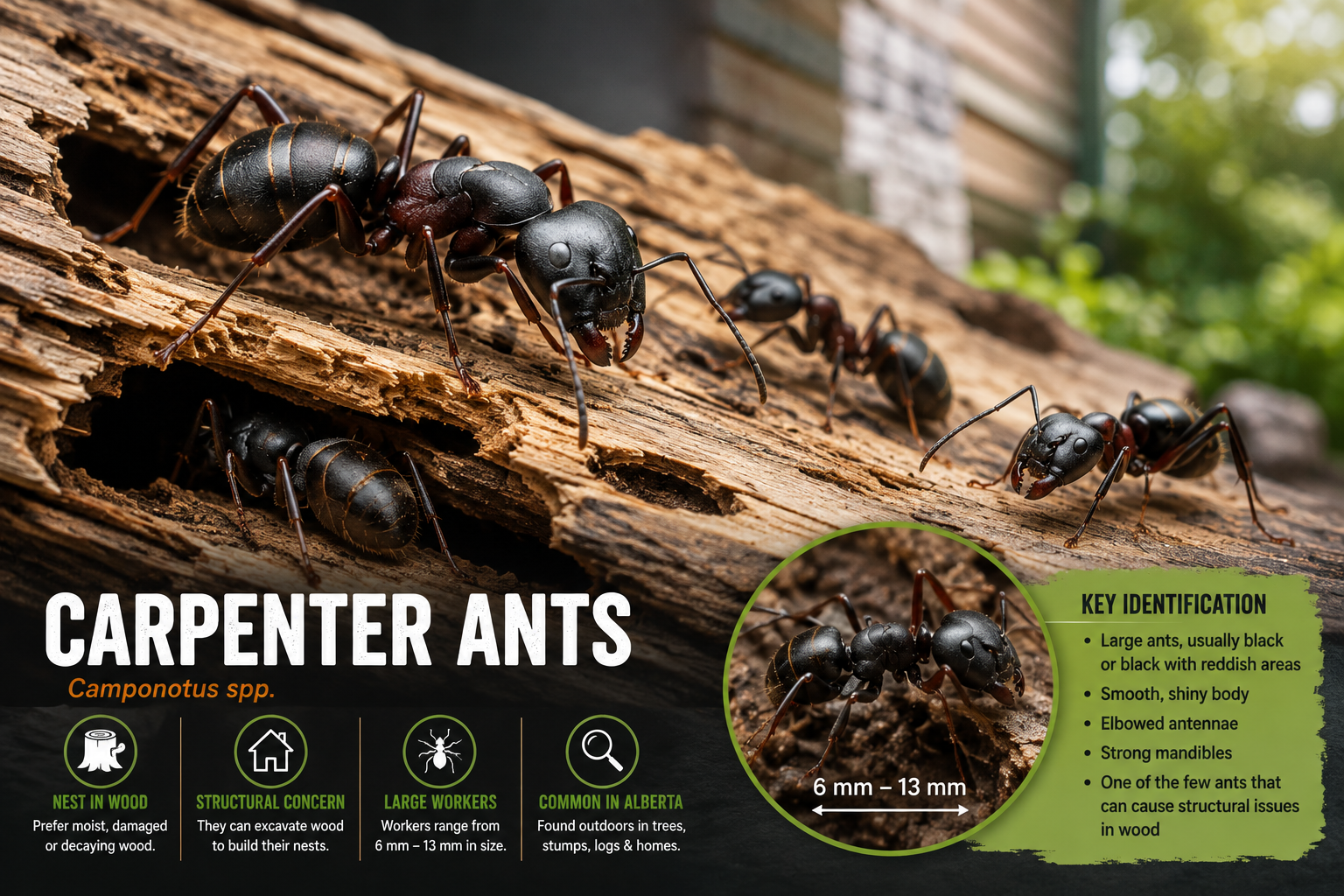
- Length: 6–13 mm
- Black, reddish-black, or dark brown
- Strong mandibles
- Elbowed antennae
- Narrow waist (one node)
- Smooth, rounded thorax
Queen
The queen is the largest member of the colony.
Characteristics include:
- Up to 18 mm long
- Large abdomen
- Capable of laying thousands of eggs
- Lives for many years
Males
Male carpenter ants are:
- Winged
- Slender
- Short-lived
- Present only during mating season
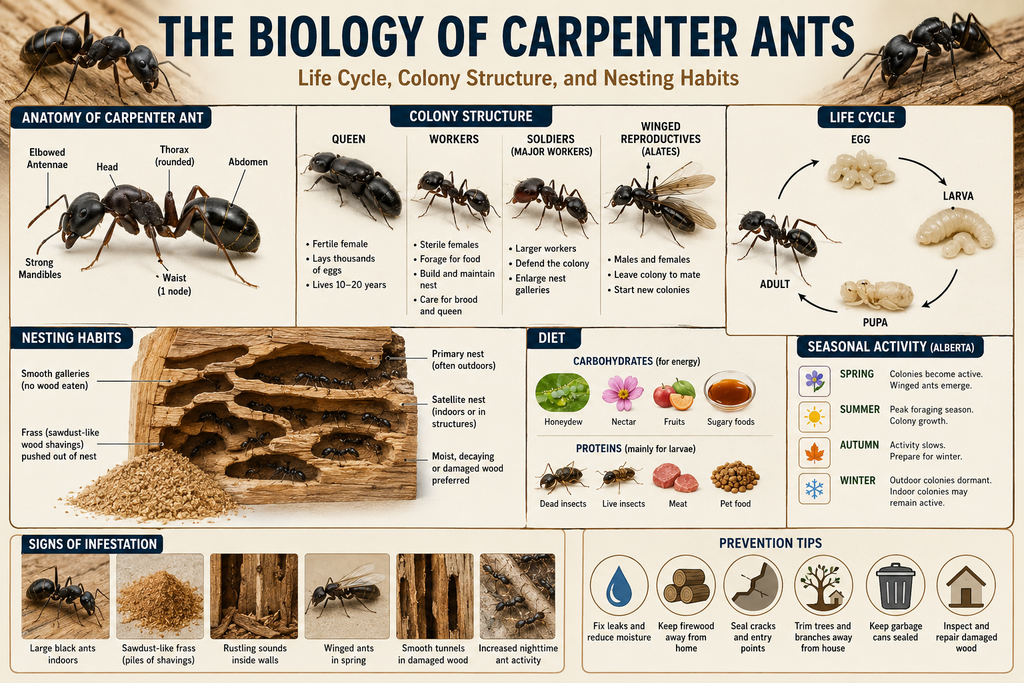
Carpenter Ant Colony Structure
Carpenter ants are eusocial insects, meaning they live in highly organized colonies where individuals perform specialized tasks.
The colony consists of:
Queen
The queen’s primary responsibility is reproduction.
She:
- Produces eggs
- Releases pheromones that regulate colony behavior
- Can live 10–20 years, depending on the species and conditions
Workers
Worker ants are sterile females responsible for nearly every aspect of colony maintenance.
Their duties include:
- Foraging for food
- Feeding larvae
- Excavating galleries
- Cleaning the nest
- Caring for the queen
- Defending the colony
Older workers typically forage outside, while younger workers remain inside the nest caring for brood.
Soldiers
Some carpenter ant species have larger “major workers” that function as soldiers.
They possess:
- Larger heads
- More powerful jaws
- Defensive roles
- Ability to enlarge nest galleries
Winged Reproductives (Alates)
Every mature colony eventually produces:
- Winged females (future queens)
- Winged males
These reproductive ants leave the colony during mating flights to establish new colonies.
Life Cycle of Carpenter Ants
Carpenter ants undergo complete metamorphosis, consisting of four developmental stages.
- Egg
- Larva
- Pupa
- Adult
Egg
The queen lays tiny white eggs that hatch after approximately 2–4 weeks, depending on temperature.
Larva
Larvae resemble small white grubs.
Workers feed them by:
- Regurgitating liquid food
- Feeding insect proteins
- Grooming and moving them within the nest
The larval stage is the primary feeding stage.
Pupa
The larvae transform into pupae before becoming adults.
Some carpenter ant species spin cocoons around their pupae.
Adult
Adults emerge fully developed and immediately begin performing colony duties.
A new colony typically requires 3–6 years before producing winged reproductives.
Colony Development
A newly mated queen begins a colony alone.
The stages include:
Founding Stage
- Queen finds a protected cavity.
- She seals herself inside.
- Lays her first eggs.
- Raises the first generation without leaving.
Growth Stage
Once workers emerge:
- Workers forage.
- Queen focuses solely on egg laying.
- Colony size increases steadily.
Mature Colony
Established colonies may contain:
- Several thousand workers
- Satellite nests
- Multiple brood chambers
- Seasonal reproductive ants
Some colonies exceed 10,000 individuals.
Nesting Biology
Unlike termites, carpenter ants do not consume wood.
Instead, they excavate wood to create smooth tunnels called galleries.
Preferred nesting sites include:
- Moist wood
- Water-damaged framing
- Tree stumps
- Dead trees
- Hollow logs
- Decks
- Fence posts
- Roof structures
- Wall voids
The galleries are remarkably clean because workers remove wood shavings from the nest.
These piles of sawdust-like material, known as frass, are one of the most recognizable signs of a carpenter ant infestation.
Primary and Satellite Colonies
One unique aspect of carpenter ant biology is their use of multiple nests.
Primary Nest
Usually contains:
- Queen
- Eggs
- Young larvae
Often located outdoors.
Satellite Nest
May be located:
- Inside homes
- Attics
- Wall cavities
- Window frames
- Ceilings
Satellite nests contain workers, pupae, and older larvae but usually do not house the queen.
Feeding Biology
Carpenter ants are omnivores.
Their diet changes throughout the year.
Adult Diet
Adults primarily consume carbohydrates, including:
- Honeydew from aphids
- Plant nectar
- Fruit juices
- Sugary foods
- Soft drinks
Protein Sources
Protein is collected mainly for developing larvae.
Workers gather:
- Dead insects
- Live insects
- Meat
- Pet food
- Fish
- Eggs
The larvae digest solid food and produce nutrient-rich liquids that are shared throughout the colony through trophallaxis, or mouth-to-mouth food exchange.
Communication
Carpenter ants communicate using pheromones.
Chemical signals help workers:
- Locate food
- Follow trails
- Identify nestmates
- Warn of danger
- Coordinate nest construction
When a food source is discovered, workers lay a pheromone trail that recruits additional ants.
Seasonal Activity
In Alberta and much of Canada:
Spring
- Colonies become active.
- Winged reproductives emerge.
- Indoor sightings increase.
Summer
- Peak foraging season.
- Colony expansion.
- Satellite nests become active.
Autumn
- Activity slows.
- Colonies prepare for winter.
Winter
Outdoor colonies become dormant, but indoor colonies in heated buildings can remain active year-round.
Natural Enemies
Carpenter ants face several predators and parasites, including:
- Birds
- Spiders
- Ground beetles
- Other ant species
- Parasitic flies
- Fungi
- Nematodes
Despite these natural enemies, established colonies are resilient and can survive for many years.
Ecological Importance
Although carpenter ants are considered structural pests in buildings, they provide valuable ecological benefits in forests by:
- Recycling dead wood
- Accelerating decomposition
- Improving soil quality
- Dispersing nutrients
- Serving as prey for wildlife
- Helping regulate populations of other insects
They are an important part of healthy forest ecosystems.
Why Carpenter Ants Invade Homes
Carpenter ants are attracted to structures that provide moisture and suitable nesting sites.
Common contributing factors include:
- Roof leaks
- Plumbing leaks
- Condensation
- Rotting window frames
- Damp crawl spaces
- Decaying decks
- Firewood stacked against the house
- Tree branches touching the roof
Homes with chronic moisture problems are significantly more attractive to carpenter ants.
Signs of a Carpenter Ant Infestation
Watch for these common indicators:
- Large black ants indoors
- Sawdust-like frass beneath walls or wood
- Rustling sounds inside walls
- Winged ants indoors during spring
- Smooth tunnels inside damaged wood
- Increased nighttime ant activity
Early detection can help prevent extensive structural damage.
Frequently Asked Questions
Do carpenter ants eat wood?
No. Carpenter ants excavate wood to create nesting galleries but do not consume it. They obtain nutrition from sugars, insects, and other organic food sources.
How long does a carpenter ant queen live?
A healthy queen can live 10 to 20 years, making carpenter ant colonies capable of persisting for a long time if left untreated.
How large can a carpenter ant colony become?
Mature colonies may contain 2,000 to more than 10,000 workers, depending on the species and available resources.
Are carpenter ants active during winter?
Outdoor colonies become inactive during cold Alberta winters, but colonies nesting inside heated buildings may remain active throughout the year.
Why are carpenter ants attracted to damp wood?
Moist or decaying wood is easier to excavate than dry, sound wood. Water-damaged structural timber provides ideal nesting conditions and is often the first area colonized.
Conclusion
Carpenter ants are remarkable social insects with sophisticated colony organization, long-lived queens, and highly specialized worker castes. In natural ecosystems they play an essential role in breaking down dead wood and recycling nutrients. However, when they establish nests inside homes, they can gradually weaken wooden structures by excavating extensive galleries.
Understanding the biology of carpenter ants—from their life cycle and feeding habits to their nesting behavior—allows homeowners to recognize early signs of infestation and take appropriate action. Managing moisture, repairing damaged wood, and addressing infestations promptly are key to protecting homes from these persistent insects.