Pharaoh Ant Biology and Origin
Table of Contents
Origin of Pharaoh Ants
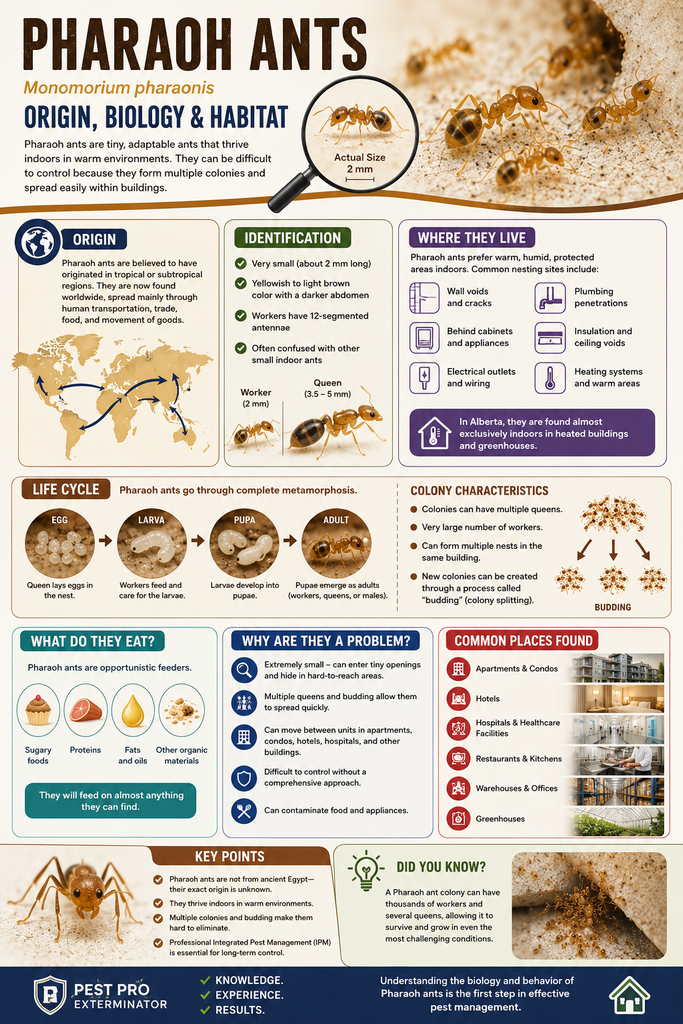
The Pharaoh ant (Monomorium pharaonis) is a tiny ant species that has become widely distributed throughout the world. Despite its name, there is no reliable scientific evidence that Pharaoh ants originated in ancient Egypt. Their exact native origin is uncertain, although they are generally associated with tropical and subtropical regions. Their worldwide distribution is largely connected to human transportation, commerce, and the movement of food, equipment, and other materials.
Because Pharaoh ants are highly sensitive to cold, they are particularly successful in warm indoor environments. In colder regions such as Alberta, they can survive year-round inside heated buildings where temperatures remain suitable for colony development.
Pharaoh Ant Biology
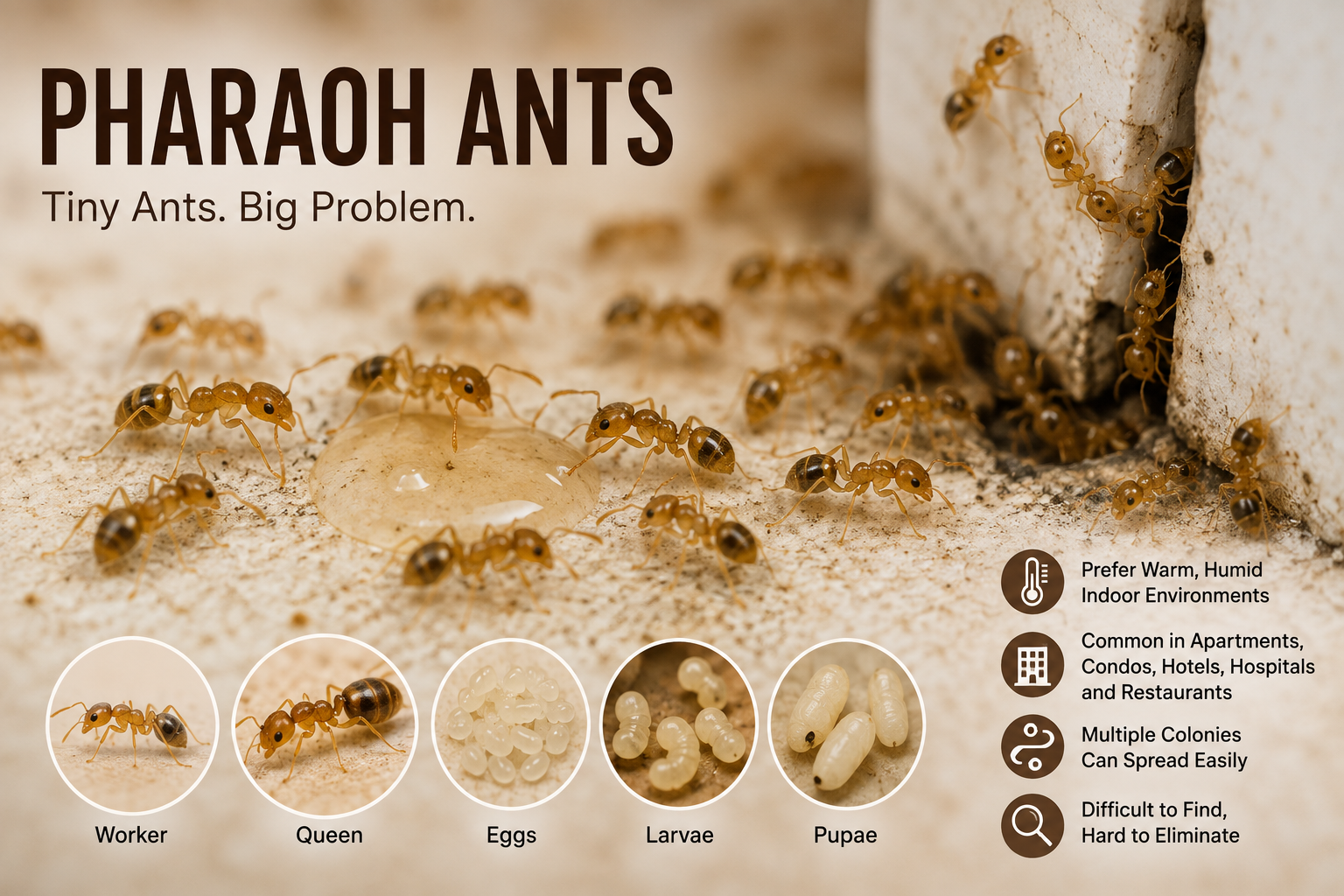
Pharaoh ants are among the smallest ants commonly encountered indoors. Adult workers are typically about 2 mm long and are usually yellowish to light brown, with a darker abdomen. Their small size allows them to enter extremely narrow cracks, wall voids, cabinets, electrical areas, plumbing penetrations, and other concealed spaces.
They are highly adaptable scavengers and can feed on a wide variety of materials. Depending on what is available, Pharaoh ants may seek out sugary foods, proteins, fats, and other organic materials. This broad diet allows them to survive in homes, apartments, restaurants, hotels, hospitals, warehouses, and commercial buildings.
Pharaoh Ant Colonies
A Pharaoh ant colony can contain multiple queens and a large number of workers. Unlike many ant species that maintain a single obvious nest, Pharaoh ants can establish colonies in numerous protected locations throughout a building.
Their colonies may be found in wall voids, behind cabinets, around plumbing and electrical penetrations, inside insulation, near heating systems, and other warm, protected areas. Because nests can be hidden from view, people may notice worker ants long before the actual colony location is discovered.
Pharaoh Ant Reproduction and Budding
One of the most important characteristics of Pharaoh ants is their ability to reproduce through colony budding, also called budding or fragmentation. A portion of an established colony can separate and establish another colony when conditions are suitable.
This behavior can allow Pharaoh ants to spread from one area of a building to another. In multi-unit properties, colonies may become established in several apartments, hallways, utility areas, mechanical spaces, or other connected areas.
Their ability to form additional colonies is one reason Pharaoh ant infestations can become persistent and widespread in large buildings.
Pharaoh Ant Life Cycle
Pharaoh ants undergo complete metamorphosis, meaning they develop through four distinct stages: egg, larva, pupa, and adult.
The queen produces eggs, which hatch into larvae. Worker ants care for the larvae and provide them with food. The larvae eventually develop into pupae before emerging as adult ants.
Unlike outdoor ants in Alberta that are strongly affected by winter temperatures, Pharaoh ants living inside heated buildings can remain active throughout the year. Warm indoor conditions can allow their colonies to continue developing without the normal seasonal interruption experienced by many outdoor insects.
Where Are Pharaoh Ants Found in Alberta?
In Alberta, Pharaoh ants are primarily associated with warm indoor environments because they are poorly adapted to prolonged cold outdoor conditions. They may be encountered in apartment buildings, condominiums, hotels, hospitals, restaurants, commercial facilities, warehouses, and other heated structures.
They can also occur in greenhouses and other controlled environments where temperatures and humidity provide suitable conditions for survival and reproduction.
Multi-unit buildings can be particularly vulnerable because plumbing lines, electrical conduits, wall voids, heating systems, and other structural pathways can provide opportunities for ants to move between areas.
Why Pharaoh Ants Are So Successful Indoors
The success of Pharaoh ants is closely connected to their biology. Their extremely small size allows them to exploit hidden spaces, while their broad diet allows them to take advantage of many different food sources. Their preference for warm environments makes heated buildings suitable year-round habitats, particularly in colder climates such as Alberta.
Their ability to maintain colonies with multiple queens and establish new colonies through budding also contributes to their persistence. These characteristics make Pharaoh ants an important indoor pest in multi-residential and commercial environments.
Pharaoh Ants and Human Transportation
Pharaoh ants have achieved a nearly worldwide distribution largely because humans unintentionally transport them. They can be moved in boxes, food products, furniture, equipment, packaging materials, plants, and other items.
This ability to travel with human goods is one reason Pharaoh ants can appear in buildings far from their presumed tropical or subtropical origins. Once introduced into a suitable heated environment, they may establish colonies and spread within the structure.
Frequently Asked Questions About Pharaoh Ants
Are Pharaoh ants really from Egypt?
No. Despite their common name, there is no strong scientific evidence that Pharaoh ants originated in Egypt. Their exact geographic origin is uncertain, but they are generally associated with tropical and subtropical regions.
What do Pharaoh ants look like?
Pharaoh ants are extremely small, generally around 2 mm long. Workers are usually yellowish or light brown with a darker abdomen.
Can Pharaoh ants survive outside in Alberta?
They are poorly adapted to Alberta’s cold outdoor climate. They are much more likely to survive in heated indoor environments, although they may occur in warm controlled environments such as greenhouses.
Where do Pharaoh ants build their nests?
They can establish nests in protected areas such as wall voids, cabinets, insulation, electrical areas, plumbing spaces, and other warm, concealed locations.
How many queens can a Pharaoh ant colony have?
Pharaoh ant colonies can contain multiple queens. This contributes to their ability to establish and maintain colonies in suitable indoor environments.
What is budding in Pharaoh ants?
Budding occurs when part of an established colony separates and establishes another colony. It is an important reason Pharaoh ants can spread through connected areas of buildings.
What do Pharaoh ants eat?
They are opportunistic feeders and can consume a variety of foods, including sugary substances, proteins, fats, and other organic materials.
Are Pharaoh ants active during winter?
Yes. When they live inside heated buildings, Pharaoh ants can remain active throughout the winter because indoor temperatures provide conditions suitable for continued colony activity.
Can Pharaoh ants spread between apartment units?
Yes. Their small size and ability to use concealed structural pathways can allow them to move between connected areas of multi-unit buildings.
Why are Pharaoh ants difficult to identify?
Their extremely small size means they can easily be mistaken for other small ants. Correct identification is important because different ant species have different biology and behaviors.
Are Pharaoh ants an Alberta-native ant?
No. Pharaoh ants are considered an introduced indoor pest rather than a native outdoor ant species of Alberta. Their presence in Alberta is closely associated with heated buildings and human transportation.
Conclusion
The Pharaoh ant is a remarkable example of an insect that has adapted extremely well to living alongside humans. Its small size, broad diet, multiple-queen colonies, budding behavior, and preference for warm environments allow it to survive year-round inside buildings. In Alberta, understanding the biology and environmental requirements of Pharaoh ants is especially important because heated buildings provide the warm conditions these ants need to establish persistent indoor populations.