Pavement Ant Biology (Tetramorium immigrans): Identification, Life Cycle & Control in Calgary
Table of Contents
Pavement ants (Tetramorium immigrans) are among the most common ant species found in urban environments across Canada, including Calgary, Alberta. These small but highly adaptable insects thrive in residential neighborhoods, commercial properties, sidewalks, driveways, patios, and building foundations. Although they are generally considered nuisance pests rather than structural pests, pavement ants can establish large colonies close to homes and frequently invade kitchens, basements, garages, and other indoor spaces in search of food. Understanding the biology of pavement ants is essential for effective prevention and long-term pest management.
What Are Pavement Ants?
Pavement ants belong to the family Formicidae and are one of the most successful invasive ant species in North America. Originally introduced from Europe, they have spread throughout much of Canada and the United States due to their remarkable adaptability to urban environments.
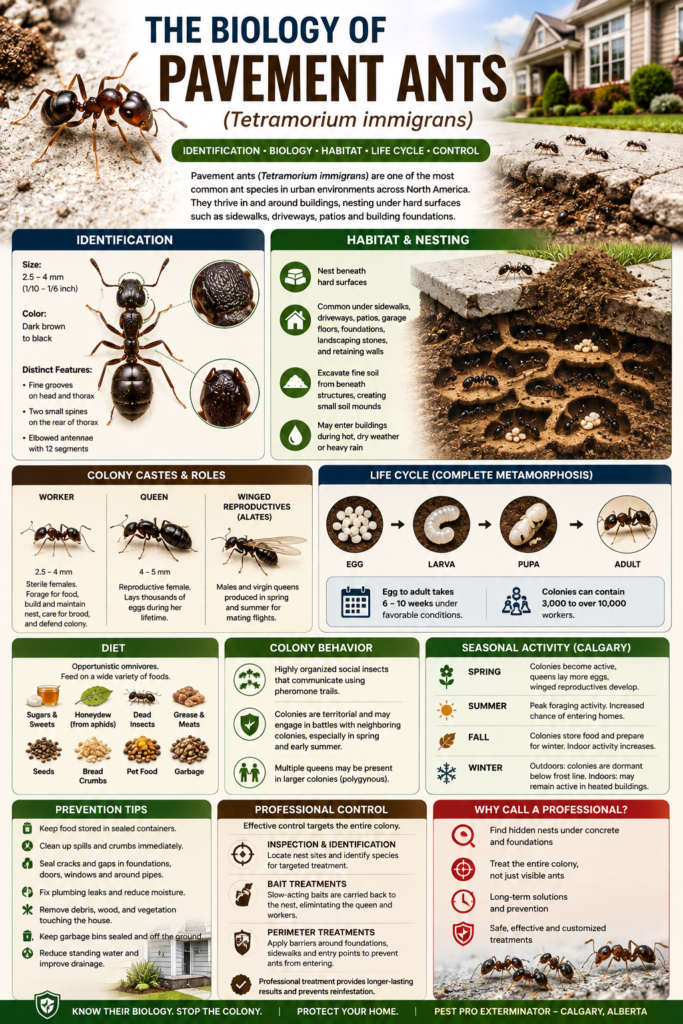
Adult workers measure approximately 2.5 to 4 mm (1/10 to 1/6 inch) in length and are dark brown to black with lighter-colored legs and antennae. Under magnification, their bodies display fine grooves on the head and thorax, while two small spines are visible on the rear of the thorax. These identifying features distinguish pavement ants from several other common household ants.
Physical Characteristics
Pavement ant colonies consist of different castes, each with a specialized role.
- Workers: Sterile females responsible for foraging, nest construction, brood care, and colony defense.
- Queen: Larger than workers, capable of laying thousands of eggs throughout her lifetime.
- Winged Reproductives (Alates): Males and virgin queens produced during the reproductive season for mating flights.
Workers are highly organized and communicate using pheromone trails, allowing them to efficiently locate and recruit nestmates to food sources.
Habitat and Nesting Behavior
Pavement ants prefer nesting beneath hard surfaces, which explains their common name. Their colonies are frequently found beneath:
- Sidewalks
- Driveways
- Concrete slabs
- Garage floors
- Patio stones
- Building foundations
- Landscaping rocks
- Retaining walls
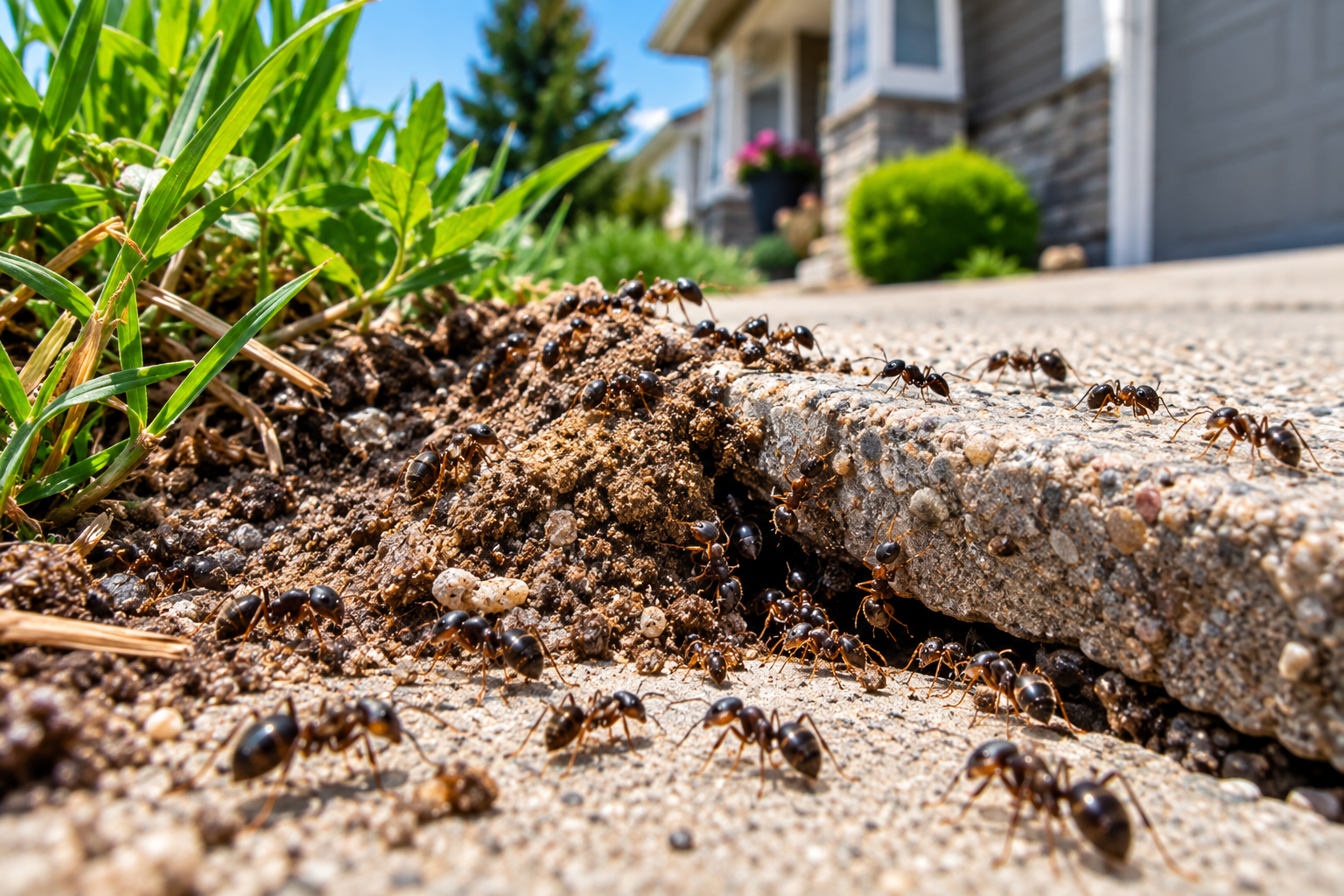
They excavate fine soil from beneath these structures, producing the small soil mounds commonly seen along cracks in pavement.
During hot, dry weather or periods of heavy rainfall, pavement ants often migrate indoors where food and moisture are more reliable.
Life Cycle of Pavement Ants
Like all ants, pavement ants undergo complete metamorphosis, progressing through four developmental stages:
- Egg
- Larva
- Pupa
- Adult
The queen continuously lays eggs during the active season. After hatching, larvae are fed by worker ants until they pupate and eventually emerge as adults. Under favorable temperatures, development from egg to adult typically takes 6 to 10 weeks, depending on environmental conditions.
Established colonies may contain 3,000 to over 10,000 workers, while mature colonies often produce winged reproductives each spring and summer.
Feeding Habits
Pavement ants are opportunistic omnivores with a highly varied diet.
They commonly feed on:
- Sugary foods
- Honeydew produced by aphids
- Dead insects
- Grease
- Meat
- Seeds
- Bread crumbs
- Pet food
- Outdoor garbage
Their flexible diet allows colonies to survive in nearly any urban environment.
Colony Structure and Behavior
Pavement ants exhibit highly organized social behavior.
A colony typically contains:
- One or multiple queens
- Thousands of workers
- Developing eggs
- Larvae
- Pupae
Unlike many ant species, pavement ants are well known for engaging in territorial battles with neighboring colonies. During spring and early summer, workers from competing colonies often gather on sidewalks and driveways in large numbers as they defend nesting territories.
Seasonal Activity in Calgary
In Calgary, pavement ants become active as temperatures rise in spring.
Typical seasonal activity includes:
Spring
- Colonies resume foraging.
- Winged reproductives begin developing.
Summer
- Peak outdoor activity.
- Indoor invasions increase during drought.
Fall
- Colonies increase food storage.
- Indoor sightings become more common.
Winter
- Outdoor colonies become dormant beneath frost lines.
- Heated buildings may support year-round activity indoors.
Why Pavement Ants Invade Homes
Although pavement ants naturally nest outdoors, they frequently enter homes searching for food and moisture.
Common entry points include:
- Foundation cracks
- Expansion joints
- Utility penetrations
- Door thresholds
- Window frames
- Basement cracks
Once inside, workers establish pheromone trails that attract hundreds of additional ants to the same food source.
Preventing Pavement Ant Infestations
Homeowners can reduce pavement ant activity by practicing good sanitation and eliminating attractive nesting conditions.
Helpful prevention measures include:
- Clean food spills immediately.
- Store food in sealed containers.
- Seal cracks around foundations.
- Repair plumbing leaks.
- Remove outdoor debris.
- Trim vegetation touching the house.
- Keep garbage containers tightly sealed.
- Reduce standing water around the foundation.
Early prevention greatly reduces the likelihood of colonies expanding indoors.
Professional Pavement Ant Control
DIY sprays often eliminate only the ants that are visible while leaving the queen and developing brood untouched beneath the nest. Because pavement ants maintain complex underground colonies, effective control usually requires identifying the nesting site and applying targeted treatments that eliminate the colony at its source.
Professional pest management specialists can accurately identify the ant species, locate hidden nests, and implement customized treatment strategies that provide longer-lasting results while minimizing the chance of reinfestation.
Frequently Asked Questions (FAQ)
1. What are pavement ants?
Pavement ants (Tetramorium immigrans) are small dark-colored ants that commonly nest beneath sidewalks, driveways, patios, and building foundations throughout Calgary and North America.
2. Are pavement ants dangerous?
No. Pavement ants are primarily nuisance pests. They rarely bite people and are not known to cause structural damage like carpenter ants.
3. Why are pavement ants entering my house?
They enter homes searching for food, moisture, and shelter, especially during hot, dry weather or after heavy rainfall.
4. Where do pavement ants build their nests?
They commonly nest beneath concrete sidewalks, patios, driveways, landscaping stones, retaining walls, and foundations.
5. How large can a pavement ant colony become?
Mature colonies often contain several thousand workers and may exceed 10,000 ants under ideal conditions.
6. What do pavement ants eat?
They feed on sweets, grease, proteins, seeds, dead insects, honeydew from aphids, pet food, and household food crumbs.
7. When are pavement ants most active in Calgary?
Activity usually begins in spring, peaks during summer, and declines in fall, although heated buildings may support year-round indoor activity.
8. Can pavement ants damage my home?
Pavement ants generally do not damage wood or structural components. Their main concern is contaminating food and creating nuisance infestations indoors.
9. Why do I see ants fighting on my sidewalk?
Pavement ants commonly engage in territorial battles with neighboring colonies during spring and summer as they compete for nesting space and food resources.
10. Are DIY ant sprays effective?
Surface sprays may kill visible ants but often fail to eliminate the queen or the underground colony, allowing the infestation to continue.
11. How can I prevent pavement ants?
Maintain good sanitation, seal entry points, eliminate moisture problems, and remove food sources around your property.
12. When should I call a professional pest control company?
If pavement ants repeatedly return, multiple colonies are present, or ants continue entering your home despite preventive measures, professional treatment offers the most effective long-term solution.