Types of Wasps Found in Alberta: Identification, Biology, Nests and Seasonal Activity
Table of Contents
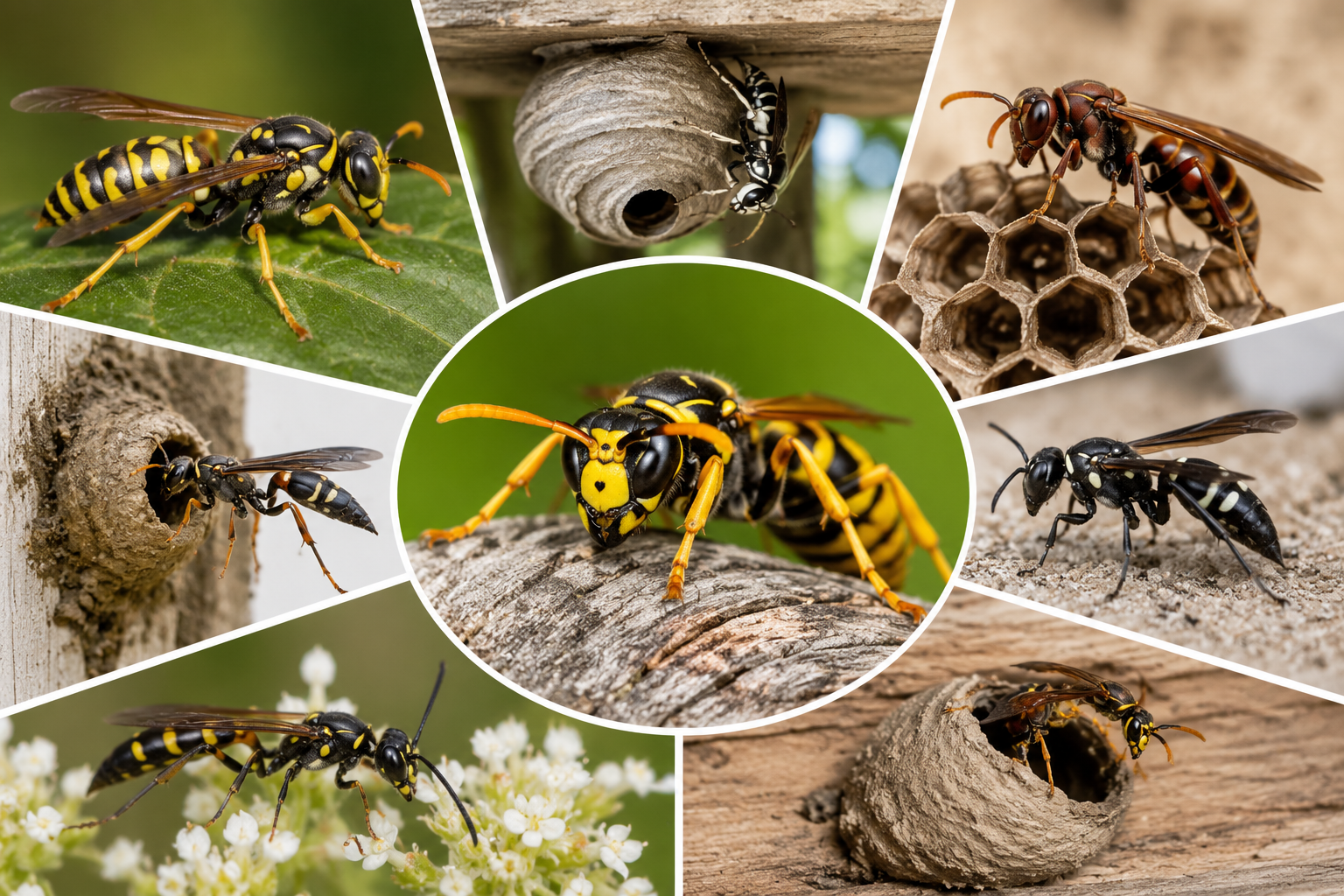
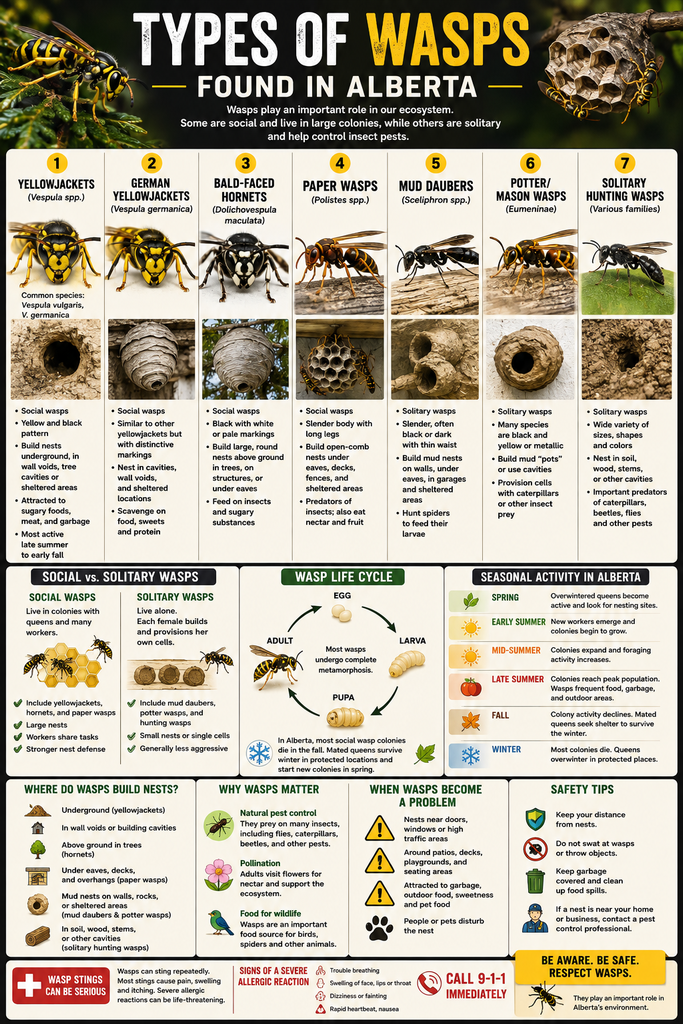
Alberta is home to many different wasps, ranging from social yellowjackets and paper wasps to solitary mud daubers and other hunting wasps. Although many people simply call them “wasps,” these insects have very different nesting habits, diets, colony structures, and behaviours.
For homeowners and businesses in Calgary and across Alberta, knowing which type of wasp is present can make it much easier to understand whether the insect is simply a beneficial outdoor predator or whether a nest is creating a pest problem.
Important: “Wasp” is a broad group rather than a single species. The species and abundance found in Alberta can vary by location and habitat. Alberta’s biodiversity databases contain records for many nonvertebrate species, while University of Alberta museum records provide species-level information for individual wasps.
1. Yellowjackets
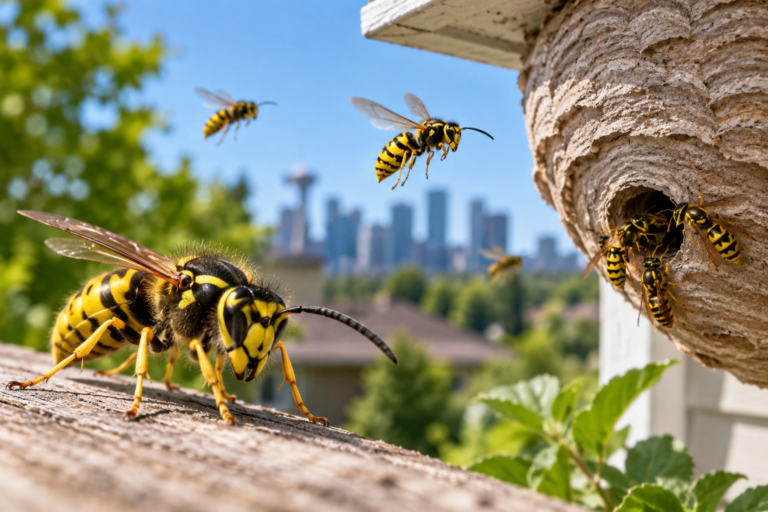
Yellowjackets are among the most familiar wasps in Alberta. They belong primarily to the genus Vespula and are recognized by their yellow-and-black bodies.
Several Vespula species occur in Alberta. The University of Alberta’s E.H. Strickland Entomological Museum, for example, documents the common yellowjacket (Vespula vulgaris) in the province.
Yellowjacket biology
Yellowjackets are social wasps. A colony begins when a reproductive queen establishes a nest and starts producing workers. As the season progresses, the worker population increases and the colony becomes increasingly active.
Yellowjackets feed their developing young with protein obtained from insects and other animal material, while adults commonly consume sugary substances such as nectar and fruit juices. Alberta’s beekeeper handbook notes that yellowjackets also forage for meat, fish and insects to feed their young.
Where do yellowjackets build nests?
Depending on the species, yellowjackets may build nests:
- Underground
- In wall voids
- In tree cavities
- Beneath structures
- In sheltered outdoor locations
- Occasionally above ground
The University of Alberta records Vespula vulgaris nesting in locations including soil, tree hollows and building cavities, with some nests also occurring above ground.
Why yellowjackets become a problem
Yellowjackets can become particularly noticeable in late summer, when colonies have reached large populations and workers are actively searching for sugary foods.
They may gather around:
- Garbage cans
- Outdoor food
- Fallen fruit
- Picnic areas
- Compost
- Sweet beverages
- Restaurant waste
Alberta’s beekeeper handbook identifies late summer as the period when yellowjacket populations reach their peak.
2. German Yellowjackets
The German yellowjacket (Vespula germanica) is another important yellowjacket species to recognize.
It resembles other yellowjackets, which can make identification difficult without examining specific markings.
German yellowjackets are social insects and can establish nests in protected cavities around buildings and landscapes.
Why are German yellowjackets important?
German yellowjackets can become nuisance pests when colonies develop close to people. Workers may forage around food, garbage, fruit and other sugary or protein-rich sources.
They can also become defensive when their nest is disturbed.
Because yellowjackets can sting repeatedly, caution is important when a large number of wasps are concentrated around a suspected nest. Alberta Health Services notes that wasps, including yellowjackets and hornets, can sting repeatedly.
3. Bald-Faced Hornets
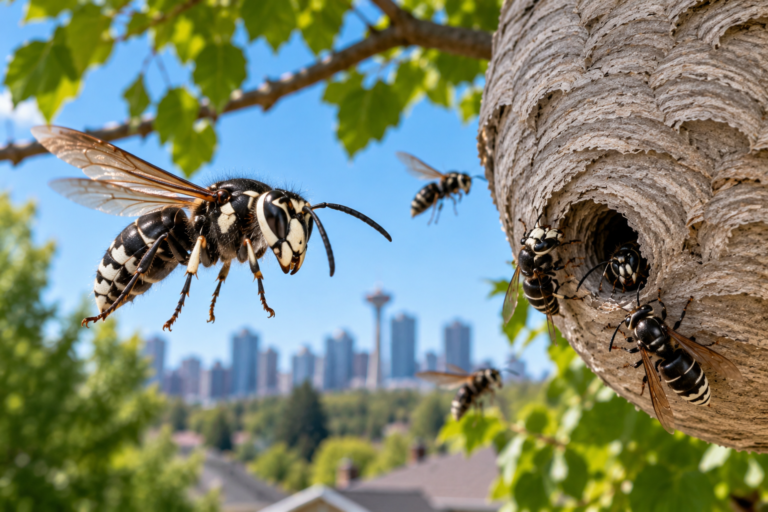
Despite their common name, bald-faced hornets are actually wasps. Their scientific name is Dolichovespula maculata.
They are generally larger than yellowjackets and have a predominantly black body with contrasting white or pale markings.
Alberta’s beekeeper handbook specifically identifies bald-faced hornets as common visitors to honey bee colonies and notes that they build their paper nests above ground.
Bald-faced hornet nests
Their large paper nests can often be found:
- In trees
- On branches
- Under eaves
- On structures
- In sheltered elevated locations
Unlike many yellowjackets, they do not typically build their nests underground.
What do bald-faced hornets eat?
Adults consume sugary food sources, while developing larvae require protein.
They hunt other insects and can therefore provide an important ecological service by helping regulate populations of other insects.
Alberta agricultural information also recognizes predatory wasps, including hornets and yellowjackets, as predators of insects.
4. Paper Wasps
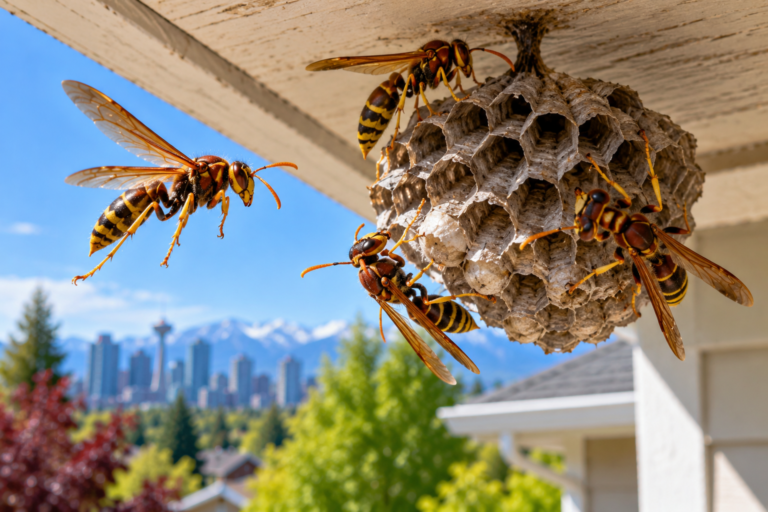
Paper wasps belong primarily to the genus Polistes. They are generally more slender than yellowjackets and have long legs that can hang noticeably while they fly.
Their nests are very different from the enclosed nests of many yellowjackets.
Paper wasp nests
Paper wasps construct open-comb nests consisting of exposed cells attached to a surface.
They may build nests:
- Under roof overhangs
- Beneath decks
- Under eaves
- Around sheltered structures
- In protected building locations
- In vegetation
The open structure of their nest is one of the easiest characteristics to recognize.
Paper wasp behaviour
Paper wasps are predators and scavengers. Workers collect insects and other protein sources to feed developing larvae.
They also consume sugary substances as adults.
Paper wasps can sting if threatened, particularly when their nest is disturbed.
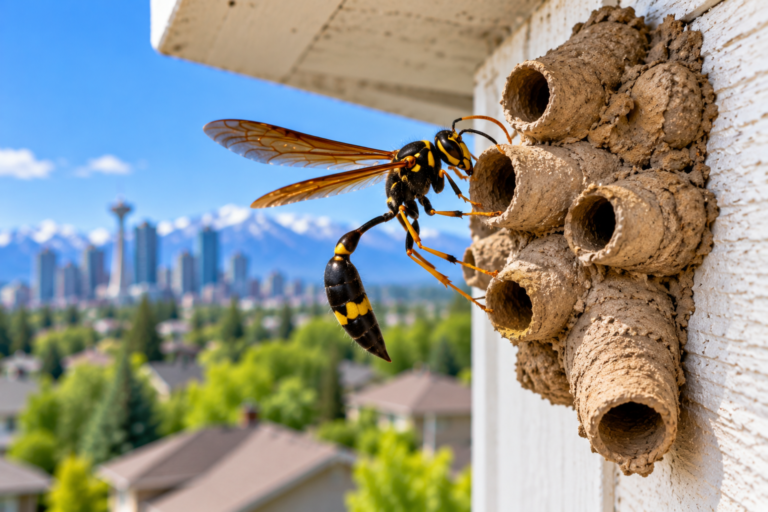
5. Mud Daubers
Mud daubers are very different from yellowjackets and hornets.
They are generally solitary wasps, meaning they do not establish the large colonies associated with social yellowjackets.
Instead, a female mud dauber constructs individual mud chambers where she lays eggs and provisions developing larvae with prey.
Mud dauber nests
As their name suggests, mud daubers use mud or soil to construct their nests.
Nests may be attached to:
- Walls
- Buildings
- Sheltered structures
- Garages
- Protected outdoor surfaces
What do mud daubers eat?
Many mud daubers specialize in hunting spiders.
A female captures prey and places it inside a nest chamber for her developing offspring.
This makes mud daubers beneficial predators in many environments.
6. Potter and Mason Wasps
Potter wasps and mason wasps belong to the subfamily Eumeninae and are generally solitary.
They are related to the social wasps but have very different lifestyles.
Many species construct small nests from mud or use existing cavities.
A female provisions individual brood cells with caterpillars or other insect prey before sealing the cell.
Their nests can sometimes resemble tiny mud pots, which explains the common name potter wasp.
7. Solitary Hunting Wasps
Alberta also supports numerous solitary hunting wasps.
Unlike yellowjackets, these wasps do not maintain large colonies containing thousands of workers.
Instead, an individual female generally builds or selects a nesting site and provisions it with prey for her offspring.
Different groups specialize in different prey, including:
- Caterpillars
- Beetle larvae
- Flies
- Grasshoppers
- Spiders
- Other insects
These wasps can be extremely valuable predators because they help naturally regulate insect populations.
Social Wasps vs. Solitary Wasps
One of the most important differences between Alberta’s wasps is whether they are social or solitary.
| Characteristic | Social Wasps | Solitary Wasps |
|---|---|---|
| Examples | Yellowjackets, bald-faced hornets, paper wasps | Mud daubers, potter wasps, hunting wasps |
| Colony | Workers cooperate | Usually individual females |
| Nest | Often shared by many wasps | Individual brood cells |
| Queen | Present in social colonies | No large worker colony |
| Food for young | Workers commonly provide food | Female provisions each nest |
| Nest defence | Often strong | Usually limited to individual wasp |
| Pest concern | Can be significant | Usually lower |
Wasp Life Cycle in Alberta
Most wasps undergo complete metamorphosis:
Egg → Larva → Pupa → Adult
In social species, the queen lays eggs in nest cells and workers care for the developing larvae.
As the colony grows, more workers are produced. Later in the season, reproductive males and females are produced.
In Alberta’s colder climate, many social wasp colonies are annual, with the colony declining as temperatures fall. Alberta’s beekeeper handbook notes that yellowjacket colonies die when temperatures drop below 0°C, while mated daughter queens can seek sheltered locations to survive the winter and establish new colonies in spring.
Why Are Wasps Important to Alberta’s Ecosystem?
Not every wasp is a pest.
Wasps play several important ecological roles.
Natural Pest Control
Many wasps are predators that capture insects to feed their developing young.
They can prey on:
- Caterpillars
- Insect larvae
- Flies
- Beetles
- Other insects
Alberta agricultural resources recognize predatory wasps as important natural enemies of pest insects.
Pollination
Adult wasps may also visit flowers for nectar. While they are not generally as important as bees for pollination, their flower-visiting behaviour contributes to ecosystem interactions.
Food Webs
Wasps are also prey for birds, spiders, mammals and other predators, making them an important component of Alberta’s food webs.
Why Do Wasps Become a Pest Problem?
Wasps become a more significant concern when their nests are located close to people or high-traffic areas.
Potential problem locations include:
- Children’s play areas
- Patios
- Decks
- Doorways
- Walkways
- Restaurant patios
- Garbage areas
- Building entrances
- Wall cavities
The risk is generally greater when people accidentally approach or disturb a nest.
Wasp Activity in Calgary and Alberta by Season
Spring
Overwintered queens become active and begin searching for suitable nesting locations.
Early Summer
New workers begin emerging and colonies start expanding.
Mid-Summer
Worker populations increase and foraging activity becomes more noticeable.
Late Summer
Social wasp colonies can reach their largest populations. Yellowjackets may become particularly noticeable around garbage, fruit and outdoor food.
Fall
Colony activity eventually declines as temperatures fall. Reproductive queens may seek protected locations to survive the winter.
Winter
Most social wasp colonies become inactive or die, although certain reproductive queens can survive the winter in protected locations.
How to Identify a Wasp Nest
The location and construction style of a nest can provide useful clues.
Underground nest
Often associated with yellowjackets.
Enclosed paper nest
Commonly associated with yellowjackets or hornets.
Large aerial paper nest
Characteristic of bald-faced hornets.
Open paper comb
Typical of paper wasps.
Mud nest
Suggestive of mud daubers or certain solitary wasps.
However, nest appearance alone should not be considered a definitive species identification.
Are Wasps Dangerous?
Wasps can sting repeatedly, unlike honey bees, which normally leave their stinger behind after stinging. Alberta Health Services notes that yellowjackets are responsible for the greatest number of allergic reactions among the insects discussed on its health information page.
Most stings cause localized pain, redness, swelling and itching, but some people can experience a serious allergic reaction.
If someone develops signs of a severe allergic reaction after a sting, emergency medical attention is required.
What Should You Do If You Find a Wasp Nest?
Avoid disturbing a nest or repeatedly approaching it to determine its size.
Instead:
- Keep people and pets away from the immediate area.
- Avoid shaking, hitting or blocking the nest.
- Identify the general location of the nest from a safe distance.
- Consider professional pest identification and management if the nest is close to a building or high-traffic area.
Alberta Health Services recommends moving away with slow, deliberate movements if caught near a swarm and advises against swatting at a wasp or throwing objects at a nest.
Frequently Asked Questions About Wasps in Alberta
What are the most common types of wasps in Alberta?
Commonly encountered groups include yellowjackets, bald-faced hornets, paper wasps, mud daubers, potter wasps and other solitary hunting wasps. Several individual species occur within these groups.
Are yellowjackets and wasps the same thing?
Yellowjackets are a type of wasp. The term “wasp” includes many different families, genera and species.
Is a bald-faced hornet actually a hornet?
Despite its common name, the bald-faced hornet is actually a social wasp in the genus Dolichovespula. It is not a true Vespa hornet.
What is the difference between a yellowjacket and a paper wasp?
Yellowjackets generally have more compact bodies and commonly construct enclosed nests, while paper wasps are more slender and typically build exposed, open-comb nests.
What is the difference between a wasp and a bee?
Wasps generally have a narrower waist and less hairy bodies than bees. Many wasps are predators or scavengers, while bees are primarily associated with collecting pollen and nectar.
Do all wasps live in colonies?
No. Many wasps are solitary. Mud daubers, potter wasps and numerous hunting wasps generally do not form the large social colonies associated with yellowjackets.
Are mud daubers dangerous?
Mud daubers are generally considered much less of a nuisance than social wasps because they are solitary and do not defend large colonies in the same way.
Why are there so many yellowjackets around my garbage?
Yellowjackets are attracted to food sources, including sugary substances and protein. Garbage can provide both types of food, particularly during late summer.
When are wasps most active in Alberta?
Wasp activity generally increases during the warmer months, with social yellowjacket populations often becoming particularly noticeable in late summer.
Do wasps die in winter?
Many social wasp colonies are annual and decline as temperatures become cold. However, mated reproductive queens of some species can survive winter in protected locations and start new colonies the following spring.
Are wasps beneficial?
Yes. Many wasps are important predators of insects and contribute to natural pest control. Alberta agricultural resources specifically recognize predatory wasps as natural enemies of insect pests.
Can wasps damage a house?
Wasps generally do not damage structural wood in the same way carpenter ants or termites do. The main concern around buildings is usually nest location and stinging risk, rather than structural damage.
Conclusion
Alberta is home to a diverse range of wasps, from yellowjackets and bald-faced hornets to paper wasps, mud daubers, potter wasps and solitary hunting wasps. These insects have very different biological characteristics and should not all be treated as the same type of pest.
For Calgary homeowners and businesses, understanding the difference between social and solitary wasps is particularly useful. A large yellowjacket colony near a doorway is a very different situation from a solitary mud dauber building a small mud nest in a sheltered location.
Wasps also provide important ecological benefits. Many species hunt insects and help naturally control populations of other pests.
When a wasp nest is located close to people, especially around entrances, patios, playgrounds or commercial areas, professional identification can help determine the appropriate approach.