Fresh vs. Dry Pigeon Droppings: The Corrosive Threat to Your Roof and Solar Assets
Table of Contents
Pigeons are one of the most persistent nuisance birds in urban environments, and their presence around rooftops can create much more than an unsightly mess. Pigeon droppings can contribute to staining, surface deterioration, corrosion of certain materials, blocked drainage, and damage around rooftop equipment and solar panel installations.
The difference between fresh and dried pigeon droppings is important because the chemical composition and physical characteristics of bird waste change as it dries and decomposes.
For Calgary homeowners, property managers, commercial building owners, and solar panel owners, controlling pigeon access before birds establish a permanent nesting site can help reduce the long-term maintenance problems associated with accumulated bird droppings.
Fresh vs. Dry Pigeon Droppings: What Is the Difference?
Fresh pigeon droppings contain uric acid and significant moisture. Because the waste is still wet, it can spread across surfaces and enter small gaps, seams, and drainage areas.
As the material dries, the water evaporates and the remaining waste becomes concentrated and adheres firmly to the surface.
Over time, microorganisms can break down components of the droppings, producing compounds including ammonia and other nitrogen-containing substances. The chemistry therefore changes as the material ages.
Fresh Pigeon Droppings
Fresh droppings are particularly problematic because they are wet, chemically active, and easily spread by rain, wind, and foot traffic from birds.
The combination of uric acid, moisture, salts, and organic material can contribute to deterioration of susceptible surfaces and coatings.
Repeated deposits can be especially troublesome on:
- Metal roofing components
- Painted and coated surfaces
- HVAC equipment
- Gutters and downspouts
- Masonry and concrete
- Rooftop equipment
- Solar panel frames and surrounding hardware
- Electrical components located beneath bird nesting areas
The concern is not simply one deposit. Repeated pigeon activity can create continuous accumulation and repeated exposure.
The Drying Stage: Why Accumulated Droppings Become Difficult to Remove
As pigeon droppings dry, moisture evaporates and the material becomes harder and more strongly attached to the surface.
This creates another maintenance problem.
Instead of being easily washed away, dried guano can form a stubborn layer that requires careful cleaning. Aggressive scraping or improper pressure washing can potentially damage delicate coatings, roofing materials, seals, or solar equipment.
For this reason, professional pigeon guano cleanup should be approached differently from ordinary surface washing, particularly when droppings have accumulated beneath solar panels or around electrical equipment.
Aged and Dry Pigeon Guano Still Creates Problems
Dry pigeon droppings may no longer behave chemically in exactly the same way as fresh waste, but that does not make them harmless.
Older accumulations can:
- Create persistent staining
- Produce unpleasant odors
- Contaminate rooftop surfaces
- Block drainage pathways
- Add organic debris around equipment
- Attract insects and other pests
- Create sanitation concerns
- Become airborne as dust when disturbed
This is particularly important in enclosed or poorly ventilated areas where large amounts of accumulated bird waste are present.
Fresh vs. Dry Pigeon Droppings at a Glance
| Characteristic | Fresh Droppings | Dry/Aged Droppings |
|---|---|---|
| Moisture | High | Low |
| Uric acid present | Yes | Remains as part of the residue, with ongoing decomposition |
| Surface spreading | High | Lower |
| Adhesion | Increasing as it dries | Often strongly adhered |
| Cleaning difficulty | Generally easier when appropriately handled | Often more difficult |
| Odor potential | Can be significant | Can persist in heavy accumulations |
| Surface contamination | High | High |
| Health/sanitation concern | Yes | Yes |
Why Pigeons Are Attracted to Solar Panels
Solar panel systems can unintentionally create an ideal shelter for pigeons.
The space beneath solar modules may provide:
- Protection from weather
- Shade during hot conditions
- Shelter from predators
- A relatively secure nesting location
- Protection from wind
- Easy access from nearby rooftops
Once pigeons discover a suitable location, they can repeatedly return to the same area.
This creates a cycle of nesting, droppings, feathers, nesting debris, and repeated maintenance.
How Pigeon Droppings Can Affect Solar Panels
Solar panels are designed to operate outdoors, but they are not immune to contamination or physical damage caused by persistent bird activity.
1. Droppings Can Reduce Solar Panel Performance
Bird droppings are opaque and can prevent sunlight from reaching portions of the photovoltaic surface.
Even relatively small deposits can create shaded areas on a panel.
When contamination becomes extensive, it can reduce the amount of sunlight reaching the cells and therefore reduce energy production.
The impact depends on the amount of contamination, where it occurs, panel design, weather conditions, and how quickly the contamination is removed.
2. Persistent Contamination Can Affect the Glass and Coatings
Solar panels commonly use specialized glass and surface coatings designed to improve light transmission and protect the photovoltaic module.
Repeated exposure to contaminants, combined with moisture, temperature changes, and environmental conditions, can contribute to surface deterioration over time.
This is one reason why regular solar panel inspection and appropriate cleaning are important when pigeons are nesting around an array.
3. Droppings and Nesting Debris Can Affect Hardware
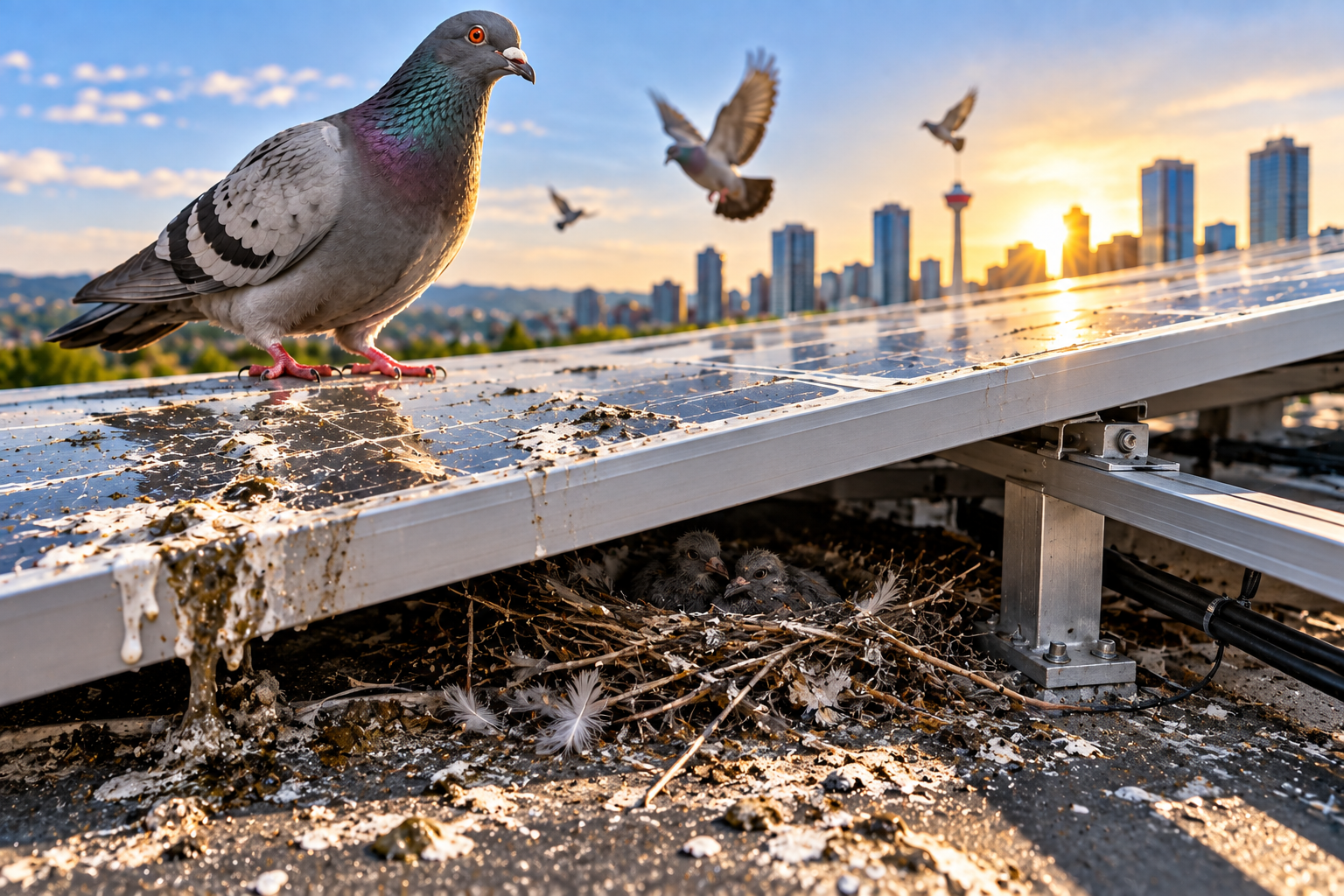
Pigeon nesting materials can accumulate beneath solar modules.
Feathers, twigs, leaves, droppings, and other debris may collect around:
- Wiring
- Mounting hardware
- Roof penetrations
- Drainage areas
- Module edges
- Cable management systems
The problem becomes more significant when moisture is trapped alongside organic material.
4. Pigeon Nests Can Create Additional Maintenance Problems
Pigeons don’t just leave droppings behind.
They also build nests.
Nesting material can obstruct drainage, accumulate against wiring, and create additional combustible or organic debris beneath the array.
For solar installations, preventing access to the underside of the panels is generally more effective than repeatedly removing nests after pigeons have established the location as a nesting site.
Do Pigeon Droppings Cause Solar Panel “Hotspots”?
This issue requires an important distinction.
Heavy bird-dropping contamination can create localized shading on photovoltaic modules. Depending on the panel design and electrical configuration, persistent partial shading can contribute to uneven electrical performance and localized heating.
However, it would be inaccurate to claim that every dried dropping automatically creates a dangerous hotspot or causes immediate cell failure.
The safest approach is to treat heavy bird contamination as a solar performance and maintenance issue and have damaged or persistently contaminated panels inspected by a qualified solar professional.
Pigeon Droppings and Roof Damage
Solar panels aren’t the only concern.
Accumulated pigeon waste can affect the surrounding roof environment.
Repeated contamination around rooftop drains and gutters can combine with leaves, feathers, nesting material, and other debris.
Over time, this may contribute to:
- Blocked drainage
- Standing water
- Persistent staining
- Deterioration around vulnerable surfaces
- Increased roof maintenance requirements
For commercial buildings and multi-unit properties, repeated pigeon activity can turn a relatively small bird problem into an ongoing building-maintenance expense.
Why Cleaning Alone Doesn’t Solve a Pigeon Problem
One of the biggest mistakes property owners make is treating pigeon droppings as the main problem.
The droppings are the symptom. The bird access is the underlying problem.
A property may be cleaned today, but if pigeons can still access the same sheltered location, new droppings and nesting material can appear again shortly afterward.
Effective pigeon management therefore involves two separate steps:
Step 1: Remove the Existing Contamination
Accumulated droppings and nesting debris should be removed using appropriate safety and sanitation procedures.
Large accumulations may require professional cleanup because disturbing dried bird waste can create airborne dust and contamination risks.
Step 2: Prevent Pigeons From Returning
After cleanup, the access point should be addressed.
For solar arrays, one commonly used exclusion approach is a solar panel bird barrier installed around the perimeter of the array.
A properly installed barrier helps prevent pigeons from getting underneath the panels while maintaining the intended function of the solar installation.
Solar Panel Bird Barrier: Long-Term Pigeon Prevention
A solar panel bird barrier is a physical exclusion system designed to close the accessible perimeter underneath solar panels.
Instead of relying on repeated bird removal, the objective is to prevent pigeons from entering the sheltered cavity in the first place.
A properly designed system should account for:
- Solar panel configuration
- Array dimensions
- Roof conditions
- Access points
- Wiring locations
- Drainage
- Panel movement and thermal expansion
- Long-term durability
- Maintenance access
For homeowners and property managers, physical exclusion can provide a more sustainable approach to managing pigeon nesting beneath solar panels than repeatedly cleaning the same area.
Protect Your Solar Investment From Pigeon Damage
Solar panels are a significant investment, and protecting the system involves more than monitoring energy production.
If pigeons are repeatedly nesting underneath your panels, look for signs such as:
- Fresh droppings around the array
- Feathers beneath panels
- Twigs and nesting materials
- Pigeons entering beneath modules
- Persistent bird activity on the roof
- Dropping accumulation on panel surfaces
- Debris around wiring or mounting hardware
- Blocked roof drainage near the solar array
Early intervention can help prevent a small bird problem from becoming a larger cleaning, maintenance, or exclusion project.
Professional Solar Panel Bird Barrier Installation in Calgary
If pigeons are nesting beneath your solar panels, Pest Pro Exterminator provides solar panel bird barrier solutions in Calgary and surrounding communities.
A properly installed exclusion system can help protect the space beneath your solar panels from repeated pigeon nesting, droppings, feathers, and nesting debris.
Our bird-control approach focuses on physical exclusion rather than simply removing the birds and leaving the access point open.
Learn more about our Solar Panel Bird Barrier service and how physical bird exclusion can help protect your solar installation.
Frequently Asked Questions About Pigeon Droppings and Solar Panels
Are fresh pigeon droppings more corrosive than dry droppings?
Fresh droppings contain moisture and uric acid, allowing the waste to interact more readily with susceptible surfaces. However, the actual corrosive effect depends on the material, exposure time, environmental conditions, and repeated contamination.
Can pigeon droppings damage solar panels?
Heavy or repeated bird-dropping contamination can reduce sunlight reaching the photovoltaic surface and contribute to ongoing maintenance problems. Persistent contamination should be cleaned appropriately, and any suspected physical or electrical damage should be assessed by a qualified solar professional.
Can pigeon droppings cause solar panel hotspots?
Bird droppings can create localized shading. Under certain conditions, partial shading can contribute to uneven electrical performance and localized heating. However, the relationship depends on the specific photovoltaic module and electrical configuration.
Why do pigeons nest under solar panels?
Solar panels can provide pigeons with sheltered, relatively protected spaces that are suitable for roosting and nesting. The underside of an array can offer protection from weather and predators.
Will cleaning pigeon droppings stop pigeons from returning?
Usually, cleaning alone does not address the reason pigeons are using the location. If birds can still access the space underneath the panels, they may return and rebuild nests.
What is a solar panel bird barrier?
A solar panel bird barrier is a physical exclusion system installed around the perimeter of solar panels to prevent birds from entering the space underneath the modules.
Is pigeon guano dangerous to clean?
Large accumulations of dried bird waste should be handled carefully because disturbing contaminated material can generate dust and create sanitation concerns. Appropriate protective equipment, cleaning procedures, and waste-handling practices are important.
How can I prevent pigeons from nesting under solar panels?
The most effective long-term approach is generally to prevent physical access to the nesting area. A professionally installed solar panel bird barrier can help close the perimeter and reduce access beneath the array.
Final Takeaway: Stop the Access, Not Just the Droppings
The difference between fresh and dry pigeon droppings illustrates why bird infestations should be addressed early.
Fresh waste contains moisture and uric acid, while dried and aged guano becomes a persistent contaminant that can be difficult to remove. Repeated deposits can contribute to staining, maintenance problems, and contamination around roofing and solar equipment.
For solar panel owners, the long-term solution is not simply cleaning the droppings—it is preventing pigeons from accessing the space beneath the panels.
A professionally installed solar panel bird barrier in Calgary can help protect the area beneath your solar array from repeated nesting, droppings, feathers, and debris while reducing the need for recurring cleanup.
Pigeon control is most effective when exclusion is part of the solution.