Signs of Bed Bugs in Apartment: 7 Warning Signs
Table of Contents
- 7 Early Signs of Bed Bugs in Apartment Units
- Bed Bug Bites vs Other Insect Bites
- Your Bed Bug Inspection Checklist for Apartments
- How to Report Bed Bugs to Your Landlord
- Why Bed Bugs Spread Between Apartment Units
- DIY vs Professional Treatment: What Works for Apartments
- Frequently Asked Questions
Last Updated: September 23, 2026
7 Early Signs of Bed Bugs in Apartment Units
Spotting the signs of bed bugs in apartment units early is the difference between a contained problem and a building-wide infestation. The most reliable indicators are live insects, dark fecal spots, shed exoskeletons, tiny eggshells, and a sweet, musty odor in sleeping areas. Because apartments share walls, floors, and utility lines, one infested unit can seed the units around it within weeks.
Bites and Skin Reactions
Bites are usually the first thing people notice, and the least reliable. They appear as small, red, itchy welts, often in a line or cluster of three or more, a pattern called “breakfast, lunch, and dinner.” Reactions vary: some people show no marks, others develop significant swelling.
Physical Evidence: Stains, Skins, and Smells
Physical evidence is far more conclusive than bites. Look for:
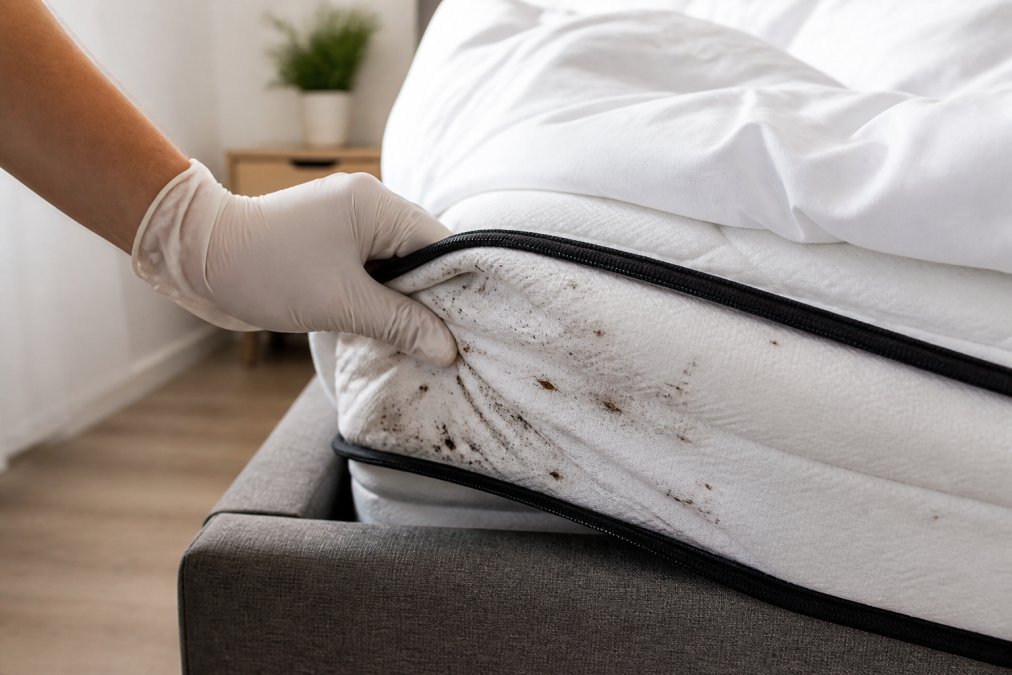
- Fecal matter: Small dark spots, like ink dots or ground pepper, on sheets, mattress seams, and baseboards
- Blood stains: Rust-colored smears from crushed bugs or feeding wounds
- Shed skins: Translucent exoskeletons left behind as nymphs molt
- Eggshells: Tiny pale husks, roughly the size of a pinhead, glued into crevices
- Odor: A sweetish, musty smell in heavy infestations
Bites are suggestive; physical evidence is proof. If you find fecal spots or shed skins, you have an active infestation, not a suspicion.
Bed Bug Bites vs Other Insect Bites
Bed bug bites are hard to distinguish from other insect bites by appearance alone, so most pest management professionals treat visual identification as supporting evidence, not confirmation. The table below compares common lookalikes.
| Feature | Bed Bugs | Fleas | Mosquitoes | Spider Bites |
|---|---|---|---|---|
| Bite pattern | Clusters or lines | Ankles, lower legs | Isolated, exposed skin | Single, sometimes paired |
| Timing | Overnight, while sleeping | Any time near pets | Dusk and dawn | Any time |
| Itch onset | Delayed, hours to days | Immediate | Immediate | Variable |
| Visible pest | Rarely seen | Often seen jumping | Often seen flying | Rarely seen |
| Key clue | Fecal spots nearby | Pets scratching | Recent outdoor exposure | No other evidence |
Your Bed Bug Inspection Checklist for Apartments
A structured inspection takes about 30 minutes for a one-bedroom unit and requires only a flashlight, a credit card or thin putty knife, and a white sheet or paper towel. Work slowly. Bed bugs congregate in tight hiding spots, and rushing means missing them.
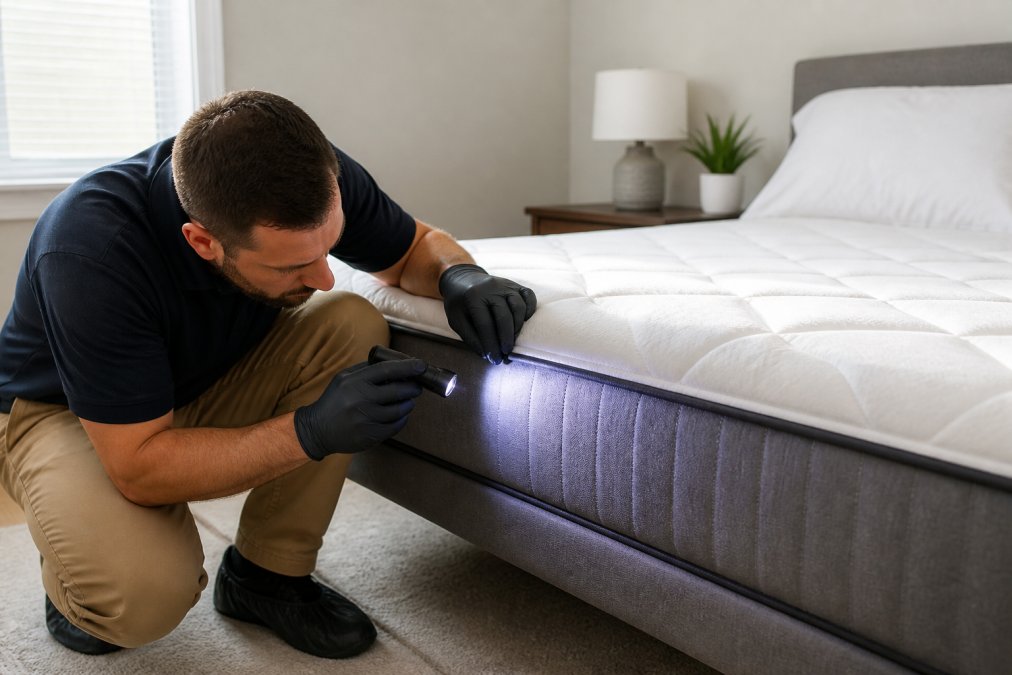
Follow this bed bug inspection checklist in order:
- Strip the bed and inspect the mattress seams, piping, and tags with your flashlight.
- Check the box spring, especially the corners and the fabric underside.
- Inspect the bed frame, headboard, and any bolts or joints.
- Examine upholstered furniture, including sofa seams and cushion zippers.
- Run a credit card along baseboards and electrical outlets to flush out hidden bugs.
- Check curtains, picture frames, and the gap behind the headboard.
- Inspect luggage, laundry baskets, and secondhand items before bringing them inside.
Where to Look: High-Risk Spots in Apartments
In multi-unit buildings, high-risk locations extend beyond your bedroom. Bed bugs travel through shared walls, plumbing and electrical chases, and communal laundry carts. Inspect mattress and box spring seams first, then baseboards, outlets, upholstered furniture, and any wall shared with a neighboring unit.
Do not move infested items to another room or unit “to deal with later.” Bed bugs spread on fabric and cardboard, and a single relocation can seed a second infestation.
How to Report Bed Bugs to Your Landlord
Reporting bed bugs is a legal process, not a courtesy call. In every province and territory, residential tenancy law obliges landlords to keep units fit for habitation, and an infestation generally breaches that obligation. Because wording, timelines, and remedies differ by jurisdiction, first identify which statute and regulator govern your tenancy.
| Jurisdiction | Governing statute | Regulator / dispute body |
|---|---|---|
| Ontario | Residential Tenancies Act, 2006 | Landlord and Tenant Board |
| British Columbia | Residential Tenancy Act | Residential Tenancy Branch |
| Alberta | Residential Tenancies Act | Residential Tenancy Dispute Resolution Service |
| Quebec | Civil Code of Quebec (Book 5) | Tribunal administratif du logement |
| Manitoba | Residential Tenancies Act | Residential Tenancies Branch |
| Saskatchewan | Residential Tenancies Act, 2006 | Office of Residential Tenancies |
| Nova Scotia | Residential Tenancies Act | Residential Tenancies Program |
| New Brunswick | Residential Tenancies Act | Residential Tenancies Tribunal |
| Newfoundland and Labrador | Residential Tenancies Act, 2018 | Residential Tenancies Section |
| Prince Edward Island | Rental of Residential Property Act | Island Regulatory and Appeals Commission |
| Northwest Territories | Residential Tenancies Act | Rental Office |
| Yukon | Residential Landlord and Tenant Act | Residential Tenancies Office |
| Nunavut | Residential Tenancies Act | Rental Office |
What your written notice must contain
A verbal complaint is easy to dispute later. Send a written notice, keep a dated copy, and include:
- The date you first observed signs
- A room-by-room description of the physical evidence (fecal spots, shed skins, live insects)
- Photographs with timestamps
- A clear statement that you are reporting a suspected infestation and requesting inspection and treatment
- A request for inspection of adjacent, above, and below units
- A reasonable response deadline (commonly 24-72 hours for inspection)
- A request for written confirmation of the treatment schedule
If your landlord does not act
Most tenancy statutes give tenants a formal escalation path:
- Filing an application with the tenancy regulator for an order requiring the landlord to repair or treat. Filing fees and forms vary by province.
- Applying for a rent abatement if the unit was not habitable for a period.
- Requesting early termination of the tenancy without penalty in serious cases.
- Paying for treatment and seeking reimbursement, but only where your statute permits it; do not assume this right without checking.
Do not withhold rent as a first response. In most jurisdictions, withholding rent without a regulator’s order is itself a breach and can trigger eviction.
BOOK A FREE QUOTES OR CONSULTATION! →
What your landlord is and is not allowed to do
- Your landlord generally must give written notice before entering your unit, except in emergencies. Check your statute for the required notice period.
- Your landlord cannot evict you for reporting a bed bug infestation in good faith.
- Your landlord cannot shift the cost of treatment to you unless your lease or the statute specifically allows it, or unless you caused the infestation through negligence.
- Your landlord may require you to prepare the unit for treatment (bagging clothing, laundering bedding). This is a normal condition, not retaliation.
Do not throw out your mattress, sofa, or other furniture before treatment. Discarded infested items in a shared hallway or dumpster can spread bed bugs to neighboring units, and in some jurisdictions improper disposal can expose you to a cleanup charge.
Your use as a tenant is documentation. A dated, photographed, written notice sent to the correct regulator’s jurisdiction is what converts a complaint into an enforceable obligation.
For authoritative guidance on tenant rights and landlord obligations, consult your provincial residential tenancy office or Canada Mortgage and Housing Corporation guidance on rental housing.
Why Bed Bugs Spread Between Apartment Units
Bed bugs spread between apartment units through shared structural pathways, not poor housekeeping. They crawl through gaps around plumbing and electrical lines, travel along shared wall voids, and hitchhike on laundry, furniture, and moving boxes. That’s why treating one unit in isolation rarely solves a building-wide problem.
Place interceptor cups under each bed leg and check them weekly. These simple monitoring devices catch bed bugs as they climb toward the bed and confirm whether an infestation is active or resolved.
DIY vs Professional Treatment: What Works for Apartments
DIY treatment can knock down bed bug numbers, but in a multi-unit building it almost never eliminates them. Bed bugs retreat into wall voids, electrical chases, and gaps around plumbing that no consumer product reaches. Treating your unit while the source survives next door guarantees reinfestation.
What DIY actually accomplishes
| Method | What it does | What it does not do |
|---|---|---|
| Vacuuming with a HEPA vacuum | Removes visible bugs, eggs, and debris from surfaces | Does not reach inside seams, voids, or outlets |
| Washing and drying on high heat | Kills all life stages on fabric that reaches temperature | Does not treat the mattress core, frame, or walls |
| Mattress and box spring encasements | Traps bugs already inside and prevents new ones from hiding | Does not kill bugs outside the encasement |
| Diatomaceous earth (food-grade) | Desiccates bugs that cross a thin, dry layer | Fails in humid conditions and when applied too thickly |
| Over-the-counter sprays | Kills bugs on contact | Misses voids; repeated use of one active ingredient drives resistance |
| Interceptor cups under bed legs | Monitors activity and confirms whether the problem is active | Does not eliminate an infestation |
| Steam (dry vapor, 212°F+) | Kills bugs and eggs on contact in seams and folds | Requires slow, methodical coverage; misses deep voids |
A realistic DIY role in an apartment is preparation and monitoring: laundering, decluttering, encasing the mattress, placing interceptors, and documenting activity. These steps support a professional treatment and confirm whether it worked; they are not a substitute.
Why DIY fails specifically in apartments
- Shared voids. Bed bugs move through wall cavities and electrical chases between units. A spray inside your unit does not reach them.
- Reintroduction. If an adjacent unit is untreated, bugs reinvade within days to weeks, the most common reason DIY appears to fail.
- Resistance. Bed bug populations in many urban areas show reduced susceptibility to pyrethroids, the active ingredient in most consumer sprays.
- Missed eggs. Eggs are cemented into crevices and survive vacuuming or surface sprays. Survivors restart the cycle in roughly a week to ten days.
- Misidentification. Bat bugs, carpet beetles, and booklice are frequently mistaken for bed bugs. Treating the wrong pest wastes money and delays the real fix.
When to stop DIY and escalate
Escalate to professional treatment when any of these is true:
- You have confirmed live bed bugs or viable eggs, not just bites
- You have treated once and still find activity after two weeks
- You live in a multi-unit building and cannot confirm adjacent units have been inspected
- You have bites but cannot find the source after a full inspection
- You or a household member has a medical condition worsened by bites or by pesticide exposure
- Your landlord has been notified in writing and has not arranged inspection within a reasonable period
What professional treatment involves
A qualified pest management provider will typically:
- Inspect the full unit and, with the landlord’s cooperation, adjacent units
- Confirm species identification before treating
- Recommend a method: heat, targeted residual application, or a combination
- Provide a written preparation checklist
- Schedule follow-up monitoring, because one visit rarely resolves a multi-unit problem
Ask any provider two questions before booking: how will you confirm the source unit, and what is your follow-up schedule? A provider who cannot answer both is not set up for apartment work.
Do not use outdoor or agricultural insecticides indoors, and do not mix consumer products. These practices are unsafe and, in most provinces, illegal for residential use.
For apartments, professional treatment coordinated across units is the only approach that reliably addresses the structural pathways between them. At Pest Pro Exterminator, our process starts with inspection and identification, moves to customized treatment, and finishes with monitoring and prevention. We’ve handled residential and commercial infestations across Southern Alberta for over 18 years combined, and we’re available 24/7 for contact.
Frequently Asked Questions
What are the very first signs of bed bugs in an apartment?
The earliest signs are usually small itchy bites in a line or cluster on your skin, often noticed after waking. You may also spot tiny dark spots of excrement on sheets or mattress seams, shed skins, or a sweet, musty odor in the room. Because bed bugs are nocturnal and hide in cracks, bites are often the first clue before you see the insects themselves.
Can bed bugs travel between apartments?
Yes. Bed bugs can move between units through shared walls, electrical outlets, plumbing lines, and hallways. They hitchhike on clothing, luggage, and furniture, and in multi-unit buildings they often spread from one apartment to another. This is why a single-unit treatment may not solve the problem if neighboring units are infested.
What should I do if I find bed bugs in my rental unit?
Document the signs with photos, then report the issue to your landlord in writing as soon as possible. In most provinces, landlords are responsible for maintaining pest-free living conditions, and they must arrange professional treatment. Avoid moving furniture between rooms, and follow any preparation instructions from the pest control provider to ensure the treatment works.
How do bed bug bites compare to other insect bites?
Bed bug bites often appear as small red bumps in a straight line or cluster, while flea bites tend to be around the ankles and mosquito bites are usually random and puffy. Bed bug bites don’t have a red center like some spider bites, and they rarely blister. If you’re unsure, look for other signs like fecal stains or shed skins to confirm.