Skunk Exclusion in Calgary: How to Keep Skunks From Getting Under Your Deck, Shed, or Home
Table of Contents
Skunks are common wildlife visitors in Calgary and surrounding communities, especially when they discover a quiet, protected space underneath a deck, porch, shed, garage, or addition. Once a skunk finds a safe place to shelter, simply removing the animal may not solve the problem. If the entry point remains open, another skunk may eventually use the same location. Skunk exclusion focuses on preventing the animal from getting back into the protected area by securing entry points and installing appropriate barriers.
What Is Skunk Exclusion?
Skunk exclusion is a wildlife-control method designed to prevent skunks from entering or returning to a structure. Instead of relying only on removing the animal, exclusion addresses the physical access point that allows the skunk to get underneath a building or structure.
A professional exclusion program may involve inspecting the property, identifying the active entry point, installing a one-way wildlife exclusion door, and reinforcing vulnerable areas with a dig-defense barrier. Once the skunk has safely exited and the area is confirmed clear, the remaining opening can be permanently secured.
Why Do Skunks Get Under Houses and Decks?
Skunks generally look for quiet, protected locations where they can shelter from weather and predators. Spaces underneath decks, porches, sheds, stairs, and other structures can provide exactly that type of environment.
Common areas where skunks may establish shelter include:
- Under decks and patios
- Beneath porches and stairs
- Under sheds and garages
- Around foundations
- Under additions and crawl spaces
- Beneath raised structures
- Around damaged or missing foundation barriers
- Openings created by erosion or previous digging
A small opening can become a recurring wildlife entry point if it is not properly secured.
Signs That a Skunk May Be Living Under Your Deck or Structure
One of the first signs homeowners notice is a strong skunk odour around a deck, porch, shed, or foundation. However, smell is not the only indication.
Other possible signs include:
- Fresh digging around the foundation or deck
- Soil pushed away from an opening
- A visible hole beneath a structure
- Disturbed landscaping
- Tracks around the suspected entrance
- Skunk activity during evening or nighttime hours
- Repeated wildlife activity around the same location
- Damage to existing barriers caused by digging
If you notice fresh digging near an opening, it is better to investigate the access point before simply filling the hole.
Why Simply Filling the Hole May Not Work
A common reaction to a wildlife opening is to fill it with soil, rocks, or another material. Unfortunately, if the skunk is still inside, this can create a serious problem.
Even when the animal has left, a weak repair may be dug through again. Skunks are capable diggers, so exclusion work needs to address the entire vulnerable area, not just the visible hole.
A professional approach is to determine whether the opening is active and establish an exclusion strategy before permanently sealing the access point.
How a One-Way Door Works for Skunk Exclusion
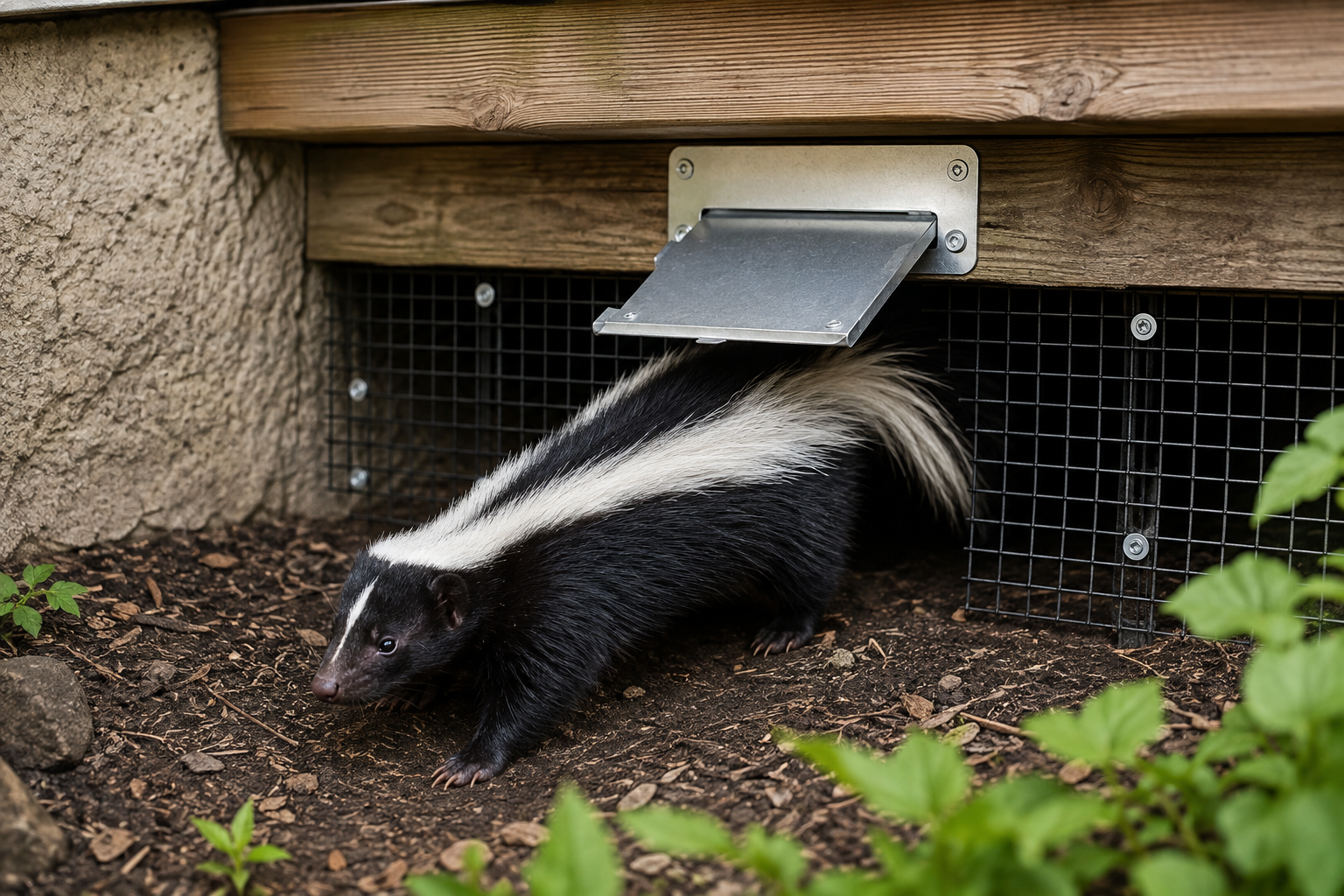
A one-way wildlife exclusion door is designed to allow the animal to leave an enclosed area while preventing it from returning through the same opening.
The general process involves:
- Identifying the active entry point.
- Installing the one-way door over the opening.
- Allowing the skunk an opportunity to exit.
- Monitoring the area for continued activity.
- Confirming that the protected space is clear.
- Removing the exclusion door or permanently securing the opening.
The exact installation method depends on the structure, opening, soil conditions, and location of the entry point.
What Is a Dig-Defense Barrier?
A dig-defense barrier is a physical exclusion system installed around vulnerable areas to make it difficult for skunks to dig underneath the structure.
Depending on the site, the barrier may be buried and/or secured along the perimeter, with the installation adapted to the ground and structure. An outward-facing section can also be used in suitable situations to discourage digging immediately beside the protected area.
The purpose is simple: stop the skunk from bypassing the exclusion by digging underneath the barrier.
Skunk Exclusion for Decks and Porches
Decks and porches are particularly attractive to skunks because they can provide a sheltered space underneath while remaining close to food, water, and landscaping.
A proper exclusion installation may include a combination of:
- One-way wildlife door
- Welded-wire exclusion material
- Buried dig-defense barrier
- Securing fasteners
- Reinforcement around vulnerable corners
- Permanent closure after the animal has exited
The barrier should follow the actual structure rather than simply covering the most obvious hole.
Skunk Exclusion Around Sheds and Garages
Sheds, detached garages, and other outbuildings can also have gaps along their foundations or lower walls. Skunks may exploit damaged siding, gaps beneath doors, foundation openings, or areas where the ground has eroded.
During an inspection, the goal is to identify both the active entrance and nearby areas that could become future access points.
Why Professional Skunk Exclusion Is Important
Effective wildlife exclusion is more than placing a piece of material over a hole. The installation needs to account for how the animal is accessing the structure and whether there are additional openings nearby.
Professional skunk exclusion can help:
- Reduce repeated wildlife intrusion
- Protect vulnerable areas of the property
- Prevent future digging at the same location
- Address the physical entry point
- Reduce odour and disturbance associated with wildlife sheltering
- Provide a longer-term solution than simply removing the animal
Skunk Exclusion vs. Skunk Removal
Skunk removal addresses the animal.
Skunk exclusion addresses the access point.
In many situations, exclusion is an important part of solving the underlying problem because removing an animal without securing the entry point can leave the property vulnerable to another animal using the same shelter.
The best approach depends on the circumstances at the property, including whether an animal is currently present, whether there may be young animals, and how the structure is constructed.
How Much Does Skunk Exclusion Cost in Calgary?
The cost of skunk exclusion varies depending on the size of the entry point, accessibility, amount of dig-defense material required, condition of the structure, number of openings, and whether a one-way door is necessary.
A simple exclusion may require relatively little material, while a larger deck or foundation may require substantially more labour and reinforcement.
For this reason, an on-site inspection is usually the best way to determine the appropriate exclusion method and provide an accurate quote.
Skunk Exclusion in Calgary and Surrounding Areas
Pest Pro Exterminator provides wildlife exclusion services designed to address skunk entry points around homes and structures in Calgary and surrounding Alberta communities.
Our skunk exclusion approach can include inspection of the suspected entry point, installation of a one-way wildlife exclusion door, dig-defense barriers, securing vulnerable areas, and permanent closure after the exclusion process.
The objective is not simply to remove a skunk—it is to prevent the same access point from becoming a recurring wildlife problem.
Frequently Asked Questions About Skunk Exclusion
How do I know if a skunk is living under my deck?
A strong skunk odour, fresh digging, disturbed soil, tracks, and repeated nighttime wildlife activity can indicate that a skunk may be using the space underneath your deck.
Can I just block the hole where the skunk enters?
It is important to determine whether the opening is active before permanently blocking it. If an animal is still inside, sealing the opening can create additional problems. A one-way exclusion approach may be appropriate in certain situations.
How does a skunk one-way door work?
The device is positioned over an active opening so the animal can leave but cannot easily return through the same opening. Once the area is confirmed clear, the opening can be permanently secured.
Will a skunk dig under a fence or barrier?
Skunks are capable diggers. This is why a properly designed dig-defense barrier can be an important component of exclusion around vulnerable structures.
How long does skunk exclusion take?
The timeline depends on the location and whether the animal is currently using the space. The property should be monitored during the exclusion process before the final opening is permanently sealed.
Can skunk exclusion prevent future skunks?
A properly installed exclusion system can significantly reduce access to the protected area, but no wildlife-control system can guarantee that an animal will never attempt to access another part of a property.
Do you repair the opening after the skunk leaves?
Permanent closure can be included as part of the exclusion work, depending on the agreed scope of the project and the condition of the opening.