Mice Inside Multi-Dwelling Apartments: Why It Concerns Both Tenants and Property Management
Table of Contents
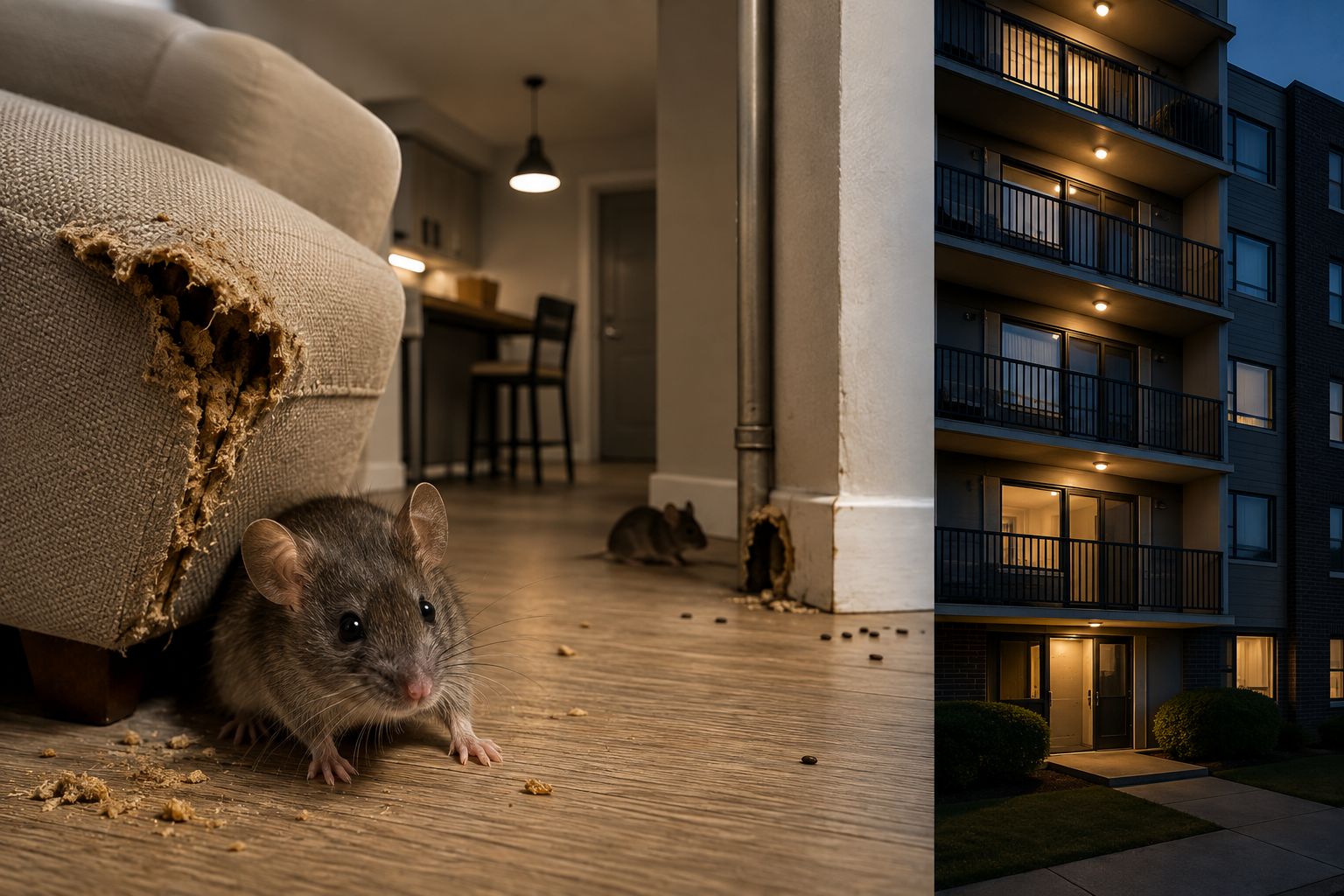
When mice are already inside a multi-dwelling apartment building, the problem should not be treated as an isolated issue affecting only one tenant. In apartment buildings, mice can move through wall voids, utility penetrations, mechanical areas, storage rooms, garbage areas, corridors and other connected spaces. What begins as activity in one suite can become a building-wide pest management concern if the underlying entry points and food sources are not addressed.
For tenants, a mouse infestation can affect health, sanitation, personal belongings and peace of mind. For property managers and landlords, an uncontrolled mouse problem can create maintenance costs, tenant complaints, reputational concerns and potential disputes over property damage.
Why Mice in an Apartment Building Are a Serious Concern
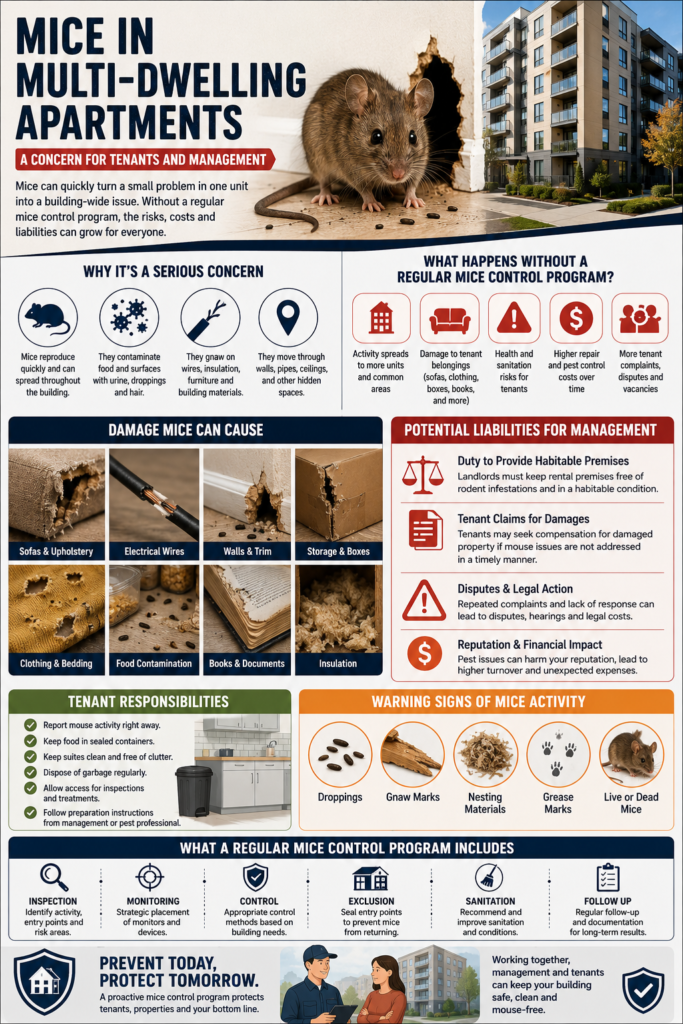
House mice can damage more than food. Alberta Health Services states that mice can gnaw insulation, building materials, electrical wires, furniture, clothing, books and other materials. They can also contaminate food with urine, hair and droppings.
In a multi-unit building, the concern is amplified because suites are interconnected. Mice may travel through openings around pipes, electrical penetrations, walls, ceilings, doors and other building components.
Canada’s public-health guidance also recommends addressing mouse activity promptly because mice reproduce quickly and occasional invaders can develop into more serious infestations.
What Happens When There Is No Regular Mice Control Program?
A reactive approach—waiting until a tenant sees a mouse and then responding to the complaint—may not be enough for a multi-dwelling property.
Without regular inspection and monitoring, management may not know where mice are entering, where they are nesting, or whether activity is occurring in other suites or common areas.
Over time, several problems can develop:
1. Mouse Activity Can Spread Between Suites
A mouse problem in one apartment does not necessarily remain confined to that apartment.
Mice can move through concealed building spaces and may enter neighboring suites through gaps around plumbing, wiring, heating systems, doors and other openings.
This can result in multiple tenants reporting mouse sightings at different times, making the infestation more difficult and expensive to resolve.
2. Damage to Tenant Furniture and Personal Belongings
One of the concerns tenants may have is damage to their personal property.
Mice are capable of gnawing materials such as furniture, clothing, books and other household items.
For example, a tenant may discover damage to:
- Sofas and upholstered furniture
- Cushions and fabric materials
- Clothing and bedding
- Books and documents
- Storage boxes
- Food packaging
- Children’s belongings
- Electrical cords
- Personal items stored in closets or storage areas
A sofa can be particularly concerning because mice may enter or nest within concealed portions of upholstered furniture. If contamination or physical damage becomes significant, the tenant may consider the furniture unusable or require professional cleaning or replacement.
However, whether a landlord or property manager is legally responsible for a tenant’s damaged furniture depends on the facts of the situation, the tenancy agreement, insurance coverage, evidence of causation and applicable law. It should not automatically be assumed that every item damaged by mice is the landlord’s financial responsibility.
Could Property Management Become Liable for Tenant Property Damage?
Potentially, but liability is fact-specific.
Property managers and landlords should not assume that a tenant’s damaged sofa, clothing or other belongings automatically becomes the landlord’s responsibility. At the same time, management should take pest complaints seriously and document the response.
Alberta’s Residential Tenancies Act framework requires landlords to keep rental premises habitable throughout the tenancy. Alberta’s Minimum Housing and Health Standards specifically state that housing premises are to be free of insect and rodent infestations.
If a tenant repeatedly reports mice and management fails to take reasonable steps to address an ongoing infestation, the situation can potentially develop into a tenancy dispute.
Alberta guidance states that where a landlord does not fulfill obligations, a tenant may potentially seek remedies through the Residential Tenancy Dispute Resolution Service or court, including recovery of damages in appropriate circumstances.
That does not mean that every mouse complaint creates automatic liability. Documentation and the specific circumstances matter.
What Factors Could Become Important in a Dispute?
If a tenant claims that mice damaged personal property, several questions may become important.
Was the Mouse Problem Reported?
Written records are extremely important.
Management should document:
- Date the complaint was received
- Location of the reported activity
- Type of evidence observed
- Dates of inspections
- Pest-control visits
- Corrective actions
- Building repairs or exclusion work
- Tenant access issues
- Follow-up inspections
Alberta Health Services advises renters to report problems promptly and to allow access for pest control when proper notice is provided.
Did Management Respond Promptly?
A documented response is very different from ignoring repeated complaints.
If a tenant reports mice and management promptly investigates, arranges professional pest control, identifies entry points and follows up, management can demonstrate that reasonable steps were taken.
Conversely, repeated complaints with little or no documented response can create greater risk of escalation.
Was the Source Building-Related?
Another important question is whether mice entered because of a building condition.
Examples could include:
- Gaps around pipes
- Openings around electrical penetrations
- Damaged door sweeps
- Gaps around utility entrances
- Structural openings
- Damaged exterior doors
- Poorly sealed mechanical penetrations
- Garbage or food-storage conditions
- Exterior conditions allowing rodent entry
The Alberta Health Services pest-control checklist specifically identifies tight-fitting exterior doors/openings, building condition, garbage management and evidence of pests as factors that should be assessed.
Why Sofa Damage Can Become a Serious Tenant Complaint
Imagine a tenant reports seeing mice in their apartment several times.
Several weeks later, the tenant discovers evidence of mouse activity around a sofa. They believe mice have entered the furniture and damaged or contaminated it.
At that point, the complaint may no longer simply be:
“I saw a mouse.”
It could become:
“My personal property has been damaged because of an unresolved pest problem.”
That can create a much more complicated situation for everyone involved.
Management may need to investigate when the infestation began, whether previous complaints were made, whether pest-control services were performed, whether building entry points were corrected and whether there is evidence connecting the alleged damage to the infestation.
This is one reason a documented, proactive pest-management program can be valuable for multi-dwelling properties.
Tenant Responsibilities Still Matter
A pest-control program is not solely the responsibility of management.
Alberta guidance says tenants are expected to keep rental premises reasonably clean, report problems promptly and allow access for repairs or pest-control work when required.
Tenants should therefore:
- Report mouse sightings immediately
- Report droppings or gnawing activity
- Avoid leaving food exposed
- Store food appropriately
- Keep garbage properly contained
- Follow reasonable preparation instructions from management or the pest professional
- Provide access for inspections and treatments
- Report new activity after treatment
A successful apartment-building mouse program requires cooperation between management, maintenance, tenants and the pest-control professional.
Why a Regular Mouse Control Program Is Better Than Complaint-Driven Service
A regular program allows management to move from a reactive model to a preventive model.
Instead of waiting for tenants to report mice, a professional program can involve scheduled inspections, monitoring, identification of activity, documentation and recommendations for exclusion or sanitation improvements.
A professional can look for evidence in areas that tenants may never see, including mechanical rooms, utility areas, common areas and exterior entry points.
Alberta Health Services recommends integrated pest management for house mice, combining physical methods with other appropriate control measures and addressing entry points.
Building-Wide Mouse Control Can Protect More Than the Building
The purpose of a regular mouse control program is not simply to eliminate mice after they appear.
A good program can help protect:
Tenants
By reducing the likelihood of ongoing mouse activity, contamination and damage to personal belongings.
Property Management
By creating documented inspections, treatments, recommendations and follow-up records.
Building Infrastructure
By identifying potential entry points and conditions that allow rodents to enter.
Tenant Relations
By demonstrating that pest complaints are being addressed systematically rather than individually and repeatedly.
Property Reputation
A building with repeated unresolved pest complaints can develop a poor reputation among current and prospective tenants.
What Can Happen When Management Waits Too Long?
A small mouse problem can become a much larger management problem.
Possible consequences include:
- More tenant complaints
- Mouse activity spreading to additional suites
- Increased sanitation requirements
- Damage to building components
- Damage to tenant belongings
- Increased pest-control costs
- Repeated emergency service calls
- Tenant dissatisfaction
- Potential tenancy disputes
- Public-health involvement
- Increased management time
- Difficulty determining where the infestation originated
The cost of repeatedly responding to individual complaints can ultimately exceed the cost of maintaining a structured preventive program.
Documentation Is an Important Part of a Multi-Dwelling Pest Program
For property managers, pest control should be treated as part of building maintenance—not simply as an emergency service.
Each service visit should ideally document relevant observations, areas inspected, evidence of activity, devices or control measures used, recommendations and follow-up requirements.
This documentation can help demonstrate that the property is being actively managed and that complaints are being investigated.
It can also help identify recurring patterns—for example, if mouse activity repeatedly occurs near the same mechanical room, garbage area or building entrance.
What Should a Multi-Dwelling Mouse Control Program Include?
A building-specific program may include:
- Initial building inspection
- Identification of mouse entry points
- Interior inspection of affected areas
- Common-area inspection
- Mechanical and utility-area inspection
- Exterior inspection
- Monitoring devices where appropriate
- Control measures appropriate for the property
- Sanitation recommendations
- Structural exclusion recommendations
- Tenant communication
- Scheduled follow-up inspections
- Activity documentation
- Corrective-action recommendations
- Ongoing monitoring
The exact program should be based on the building, level of activity, construction, tenant access and applicable pesticide requirements.
The Bottom Line for Property Managers and Landlords
Mice inside a multi-dwelling apartment building should never be treated as simply a tenant’s problem.
The presence of mice can affect tenant health concerns, sanitation, personal property, building maintenance and the overall condition of the property. Alberta’s housing standards specifically require rental housing to be free of rodent infestations, while tenants also have responsibilities to report problems, maintain reasonable cleanliness and provide access for pest-control work.
A regular mice control program gives property management a proactive way to identify activity before it becomes widespread, address building conditions that contribute to infestation and maintain documentation of pest-management efforts.
Most importantly, do not wait until multiple tenants are reporting mice, damaged furniture or contaminated belongings.
A mouse seen inside one apartment may be the visible symptom of a larger building problem.
For multi-dwelling properties, prevention, monitoring, exclusion and timely professional response are generally far more effective than waiting for complaints to accumulate.
Important Note About Liability
This article is intended for general pest-management and property-management education in Alberta. It is not legal advice. Whether a landlord, property manager, condominium corporation, tenant or insurer is responsible for specific property damage depends on the circumstances, applicable agreements, evidence and law. For a specific dispute involving damaged furniture or other tenant property, professional legal advice should be obtained.
Frequently Asked Questions
Can mice damage a tenant’s sofa?
Yes. Mice can gnaw and nest in various materials, and Alberta Health Services identifies furniture among materials that mice can damage.
Is the landlord automatically responsible for a tenant’s damaged furniture?
No. Responsibility for damaged personal property is not automatically assigned simply because mice were present. The circumstances, evidence, tenancy obligations and applicable insurance or legal rules can matter.
Is a landlord responsible for controlling mice in a rental property in Alberta?
Alberta Health Services states that landlords must keep rental homes pest-free and hire professional help as needed. Alberta’s Minimum Housing and Health Standards also require housing premises to be free of rodent infestations.
Does the tenant have responsibilities when there are mice?
Yes. Tenants are expected to report problems promptly, maintain reasonable cleanliness and allow access for pest-control work as required.
Why is mouse control more difficult in an apartment building?
Because mice can move between suites and concealed building spaces through openings associated with plumbing, wiring, walls, ceilings and other building components.
Should property managers wait until tenants report mice?
No. A proactive inspection and monitoring program can identify activity and contributing conditions before a localized problem becomes a larger building-wide issue.
Can repeated mouse complaints create a tenancy dispute?
Potentially. Alberta states that if a landlord does not fulfill applicable obligations, tenants may have access to dispute-resolution or court remedies in appropriate circumstances.
What should management do after receiving a mouse complaint?
Management should investigate promptly, document the complaint, arrange appropriate pest-control assessment, investigate possible entry points and follow up to determine whether activity has been resolved.
Why should apartment buildings consider a regular mouse control program?
Because regular monitoring can help identify activity early, document pest-management efforts, identify building deficiencies and reduce the likelihood that isolated mouse activity develops into a larger infestation.
Can mice damage electrical wiring?
Yes. Alberta Health Services identifies electrical wires among materials mice can damage.
Can mice spread between apartments?
Yes. In multi-unit buildings, mice can use interconnected building spaces and openings to move from one area to another. This is why building-level inspection and exclusion can be important when activity is recurring.
What is the best approach to mice in a multi-dwelling building?
An integrated approach is generally most effective: inspection, monitoring, appropriate control measures, sanitation improvements, exclusion of entry points and follow-up. Alberta Health Services specifically recommends integrated pest management for house mice.