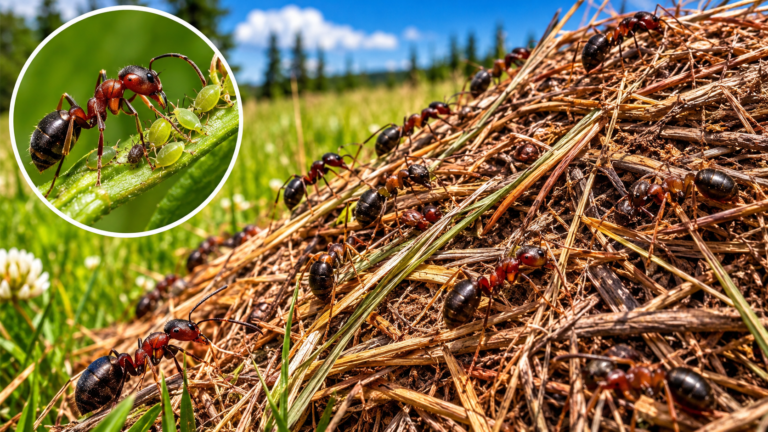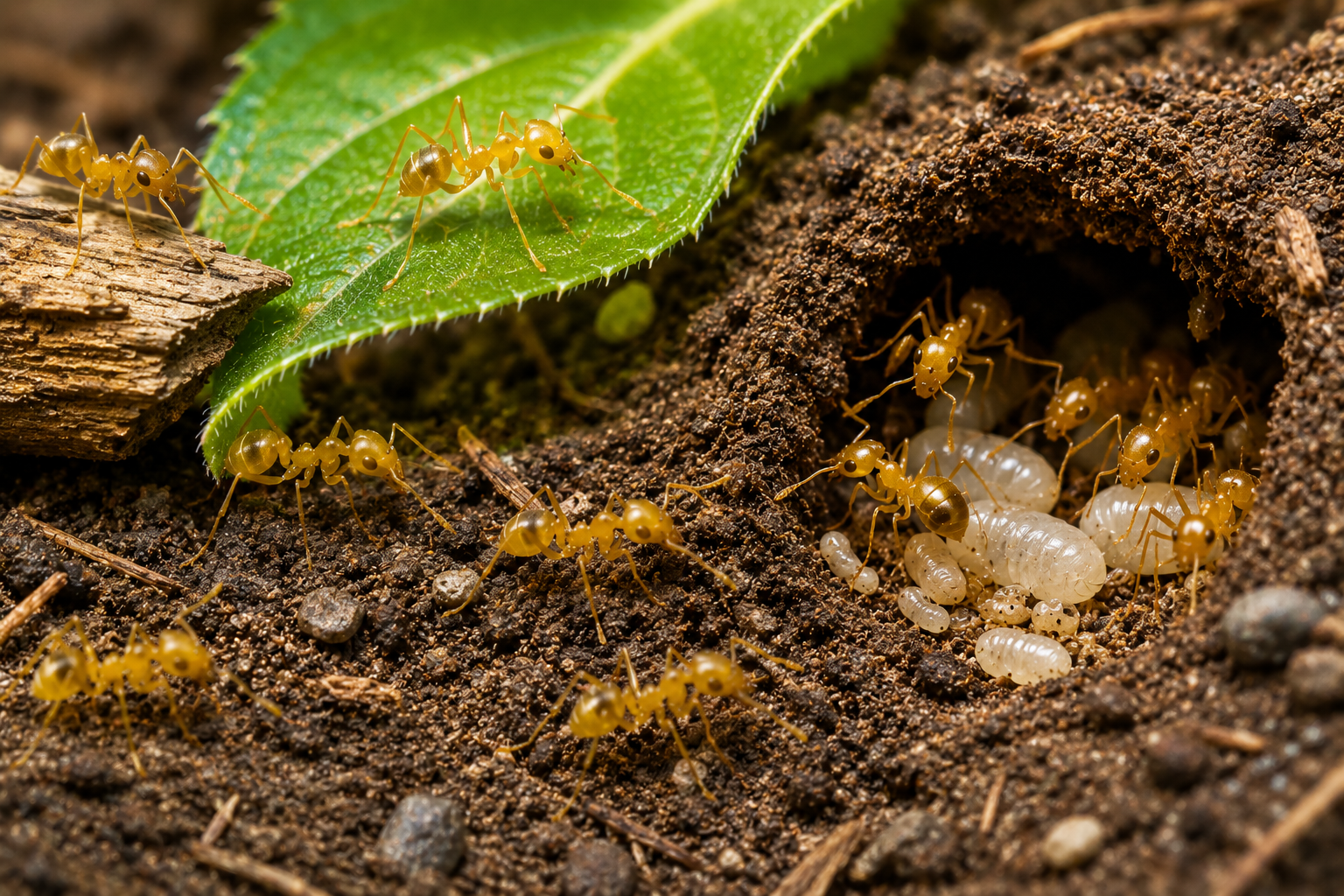
Citronella Ants in Alberta: Biology, Identification, Life Cycle and Habitat
Table of Contents
Citronella ants are small to medium-sized yellowish ants that can be found in parts of Alberta and across much of North America. They are best known for the distinctive citronella-like or lemony odor they can release when disturbed or crushed. Although citronella ants may occasionally appear around homes, they are primarily outdoor, soil-nesting ants and are not generally considered wood-destroying insects.
For homeowners in Calgary and throughout Alberta, understanding the biology of citronella ants, where they nest, what they eat, and why they sometimes appear indoors can help distinguish them from other common ants such as carpenter ants, odorous house ants, pavement ants, and Pharaoh ants.
What Are Citronella Ants?
The name citronella ant commonly refers to yellowish ants in the genus Lasius, particularly species such as Lasius claviger. They belong to the family Formicidae and are closely related to several other Lasius ants found in North America.
Citronella ants are usually associated with soil, lawns, gardens, wooded areas, and areas around building foundations. They spend much of their lives underground, which means homeowners may not notice them until colonies become active or winged reproductive ants emerge.
Their common name comes from the characteristic odor they can produce when disturbed. This odor is often described as resembling citronella, lemon, or a citrus-like smell.
What Do Citronella Ants Look Like?
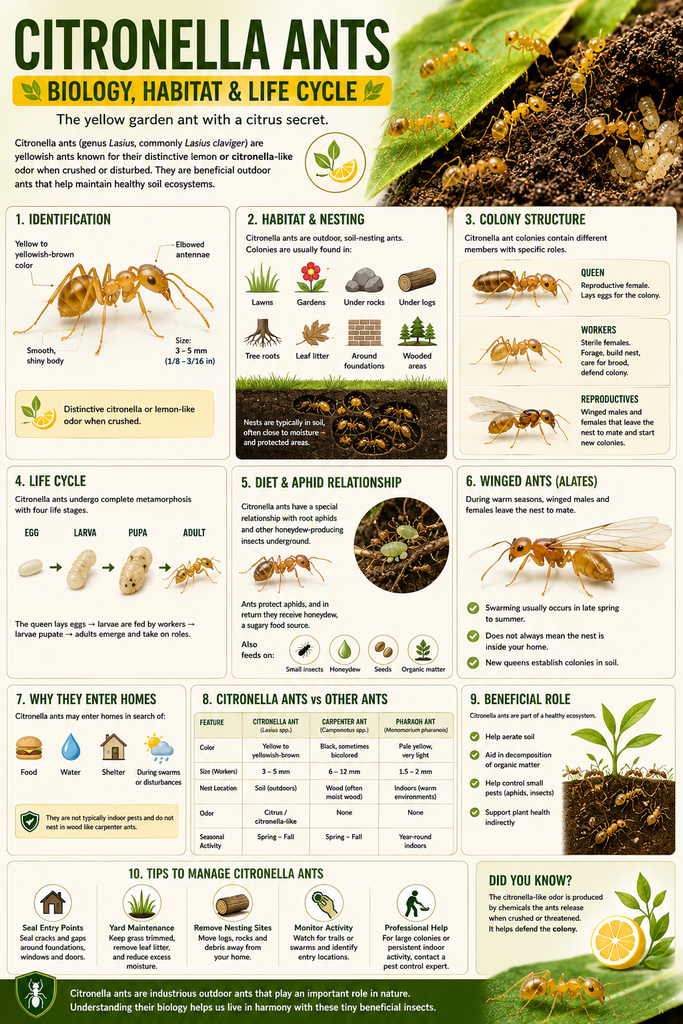
Citronella ants are generally yellow, yellowish-brown, or amber in colour, although their appearance can vary depending on the species and lighting.
Workers are typically larger than many of the tiny ants commonly found indoors. Their bodies have the typical three-part ant structure:
- Head
- Thorax
- Abdomen
They also have elbowed antennae, six legs, and strong mandibles.
Because several yellowish or light-coloured ants can look similar, colour alone should not be used to identify citronella ants. A combination of body characteristics, behaviour, nesting location, and seasonal activity provides a more reliable identification.
Why Are They Called Citronella Ants?
The name comes from the distinctive odor produced by the ants, particularly when they are crushed or disturbed. The smell can be noticeable when large numbers of ants are handled.
This characteristic can help distinguish citronella ants from some other ant species. However, odor should be considered only one identification clue because environmental conditions and individual perception can affect how the smell is noticed.
Where Do Citronella Ants Live?
Citronella ants are primarily outdoor, soil-nesting ants. Their colonies can occur in:
- Lawns
- Gardens
- Soil
- Under rocks
- Beneath logs
- Around tree roots
- Woodland areas
- Landscaping
- Areas near building foundations
They generally prefer protected locations where soil conditions provide suitable moisture and temperature.
In Alberta, citronella ants can be encountered in residential landscapes as well as natural environments.
Citronella Ants Around Calgary Homes
In Calgary, citronella ants may become noticeable around foundations, lawns, gardens, patios, and landscaped areas. Their activity can become more obvious during certain periods of the year, particularly when environmental conditions are favorable.
Occasionally, workers or reproductive ants may appear inside buildings. This does not necessarily mean that the ants have established a colony inside the house.
In many situations, ants found indoors are simply foraging or moving through an entry point from an outdoor nesting area.
Do Citronella Ants Nest Inside Houses?
Citronella ants are primarily outdoor ants and generally nest in soil rather than inside structural wood.
However, colonies can sometimes be located close to buildings, and ants may enter through cracks, gaps, foundation openings, or other entry points.
This is an important distinction from carpenter ants. Carpenter ants can excavate galleries in wood, while citronella ants are primarily associated with soil and underground nesting.
Citronella Ant Colony Structure
A citronella ant colony contains different members that perform specialized roles. These include workers, queens, and reproductive ants.
Worker ants are responsible for activities such as:
- Nest maintenance
- Caring for developing brood
- Foraging
- Colony defense
- Moving materials
- Supporting the queen
The queen’s primary biological function is reproduction. She produces eggs that develop into the next generation of ants.
Citronella Ant Life Cycle
Citronella ants undergo complete metamorphosis, meaning they develop through four distinct stages:
Egg → Larva → Pupa → Adult
The queen lays eggs inside the colony. The eggs hatch into larvae, which are cared for and fed by worker ants. The larvae then develop into pupae before emerging as adult ants.
Adult ants take on different roles within the colony depending on whether they are workers or reproductive individuals.
Citronella Ants and Winged Ants
One of the most noticeable events in the biology of citronella ants is the appearance of winged reproductive ants, also called alates.
These winged males and females leave mature colonies during reproductive periods. Homeowners may suddenly notice large numbers of winged ants around foundations, lawns, windows, or other areas.
A sudden appearance of winged ants does not automatically mean that the ants are nesting inside the building. They may be emerging from an outdoor colony nearby.
Correctly determining where the ants originated is an important part of identification.
What Do Citronella Ants Eat?
Citronella ants have an unusual relationship with aphids and other root-feeding insects.
Unlike many ants that are frequently observed collecting honeydew from aphids above ground, citronella ants can be associated with underground aphids and other honeydew-producing insects.
The ants obtain sugary secretions from these insects and, in return, provide protection and care.
This relationship is an important part of citronella ant biology and helps explain why their colonies are often located underground.
Citronella Ants and Aphids
The relationship between citronella ants and aphids is an example of mutualistic behaviour.
Aphids feed on plant roots and other plant material and can produce a sugary substance that ants use as food. The ants may protect the aphids from predators and maintain them within the colony’s underground environment.
This specialized relationship means citronella ants may spend considerable time underground rather than constantly appearing on the surface.
Why Do Citronella Ants Sometimes Enter Buildings?
Citronella ants may enter structures for several reasons, including:
- Searching for food
- Searching for moisture
- Exploring new areas
- Environmental changes
- Disturbance of an outdoor colony
- Entry through foundation cracks or other openings
Finding citronella ants indoors does not automatically indicate a structural infestation.
The location of the colony, the number of ants present, and whether activity is persistent are all important factors when evaluating the situation.
Citronella Ants in Alberta During Winter
Alberta’s cold winters have a major effect on outdoor insect activity. Citronella ant colonies survive the winter in protected underground locations where temperatures are more stable than at the soil surface.
During colder periods, visible ant activity decreases significantly. As temperatures increase in spring, colonies become active again.
This seasonal pattern is very different from indoor-adapted species such as Pharaoh ants, which can remain active year-round inside heated buildings.
Are Citronella Ants Dangerous?
Citronella ants are generally considered a nuisance rather than a dangerous pest.
They are not known for causing the type of structural wood damage associated with carpenter ants. Their primary concern around homes is usually their presence in large numbers or their occasional entry into buildings.
They can become particularly noticeable when winged reproductive ants emerge in large numbers.
Citronella Ants vs. Carpenter Ants
It is important not to confuse citronella ants with carpenter ants.
Citronella ants are generally yellowish and primarily nest underground in soil.
Carpenter ants are considerably larger and commonly nest in wood, particularly wood affected by moisture or decay. Carpenter ants can excavate galleries in wood to create nesting areas.
If large ants are repeatedly associated with damaged or moisture-affected wood, carpenter ants may be a more likely concern than citronella ants.
Citronella Ants vs. Pharaoh Ants
Citronella ants and Pharaoh ants can also be confused because both can have yellowish coloration.
However, Pharaoh ants are much smaller and are strongly associated with warm indoor environments. Pharaoh ants can establish persistent colonies inside heated buildings.
Citronella ants are generally larger, soil-nesting outdoor ants that become active seasonally in Alberta.
Correct identification is particularly important because their biology and nesting behaviour are very different.
Frequently Asked Questions About Citronella Ants
What is a citronella ant?
A citronella ant is a yellowish ant in the genus Lasius, with Lasius claviger being one of the species commonly associated with the name. They are primarily outdoor, soil-nesting ants.
Why do citronella ants smell like citronella?
When disturbed or crushed, citronella ants can release a distinctive odor that is often described as citrus-like, lemony, or similar to citronella.
Are citronella ants found in Alberta?
Yes. Citronella ants can occur in Alberta and may be encountered in lawns, gardens, soil, wooded areas, landscaping, and around building foundations.
Are citronella ants common in Calgary?
Citronella ants can occur in Calgary-area landscapes and other suitable Alberta habitats. Their visibility depends on local environmental conditions, colony location, and seasonal activity.
Do citronella ants damage houses?
Citronella ants are not considered wood-destroying ants like carpenter ants. They primarily nest in soil and underground environments.
Can citronella ants enter homes?
Yes. Individual ants or reproductive ants can occasionally enter buildings, particularly when colonies are located close to foundations or when ants find suitable entry points.
Do citronella ants nest in walls?
They are primarily soil-nesting ants rather than indoor wall-nesting ants. If ants are repeatedly emerging from wall voids or other concealed indoor locations, accurate species identification is important.
What do citronella ants eat?
Citronella ants can obtain food from underground relationships with aphids and other honeydew-producing insects. They may also consume other available food sources.
Why are there winged citronella ants around my house?
Winged ants are reproductive males and females. Their appearance can indicate that a mature colony nearby is producing reproductive ants. Their presence does not necessarily mean the colony is inside the house.
Do citronella ants bite?
Citronella ants are generally not considered an aggressive biting or stinging pest. They are primarily a nuisance when present in large numbers.
What is the life cycle of a citronella ant?
Citronella ants undergo complete metamorphosis: egg, larva, pupa, and adult.
Are citronella ants beneficial?
Yes. Like many ants, citronella ants participate in soil ecosystems and interact with other organisms. Their underground activities can contribute to nutrient cycling and soil processes.
How can I tell citronella ants from carpenter ants?
Citronella ants are generally yellowish and associated with underground soil nests. Carpenter ants are much larger and can excavate galleries in wood, particularly damp or damaged wood.
How can I tell citronella ants from Pharaoh ants?
Citronella ants are generally larger and primarily outdoor soil-nesting ants. Pharaoh ants are extremely small, yellowish ants that are highly adapted to warm indoor environments.
Conclusion: Understanding Citronella Ant Biology
Citronella ants are fascinating soil-nesting ants found in Alberta that play an important role in outdoor ecosystems. Their yellowish appearance, distinctive odor, underground colonies, relationship with root-associated aphids, and seasonal activity make them quite different from many of the ants commonly encountered inside homes.
For Calgary homeowners, seeing citronella ants around a foundation or lawn does not necessarily mean there is an indoor infestation. Understanding where citronella ants nest, how their colonies develop, why winged ants appear, and how they differ from carpenter ants and Pharaoh ants is essential for accurate identification.
When ant activity continues or the species cannot be confidently identified, a professional inspection can help determine whether the ants are simply foraging from an outdoor colony or whether there is a larger pest-management concern.