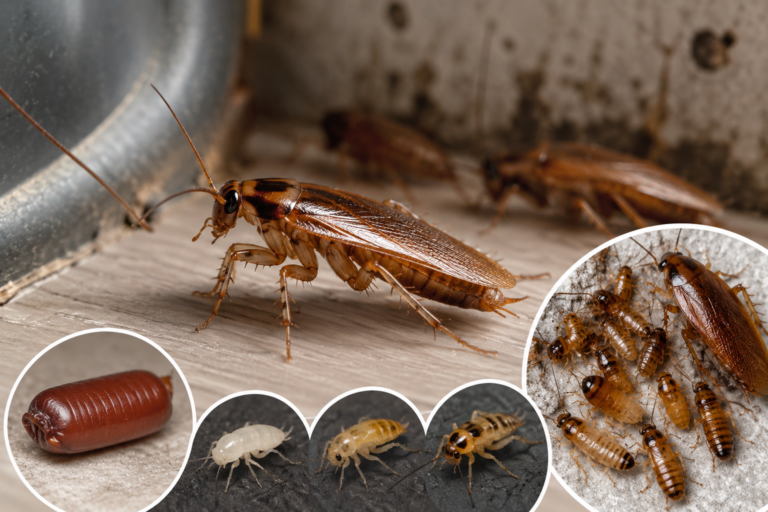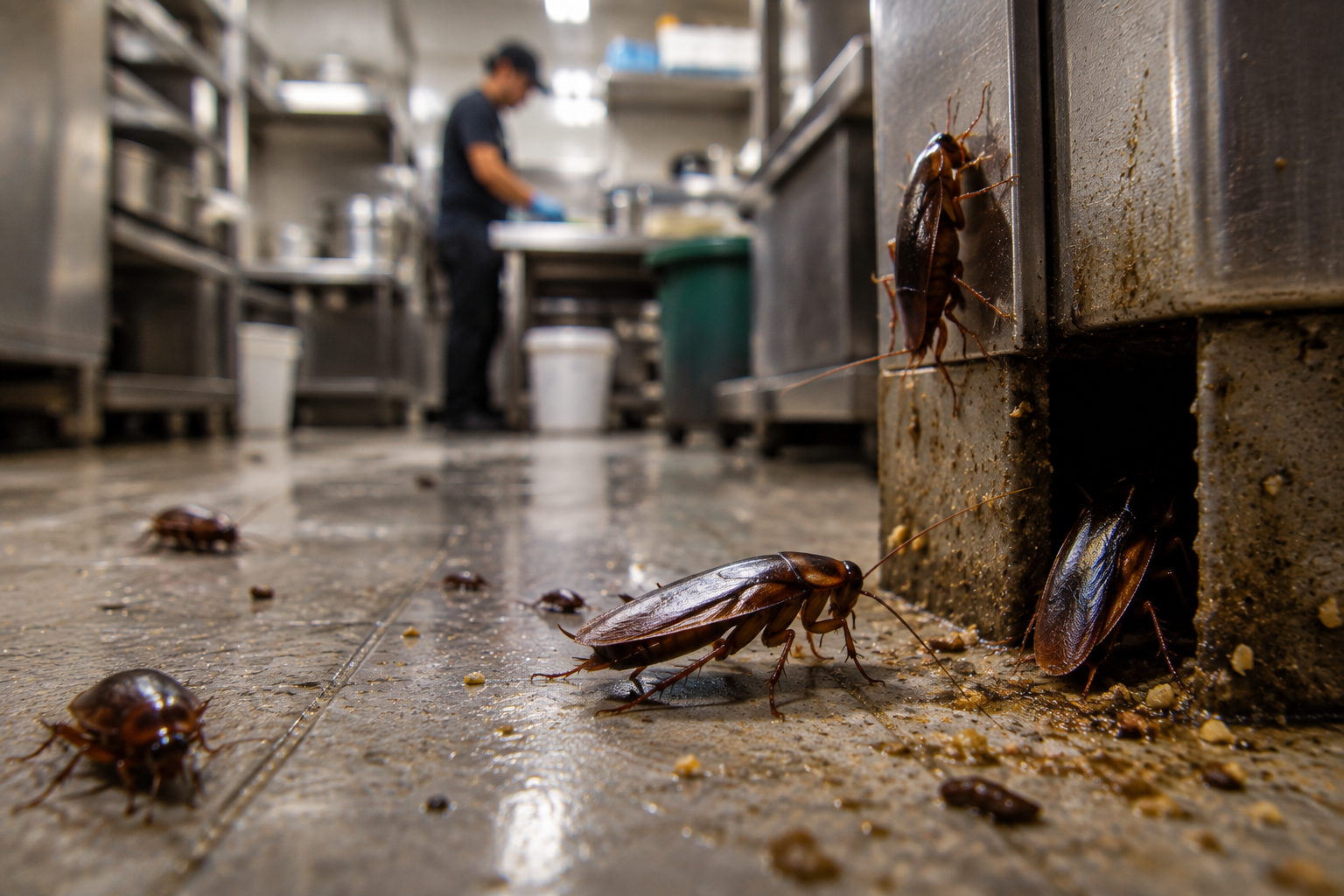
Still Seeing Cockroaches Despite Monthly Pest Control? Here’s What Commercial Businesses Should Do
Table of Contents
For a commercial business, discovering cockroaches after paying for monthly pest control can be frustrating. You may be asking yourself: “If we already have a pest control company coming every month, why are we still seeing cockroaches?”
The answer is not always that pest control does not work. Cockroach activity can continue because of building conditions, sanitation, neighboring areas, food sources, hidden harbourages, technician experience, treatment strategy, or insufficient follow-up.
Monthly service should be more than simply showing up, checking a few monitoring devices, applying a treatment, and leaving. Effective commercial cockroach management requires inspection, monitoring, treatment, sanitation recommendations, communication, documentation, and a strategy for reducing the conditions that allow cockroaches to survive and spread.
Related Guide: Learn more about [Cockroaches in Calgary: Identification, Biology, Prevention & Control].
Some Pest Control Programs Focus More on the Monthly Contract Than the Results
One reason a commercial property may continue to experience cockroach activity is that the pest control provider may be operating around the service schedule rather than actively managing the infestation.
The cheapest monthly quote can look attractive when comparing pest control companies. However, a low monthly price does not necessarily mean good value.
A commercial cockroach control program should involve more than a scheduled visit. The technician should look for evidence of activity, identify harbourage areas, inspect food and moisture sources, check vulnerable locations, monitor activity, document findings, and communicate recommendations to the customer.
If every monthly visit looks exactly the same regardless of the level of cockroach activity, the program may have become a routine service instead of an active pest-management strategy.
For a business owner, the important question should not simply be:
“How much does the monthly service cost?”
Instead, ask:
“What am I receiving for that monthly service, and is it actually reducing cockroach activity?”
A provider that actively investigates the source of the problem may provide considerably more value than a company that simply performs the same routine service every month.
Technician Experience Can Make a Significant Difference
Another factor to consider is the experience of the technician assigned to the property.
Commercial cockroach control can be challenging because cockroaches may remain hidden in cracks, equipment voids, wall spaces, cabinets, drains, storage areas, and other protected locations.
An inexperienced technician may see cockroach activity and concentrate only on the location where the insects were observed.
An experienced technician should be thinking more broadly:
- Where are the cockroaches coming from?
- Where are they hiding?
- Where are food and moisture available?
- Are there areas with heavy activity?
- Are there gaps or harbourage areas around equipment?
- Are recurring activity locations being investigated?
- Has activity increased or decreased since the previous visit?
- Are neighboring areas contributing to the problem?
- What recommendations should be provided to the business?
This difference can be important.
Simply treating the location where cockroaches were seen may reduce visible activity temporarily without addressing the conditions that allow the infestation to continue.
Monthly Pest Control Does Not Automatically Make a Business Cockroach-Free
It is also important for commercial customers to understand that pest control is only one part of cockroach management.
A successful commercial cockroach-control program may require cooperation between the pest control provider, management, employees, maintenance personnel, and cleaning staff.
For example, a restaurant may have regular pest control service but continue to experience cockroach activity because food debris, grease, moisture, clutter, or difficult-to-clean areas provide favourable conditions.
A commercial kitchen may also have equipment, drains, wall voids, storage areas, and other locations that provide shelter for cockroaches.
In multi-unit buildings, cockroaches can also move between connected areas through wall voids, utility penetrations, service spaces, or other pathways.
This is why communication is so important.
The pest control technician should explain what was found, where activity is occurring, what was done during the visit, and what the business should do next.
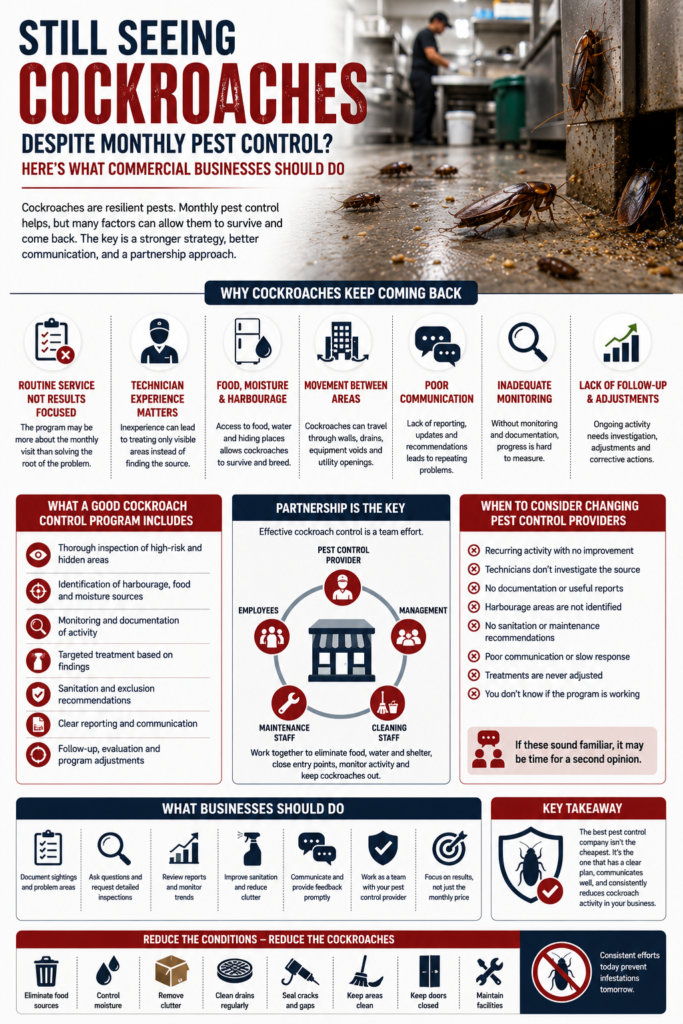
Cockroach Activity Should Be Monitored—Not Just Treated
A good commercial pest-management program should use monitoring to help determine whether the situation is improving.
Monitoring can help identify:
- Areas with recurring cockroach activity
- Locations where activity is increasing
- Potential harbourage areas
- Areas requiring additional investigation
- Changes between service visits
- Whether corrective recommendations are working
- Whether additional treatment or follow-up is necessary
Without documentation and monitoring, it can be difficult for a business owner to determine whether the infestation is actually improving.
Seeing fewer cockroaches is encouraging, but a professional program should also look at the overall trend and evidence collected over time.
Sanitation and Maintenance Are Part of Cockroach Control
Cockroaches need access to food, moisture, shelter, and suitable hiding areas.
Even an effective pest-control program can become more difficult when these conditions remain available.
Businesses should review areas such as:
- Food preparation areas
- Storage rooms
- Garbage and recycling areas
- Break rooms
- Dishwashing areas
- Under and behind equipment
- Floor drains
- Moisture-prone locations
- Cardboard and clutter
- Wall penetrations
- Damaged seals and gaps
- Areas that are difficult to clean
The pest control company should communicate practical recommendations rather than simply reporting that cockroaches were found.
The goal should be to reduce the conditions that support the infestation.
When Should a Business Consider Changing Pest Control Providers?
Changing providers should not necessarily be the first step after seeing a cockroach.
One sighting does not automatically mean the pest control company is doing a poor job.
However, if cockroach activity continues month after month without meaningful improvement, it is reasonable to evaluate whether the current provider is delivering the service the business is paying for.
Consider asking:
Are recurring cockroach locations being investigated?
Are monitoring results being documented?
Are harbourage areas being identified?
Are sanitation and maintenance recommendations being provided?
Does the technician explain what changed since the previous visit?
Is the treatment strategy adjusted when activity continues?
Does the company respond when the business reports continued activity?
Are service reports useful and detailed?
If the answer to most of these questions is no, it may be time to have a serious conversation with the current provider or obtain a second professional opinion.
Switching Providers Can Be a Useful Evaluation
For some businesses, changing providers and evaluating the results over several months can help determine whether service quality is making a difference.
The key is to establish a baseline before making the change.
Document:
- Where cockroaches have been observed
- How frequently they are being seen
- Locations with recurring activity
- Monitoring results
- Areas where evidence has been discovered
- Previous recommendations
- Previous treatments
- Communication and response times
Then ask the new provider to establish a clear starting point and develop a documented management strategy.
During the evaluation period, track:
- Cockroach sightings
- Monitoring-device activity
- Recurring problem areas
- Harbourage locations
- Sanitation concerns
- Maintenance issues
- Recommendations provided
- Corrective actions completed
- Follow-up inspections
- Overall activity trends
The goal is not simply to determine whether the new company is cheaper.
The real question is:
“Has the quality and effectiveness of our cockroach-management program improved?”
Compare the Process—Not Just the Price
One of the biggest mistakes businesses can make is comparing commercial pest control companies only by monthly price.
Instead, compare the process.
A strong commercial pest-control provider should be able to explain:
- What they are inspecting
- What they are finding
- Where activity is occurring
- What treatment or management strategy is being used
- What the business needs to correct
- How activity will be monitored
- What happens if the problem continues
If one company says, “We come once a month and treat the areas,” while another says, “We will inspect, monitor activity, identify harbourages, document findings, provide recommendations, and track changes,” the second approach may provide considerably more value.
The difference may not be obvious after one visit.
But over several months, the quality of the program should become easier to evaluate.
Don’t Ignore Recurring Cockroach Activity
For commercial businesses, recurring cockroach activity should not simply be accepted as normal because the property has a monthly pest-control contract.
Depending on the type of business, cockroach activity can create concerns involving sanitation, food safety, employee confidence, customer perception, property management, and regulatory expectations.
A monthly contract is only valuable if the service behind it is effective.
If cockroaches continue to appear, businesses should ask questions, request detailed inspections, review service reports, and determine whether the current provider has a clear strategy for improvement.
If the answers are not satisfactory, getting a second professional opinion may be worthwhile.
The Bottom Line
If your commercial business continues to experience cockroaches despite monthly pest control, don’t automatically assume that you need more frequent treatments.
First, determine why the cockroaches are still there.
The problem could involve food and moisture sources, harbourage areas, building conditions, sanitation, hidden pathways, neighboring areas, ineffective monitoring, poor communication, inadequate follow-up, or a pest-control program that is focused more on completing monthly visits than managing the underlying problem.
If your current provider cannot clearly explain what is happening and what they are doing to improve the situation, it may be time to consider another professional opinion.
The best commercial pest-control company is not necessarily the one offering the lowest monthly price.
It is the company that can demonstrate that its inspection, monitoring, treatment, communication, and prevention strategy is making a measurable difference.
Frequently Asked Questions
1. Why am I still seeing cockroaches if my business has monthly pest control?
Monthly pest control does not automatically eliminate every source of cockroach activity. Cockroaches may remain in hidden harbourage areas, access food and moisture, move through building pathways, or be introduced from other areas. A professional program should investigate why activity continues and adjust the management strategy when necessary.
2. Does seeing a cockroach mean my pest control company is doing a bad job?
Not necessarily. An occasional cockroach sighting does not automatically mean the service is ineffective. However, recurring activity without meaningful improvement should prompt a review of the inspection, monitoring, treatment, sanitation, and follow-up process.
3. What should a commercial pest control technician look for?
A technician should look beyond the location where cockroaches were seen. An inspection may include kitchens, equipment areas, storage rooms, drains, moisture sources, cracks and gaps, wall penetrations, garbage areas, and other potential harbourage locations.
4. Why does technician experience matter?
Cockroaches can hide in difficult-to-access areas and may not always be visible during a routine inspection. An experienced technician may be better equipped to recognize activity patterns, investigate likely harbourage areas, and recommend practical corrective actions.
5. Is the cheapest monthly pest control service the best option?
Not necessarily. Price is important, but it should not be the only consideration. A low-cost program that does not reduce recurring cockroach activity may ultimately provide less value than a program with stronger inspection, monitoring, reporting, and follow-up.
6. Should I ask my current pest control company to fix the problem before switching?
Yes. Start by clearly communicating the recurring activity and asking the provider to investigate the problem. Ask for an explanation and corrective plan. Give the provider an opportunity to respond. If the problem continues without meaningful improvement, consider obtaining another professional opinion.
7. When should a business consider switching pest control companies?
Consider changing providers when recurring cockroach activity continues despite regular service, inspections appear superficial, communication is poor, recommendations are not being provided, recurring areas are not investigated, or the provider cannot explain why the problem continues.
8. How can I compare two commercial pest control companies?
Don’t compare only monthly prices. Compare the inspection process, technician experience, monitoring strategy, treatment approach, documentation, communication, recommendations, follow-up, and overall approach to preventing recurring cockroach activity.
9. How long should I give a new pest control provider to see whether things improve?
Every commercial property is different. The appropriate evaluation period depends on the severity of the infestation, building conditions, sanitation, cooperation from staff, and the management strategy being implemented. Establishing a baseline and tracking activity over multiple service visits can provide useful information.
10. What should I measure during an evaluation?
Track cockroach sightings, monitoring activity, recurring locations, sanitation concerns, harbourage areas, corrective recommendations, completed maintenance work, service quality, communication, and the overall trend in activity.
11. What if the new company is more expensive?
A higher price does not automatically mean better service, just as a lower price does not automatically mean poor service. The important question is whether the provider delivers better value and demonstrates a stronger management process.
12. Can pest control eliminate cockroaches without fixing building problems?
Long-term cockroach management can be more difficult when favourable conditions remain. Food debris, moisture, clutter, cracks, gaps, equipment voids, and other harbourage opportunities can contribute to recurring activity. Pest management should be combined with appropriate sanitation and maintenance measures.
13. Should my business get a second opinion?
If cockroach activity continues despite regular service and you are unsure whether the current provider is addressing the underlying problem, a second professional opinion can be useful. Another inspection may identify conditions or opportunities that have been overlooked.
14. What should I expect from a good commercial pest control provider?
You should expect professional communication, regular inspections, monitoring, documentation, identification of contributing conditions, practical recommendations, appropriate follow-up, and a clear strategy for managing recurring activity.
The provider should be able to explain:
What did we find?
What did we do?
What needs to happen next?
Is the situation improving?
15. What is the most important question to ask my pest control company?
Ask:
“What is your plan to reduce and prevent the cockroach activity at our property—not just treat the cockroaches we are currently seeing?”
The answer can tell you a great deal about whether the provider is simply performing a monthly service or actively managing the underlying cockroach problem.
If you are dealing with recurring cockroach activity, learn more about professional Cockroach Control Calgary from Pest Pro Exterminator.