Why the Pest Control Technician Matters in Commercial Pest Management
Table of Contents
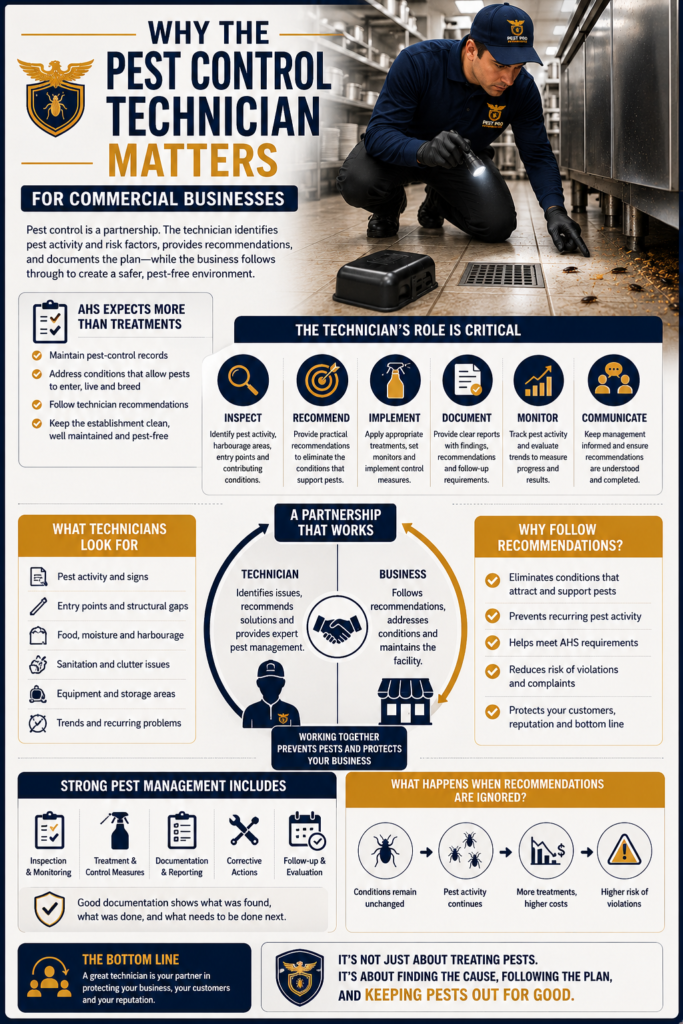
For commercial businesses, especially restaurants, food-service operations, warehouses, and other regulated environments, the pest control technician plays an important role in identifying pest activity and communicating the conditions that need to be corrected. Monthly pest control is not simply about placing traps or treating an area. The technician is often the person who observes where pest activity is occurring, identifies potential entry points and harbourage areas, and provides recommendations to help the business reduce the conditions that support pests.
AHS Looks at More Than Whether a Pest Control Company Was Called
For Alberta food establishments, pest control is part of the broader food-safety and sanitation requirements. Alberta Health Services inspection information shows that businesses can be cited when pests or conditions that allow pests to harbour or breed are present. AHS inspection records also emphasize maintaining written records of pest-control measures and addressing conditions such as gaps that allow pest entry.
This means having a pest control company visit the property does not necessarily mean the pest-control responsibility is finished. The recommendations resulting from the inspection may also require action by the business.
The Technician’s Recommendations Can Be Extremely Important
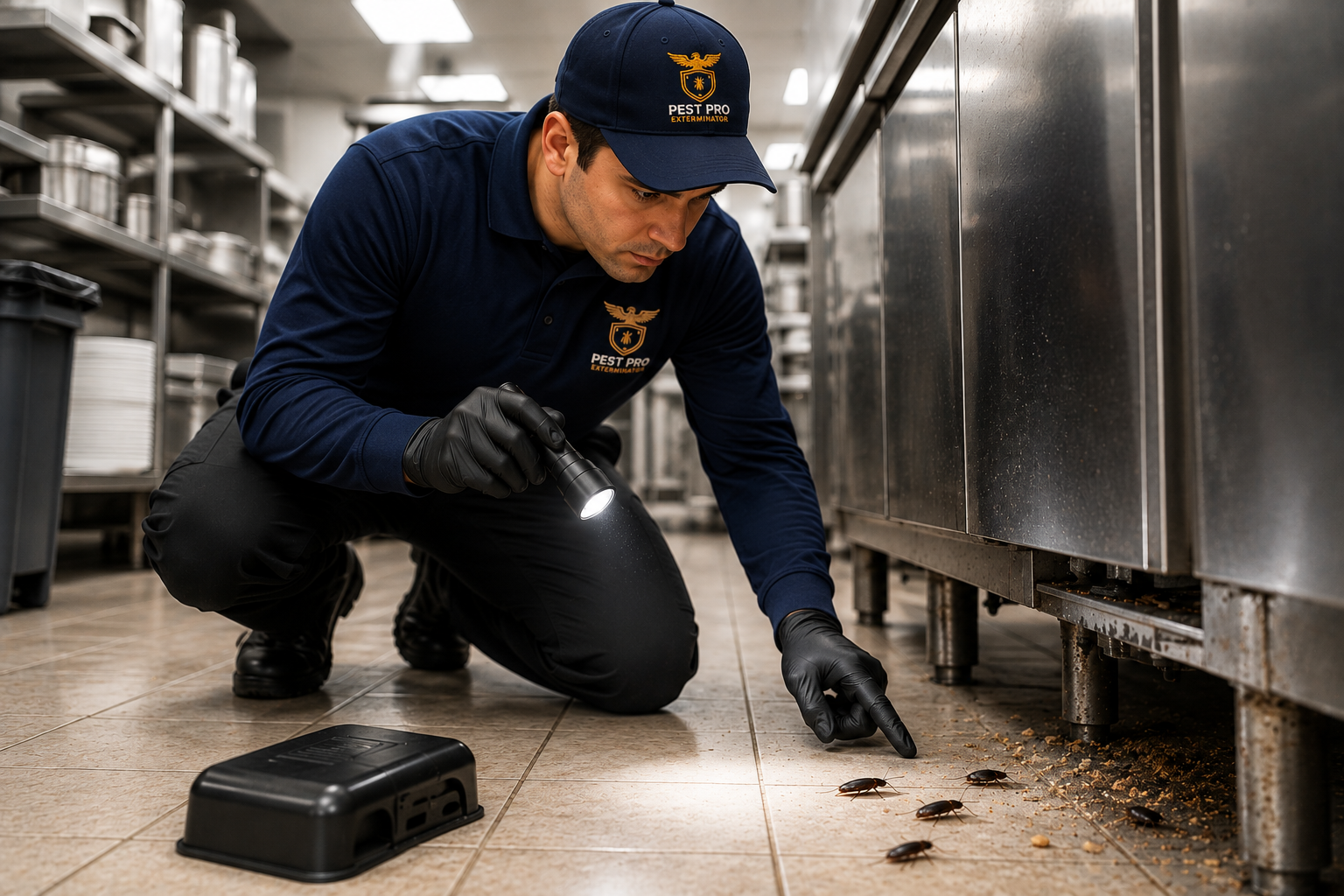
During a commercial pest inspection, a technician may identify conditions that contribute to pest activity, such as gaps around doors, damaged weatherstripping, openings around pipes, food debris, moisture, clutter, or areas that are difficult to clean.
A professional report should clearly communicate these findings to management.
For example, an AHS inspection record specifically identified pest-control documentation and sealing gaps where mice could enter as issues requiring attention. Another AHS inspection record identified a gap at an exterior door that could allow pests to enter and required the business to address the condition.
The technician’s job therefore extends beyond treating the pest. The technician needs to help identify the conditions that allow the pest problem to continue.
Following Recommendations Is Part of the Solution
A pest control program works best when the pest control provider and the business work together.
If a technician recommends repairing a damaged door seal, sealing a wall opening, correcting sanitation problems, removing unnecessary clutter, improving garbage management, or addressing moisture, those recommendations should not simply remain in the service report.
They should be reviewed, assigned, and completed.
AHS inspection documentation demonstrates why this matters. In one recent Calgary inspection, the operator was instructed to hire pest control, ensure recommendations were completed, maintain pest-control records, and repair doors to prevent pest entry.
Pest Control Reports Should Tell a Story
A good commercial pest-control report should help management understand what happened during the visit.
The report should ideally communicate:
- What pest activity was observed
- Where the activity was found
- What areas were inspected
- What control measures were implemented
- What conditions may be contributing to the problem
- What recommendations were provided
- What the business needs to correct
- What should be monitored during the next visit
This documentation becomes especially important when a business needs to demonstrate that it has an active pest-management program.
AHS materials and inspection records emphasize the importance of maintaining written pest-control records for commercial food establishments.
A Technician Should Not Simply Say “Treat Again”
When pest activity continues, the answer should not automatically be another identical treatment.
Recurring activity should trigger additional questions:
Where is the pest coming from?
Why is it continuing?
Has the activity changed since the previous visit?
Were previous recommendations completed?
Are there new conditions contributing to the problem?
Does the treatment strategy need to be adjusted?
This is where technician experience becomes particularly valuable. A technician who documents patterns and communicates clearly can help management understand the difference between an isolated pest sighting and an ongoing condition that requires corrective action.
Businesses Also Have a Responsibility
It is important to recognize that pest control is a partnership.
A pest control technician cannot repair every structural problem, clean every area, correct every sanitation issue, or control every condition inside a commercial property.
The business must also act on reasonable recommendations.
AHS inspection records demonstrate this shared responsibility. Inspection findings can involve pest-control records, sanitation, building maintenance, food storage, pest entry points, and other conditions that contribute to pest problems.
The strongest programs therefore involve cooperation between management, employees, maintenance staff, cleaning personnel, and the pest control provider.
What Happens When Recommendations Are Ignored?
When recommendations are repeatedly ignored, the pest problem can become difficult to resolve.
For example, a pest control company may identify a gap beneath a door, but if the gap remains open, pests may continue to enter. A technician may identify food debris beneath equipment, but if the area is not cleaned, the food source remains available.
In these situations, repeated pest activity does not necessarily mean that the pest control company is failing.
Sometimes the underlying conditions have simply not been corrected.
AHS Inspection Findings Can Make Documentation Even More Important
For commercial food establishments, documentation can become particularly important when pest activity is identified during an inspection.
AHS inspection records have required businesses to provide pest-control documentation, treatment reports, pest activity information, implemented control measures, and future pest-management plans in certain circumstances.
This is why a professional pest control company should provide meaningful service reports rather than simply marking a visit as completed.
Good documentation can demonstrate what was found, what was done, and what remains to be corrected.
The Best Technician Is Looking Beyond the Pest
The value of a commercial pest control technician is not simply measured by how many traps were checked or how much product was applied.
A strong technician should be looking at the whole pest-management picture.
That means identifying pest activity, investigating contributing conditions, communicating recommendations, documenting service, monitoring changes, and following up on unresolved problems.
For a business, this can make the difference between repeatedly treating symptoms and developing a structured strategy to reduce recurring pest activity.
The Bottom Line
For commercial businesses, the pest control technician matters because the technician is often the connection between pest activity and the corrective actions needed to address it.
AHS inspection information makes it clear that commercial food establishments are expected to maintain pest-control records and keep the establishment free from pests and conditions that support pest harbourage or entry.
Therefore, a good commercial pest-control program should not end when the technician leaves the property.
The technician should provide clear recommendations.
Management should review and implement those recommendations.
The technician should document the results.
And future inspections should determine whether the situation is improving.
The goal is not simply to treat pests every month. The goal is to create a documented, proactive pest-management program that identifies problems, communicates solutions, and follows through on corrective actions.
Frequently Asked Questions: Why the Pest Control Technician Matters for Commercial Businesses
1. Why is the pest control technician important for a commercial business?
A pest control technician does more than treat visible pests. The technician should inspect the property, identify pest activity and contributing conditions, provide recommendations, document findings, and help develop a strategy to reduce recurring pest problems.
2. Does Alberta Health Services look at pest control recommendations?
Yes. For applicable commercial food establishments, pest management is part of maintaining sanitary conditions. Pest-control documentation, pest activity, corrective actions, and conditions that may allow pests to enter or harbour can be relevant during an inspection.
3. Why should a business follow the pest control technician’s recommendations?
Recommendations may identify conditions that are allowing pests to enter, survive, or reproduce. Examples can include sealing gaps, repairing door sweeps, improving sanitation, correcting moisture problems, reducing clutter, or addressing other harbourage conditions.
4. Is hiring a pest control company enough to satisfy pest-control requirements?
Not necessarily. Pest management is a shared responsibility. The pest control company provides inspection, monitoring, treatment, documentation, and recommendations, while the business must address applicable sanitation, maintenance, structural, and operational conditions identified during the service.
5. What should a commercial pest control technician inspect?
Depending on the pest and property, an inspection may include kitchens, storage areas, garbage areas, equipment, drains, doors, wall penetrations, cracks, gaps, moisture sources, food-storage areas, harbourage locations, and other areas where pest activity may occur.
6. What should be included in a commercial pest control service report?
A useful report should identify pest activity, areas inspected, control measures performed, conditions contributing to pest activity, recommendations, and follow-up requirements. Clear documentation helps management understand what was found and what needs to happen next.
7. Why is technician experience important?
Commercial pest problems can involve hidden harbourage areas, structural entry points, sanitation conditions, equipment, and movement between different areas of a building. An experienced technician may be better able to recognize activity patterns and identify conditions that require corrective action.
8. What happens if a business does not follow pest control recommendations?
If contributing conditions remain unchanged, pest activity may continue even when regular pest-control service is being provided. For example, an unsealed opening can continue allowing rodents to enter, while food debris or moisture can continue supporting cockroach activity.
9. Can a pest control technician repair every pest-related problem?
No. A technician can identify and recommend corrective actions, but the business may need to involve maintenance staff, contractors, cleaning personnel, or management to complete structural repairs, sanitation improvements, or other corrective measures.
10. Why is documentation important for commercial pest control?
Documentation creates a record of pest activity, inspections, treatments, recommendations, and follow-up. For commercial food establishments, maintaining appropriate pest-control records can also be important when demonstrating an active pest-management program.
11. What should a business do when the same pest problem keeps coming back?
The business should ask the pest control provider to investigate the recurring activity rather than simply repeating the same treatment. Management should review previous recommendations, confirm whether they were completed, and determine whether additional inspection or changes to the pest-management strategy are necessary.
12. Should pest control recommendations be assigned to someone at the business?
Yes. When practical, recommendations should be reviewed by management and assigned to the appropriate person or department. This can help ensure that maintenance, sanitation, and operational issues are actually corrected.
13. Does seeing a pest automatically mean the pest control company is doing a poor job?
No. Pest activity can occur for many reasons, including pest entry, deliveries, neighbouring properties, sanitation conditions, structural openings, or other environmental factors. The important question is whether the pest control provider is identifying the problem, communicating findings, and taking appropriate corrective action.
14. What should management ask the pest control technician after each visit?
Useful questions include:
- What did you find?
- Where was the activity located?
- What did you do during the visit?
- Did you identify any entry points or harbourage areas?
- Are there sanitation or maintenance concerns?
- What recommendations do we need to follow?
- Has activity increased or decreased?
- What should we expect at the next inspection?
15. Why should pest control recommendations be followed before the next inspection?
Completing recommendations allows the technician to determine whether the corrective action reduced pest activity. It also helps prevent the same conditions from continuing to contribute to the problem.
16. What is the difference between treating pests and managing pests?
Treating pests focuses on controlling the pest that is currently present. Pest management takes a broader approach by identifying the source or contributing conditions, monitoring activity, implementing control measures, recommending corrective actions, and evaluating whether the problem is improving.
17. Can good pest control reduce the risk of problems during an AHS inspection?
A proactive pest-management program can help a business maintain better documentation, identify pest-related conditions, and address problems before they become larger concerns. However, pest control does not guarantee a specific inspection outcome, and businesses remain responsible for meeting applicable health and sanitation requirements.
18. What is the most important question to ask a commercial pest control technician?
Ask:
“What conditions are allowing the pest problem to continue, and what do we need to do to correct them?”
This question shifts the focus from simply treating pests to understanding and addressing the underlying conditions.
19. What makes a strong commercial pest control program?
A strong program should combine inspection, monitoring, treatment, documentation, communication, recommendations, corrective actions, and follow-up.
The pest control technician and the business should work together toward the same goal: reducing pest activity and preventing recurring problems.
20. What is the bottom line for commercial businesses?
A pest control technician is an important part of a commercial pest-management program, but successful pest control requires cooperation from the entire business.
The technician identifies and communicates the problem. The business follows through on the recommendations. Together, they create a more effective and documented approach to pest prevention.