Why Commercial Businesses—Especially Food Businesses—Should Have a Regular Pest Control Program
Table of Contents
For a commercial business, pest control should not be treated as something to call for only after a mouse, cockroach, fly, or other pest is discovered. A proactive pest-management program helps identify pest activity early, document findings, correct conditions that attract pests, and reduce the risk of an infestation becoming a larger business problem. This is especially important for restaurants, commercial kitchens, grocery stores, food processors, warehouses handling food, and other food establishments.
Is Monthly Pest Control Legally Required in Alberta?
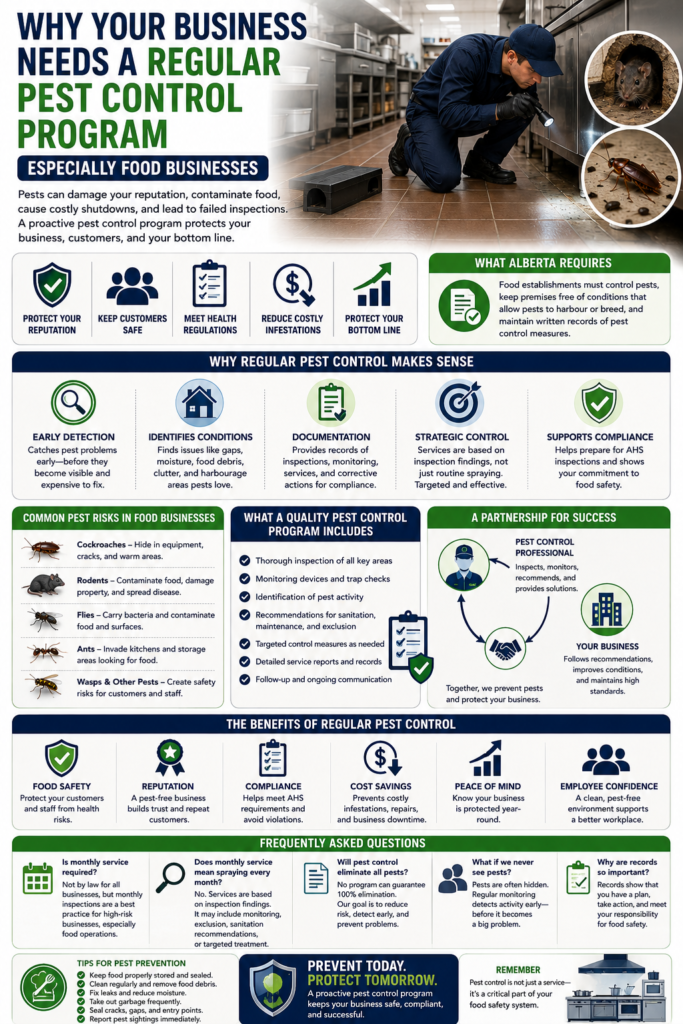
An important distinction is necessary: Alberta’s requirements do not establish a blanket rule that every commercial business must have a pest-control technician visit exactly once every month. Instead, food establishments are required to control pests and maintain written records of pest-control measures. Alberta’s Food Regulation requires commercial food establishments and supporting areas to be kept free of pests and conditions that allow pests to harbour or breed, and requires written records of pest-control measures to be maintained.
Therefore, monthly service should be viewed as a risk-based preventive program and strong operating practice, rather than claiming that Alberta law universally mandates one professional visit every month.
Why Monthly Service Makes Sense for Food Businesses
Food businesses create many of the conditions pests need: food, water, warmth, shelter, equipment, storage areas, drains, garbage, and frequent deliveries. Even when employees maintain good sanitation, conditions can change quickly.
A monthly professional inspection creates a regular opportunity to look for early signs of activity before the problem becomes obvious.
Alberta food-safety guidance emphasizes prevention, monitoring, and control as components of effective pest management. It also recommends regular monitoring for signs such as droppings, insect evidence, damage to packaging, and other indicators of pest activity.
Prevention Is Better Than Waiting for an Infestation
Waiting until employees see cockroaches running across a kitchen floor or a mouse appears in a storage area can mean the problem has already progressed.
Pests can remain hidden for considerable periods, particularly around equipment, wall voids, storage areas, drains, utility penetrations, and other protected locations.
A preventive program focuses on identifying conditions before they become major problems.
The Alberta pest-control guidance specifically identifies prevention, monitoring, and control as the three components of effective pest management.
Monthly Inspections Can Identify Conditions—not Just Pests
A professional technician should not simply look for live insects or rodents.
A good inspection can identify conditions that may contribute to pest activity, including:
- Gaps around doors
- Damaged weatherstripping
- Wall penetrations
- Plumbing openings
- Food debris
- Moisture
- Clutter
- Poorly maintained storage areas
- Garbage problems
- Pest harbourage areas
- Evidence of previous activity
Alberta’s food-safety guidance recommends maintaining buildings, sealing holes and cracks, controlling garbage, and keeping food protected from pests.
Monthly Service Creates a Documentation Trail
Documentation is particularly important for commercial food businesses.
Alberta’s Food Regulation requires written records of pest-control measures used in a commercial food establishment and its surrounding areas.
A professional service report can document information such as:
- Date of inspection
- Areas inspected
- Pest activity observed
- Monitoring results
- Control measures performed
- Conditions contributing to pest activity
- Recommendations
- Corrective actions required
- Follow-up requirements
This creates a history that management can use to evaluate whether pest activity is increasing, decreasing, or remaining unchanged.
AHS Inspection Can Look at Pest-Control Records
For example, AHS inspection findings have cited situations where pest-control records were unavailable or not maintained and required the operator to maintain pest-control records and make them readily available. AHS records have also identified gaps allowing pests to enter and conditions such as mouse droppings requiring corrective action.
Alberta Health Services inspection records show why documentation matters.
This demonstrates an important point for food businesses:
Having a pest-control company is not the entire program. The business also needs to maintain records and address conditions identified during inspections.
Monthly Service Does Not Mean Simply Spraying Every Month
A strong pest-management program should not be based on automatically applying the same treatment every month.
Instead, the technician should inspect and monitor the property and determine what action is appropriate based on the findings.
Depending on the situation, the service may involve:
- Inspection
- Monitoring
- Trapping
- Exclusion recommendations
- Sanitation recommendations
- Targeted control measures
- Documentation
- Follow-up
- Communication with management
The Alberta Food Retail and Foodservices Code emphasizes documented pest-control measures, monitoring, inspection records, methods used, and application frequency. It also emphasizes integrated pest management and minimizing reliance on chemical controls where appropriate.
Why Food Businesses Have a Higher Pest-Control Risk
Restaurants and other food businesses operate in environments that can be particularly attractive to pests.
Food preparation produces crumbs, grease, organic waste, and moisture. Deliveries can introduce pests or provide opportunities for pests to enter. Cardboard, storage areas, equipment voids, drains, garbage areas, and exterior landscaping can also create opportunities for harbourage.
Even a very clean restaurant can experience pest pressure.
That is why pest management should be viewed as part of the overall food-safety system rather than simply an emergency service.
Cockroaches Require Continuous Attention
Cockroaches can be especially challenging because they may hide in equipment, cracks, wall voids, storage areas, and other protected locations.
A monthly program allows the technician to monitor recurring locations and identify changes in activity.
If activity is discovered, the technician can communicate recommendations to management and determine whether additional inspection, treatment, sanitation, maintenance, or follow-up is necessary.
Rodent Control Requires Ongoing Monitoring
Rodent prevention also benefits from regular monitoring.
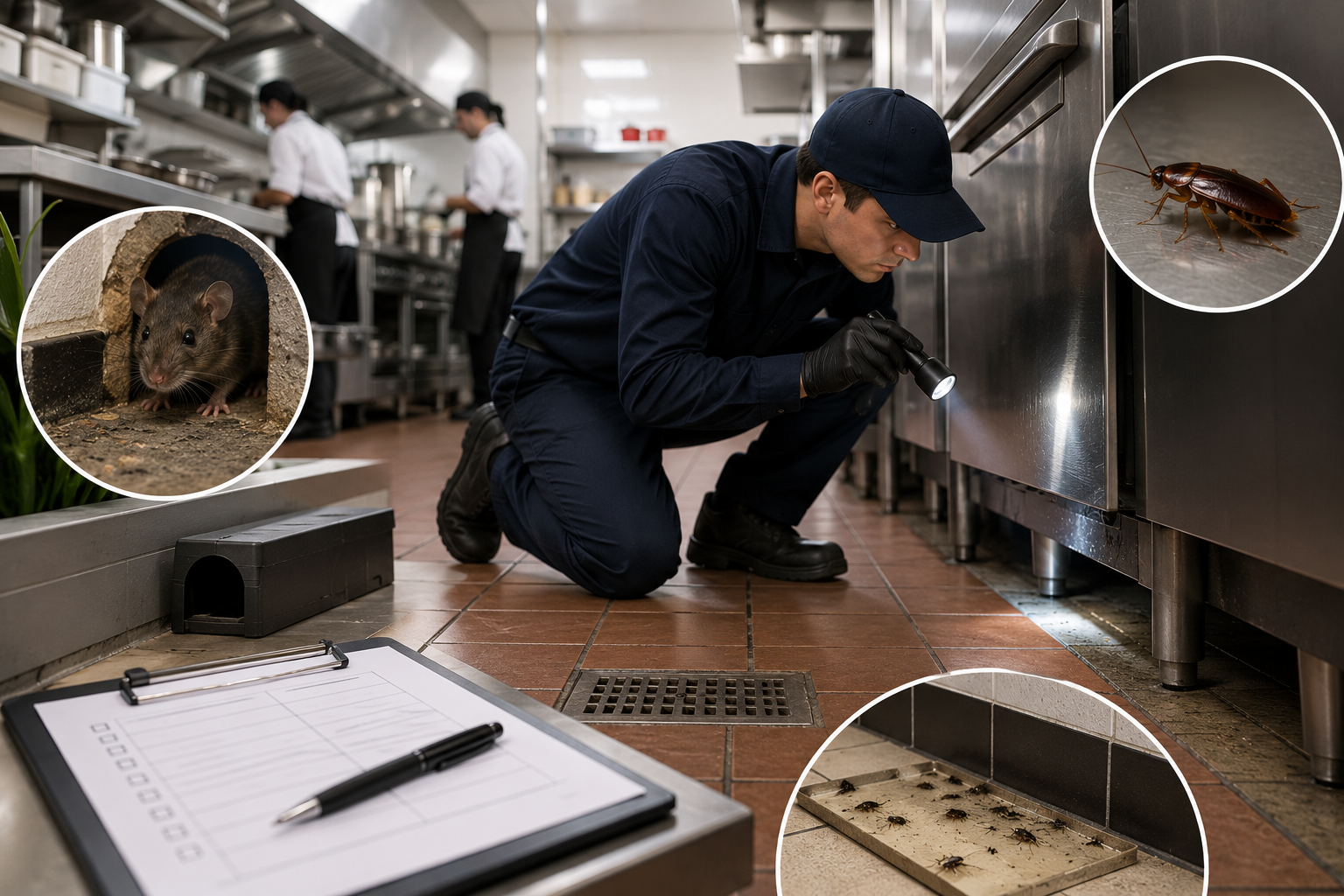
A business may not see a mouse every day, but evidence such as droppings, gnawing, damaged packaging, rub marks, or activity around monitoring devices can indicate that rodents are present.
Regular inspections can help identify potential entry points before the problem becomes a significant infestation.
Alberta guidance recommends regularly checking food establishments for signs of pest activity and monitoring strategic trap locations.
What About Flies?
Flies can quickly become a problem in restaurants, food facilities, garbage areas, and other businesses handling food.
Regular inspections can help identify conditions that contribute to fly activity, including garbage, organic material, drains, moisture, and sanitation problems.
A recurring program allows these conditions to be identified and corrected instead of waiting until customers or employees begin noticing large numbers of flies.
The Pest Control Technician Should Provide Recommendations
One of the most valuable parts of a commercial pest-control program is the technician’s ability to identify conditions that management may not notice.
For example, a technician may find a gap beneath a door, evidence of rodent movement behind equipment, moisture around a plumbing area, or cockroach activity inside an equipment void.
The technician should document these findings and provide practical recommendations.
The business then needs to follow through.
The Business Must Also Do Its Part
Pest control is a partnership.
The technician can inspect, monitor, document, and provide recommendations, but the business must address conditions within its control.
That may include:
- Improving cleaning practices
- Removing clutter
- Repairing damaged doors
- Sealing openings
- Improving garbage management
- Correcting moisture problems
- Cleaning beneath equipment
- Improving food storage
- Following pest-control recommendations
Alberta guidance specifically connects sanitation, building maintenance, exclusion, and regular monitoring with effective pest prevention.
What Should a Monthly Commercial Pest Program Include?
A quality monthly program should be more than a technician simply checking a box.
Ideally, the program should include:
Inspection: Look for current and potential pest activity.
Monitoring: Review traps, monitoring devices, and evidence of pest activity.
Identification: Determine what pest is present and where activity is occurring.
Documentation: Record findings and services performed.
Recommendations: Identify sanitation, structural, maintenance, or operational conditions that require attention.
Control: Apply appropriate control measures based on the findings.
Follow-up: Determine whether previous problems and recommendations have improved.
Communication: Explain the findings to management and identify what needs to happen next.
Why Monthly Documentation Can Help During an AHS Inspection
AHS inspection records show that pest-control documentation can be an important part of food-establishment compliance.
In one AHS inspection, pest-control records were required to be maintained and readily available, while structural gaps allowing pest entry also required correction.
Another AHS inspection identified evidence of pests and required pest-control records as well as correction of conditions contributing to pest activity.
This reinforces the importance of having an organized pest-management program rather than waiting until an inspection identifies a problem.
What Happens When a Business Does Not Have Regular Pest Monitoring?
Without regular monitoring, a business may not know that pest activity is developing until the problem becomes visible.
By that point, the infestation may be more difficult to control and may require additional inspections, treatments, sanitation work, structural repairs, or other corrective measures.
A proactive program is designed to identify problems earlier.
Is Monthly Service Appropriate for Every Business?
Not necessarily.
The appropriate frequency should be based on the property’s pest risk, type of business, building conditions, history of pest activity, sanitation conditions, surrounding environment, and monitoring results.
A low-risk office with no food preparation may require a different program from a busy restaurant, commercial kitchen, grocery store, food warehouse, or food-processing facility.
The important principle is risk-based pest management, not simply performing treatments because the calendar says it is time.
The Bottom Line
For commercial businesses, especially food establishments, a regular pest-control program is an important part of proactive facility management.
Alberta does not impose a universal rule that every commercial business must receive a professional pest-control visit every month. However, commercial food establishments must keep their premises free of pests and conditions that support pest harbourage or breeding, and they must maintain written records of pest-control measures.
For many food businesses, a monthly professional inspection is a practical way to maintain continuous monitoring, identify problems early, document corrective actions, and demonstrate an organized pest-management program.
The goal should not be “spray every month.”
The goal should be:
Inspect. Monitor. Document. Correct. Follow up. Prevent.
A strong commercial pest-control program protects the business, supports food safety, helps management identify problems early, and creates a documented process for keeping pest activity under control.
A Note for Business Owners
Before choosing a service frequency, businesses should discuss the property’s risk level and pest history with a qualified pest-management professional. The program should be designed around integrated pest management (IPM), with monitoring, sanitation, exclusion, maintenance, and targeted control measures working together—not simply routine pesticide application.
Frequently Asked Questions
1. Is monthly pest control legally required for every business in Alberta?
No. There is not a blanket requirement that every commercial business receive a professional pest-control visit exactly once per month. However, commercial food establishments must control pests, keep the premises free of conditions that allow pests to harbour or breed, and maintain appropriate pest-control records.
2. Why should a restaurant have monthly pest control?
Restaurants and food businesses regularly have access to food, moisture, warmth, garbage, storage areas, drains, and equipment that can provide opportunities for pests. Regular professional inspections help identify pest activity and contributing conditions before they become larger problems.
3. Does monthly pest control mean the technician should spray every month?
Not necessarily. A good commercial program should be based on inspection and monitoring results. Depending on the findings, the appropriate action may involve monitoring, exclusion recommendations, sanitation recommendations, targeted treatment, documentation, or follow-up rather than automatically applying pesticides.
4. What pests should commercial businesses monitor?
Depending on the type of business, common concerns can include cockroaches, mice, rats, flies, ants, stored-product pests, wasps, and other nuisance or structural pests.
5. Why are food businesses at higher risk of pest problems?
Food businesses provide many of the resources pests need to survive, including food, water, shelter, warmth, garbage, and potential harbourage areas. Deliveries and frequent movement of products can also create opportunities for pests to enter a facility.
6. What should a commercial pest control technician inspect?
A technician should look for current pest activity as well as conditions that could support future activity. This may include food-storage areas, kitchens, equipment, drains, garbage areas, doors, wall penetrations, cracks, gaps, moisture sources, storage rooms, and other potential harbourage locations.
7. Why is documentation important for commercial pest control?
Documentation provides a record of inspections, pest activity, control measures, recommendations, and follow-up. For food establishments, maintaining appropriate pest-control records is also an important part of demonstrating an organized pest-management program.
8. Can AHS ask a food business for pest-control records?
Pest-control records can be relevant during Alberta Health Services inspections. Commercial food establishments should maintain appropriate documentation of pest-control measures and make records available as required.
9. What should be included in a commercial pest-control report?
A useful report may include the service date, areas inspected, pest activity observed, monitoring results, control measures performed, contributing conditions, recommendations, corrective actions, and follow-up requirements.
10. What happens if the technician finds a gap or other pest entry point?
The technician should document the condition and provide a recommendation for correction. Depending on the issue, the business may need maintenance personnel or a contractor to repair the opening, door, wall penetration, or other structural condition.
11. Is pest control alone enough to keep a restaurant pest-free?
No. Effective pest management is a partnership. Pest control, sanitation, building maintenance, food storage, garbage management, exclusion, employee practices, and regular monitoring all contribute to preventing pest problems.
12. What happens if a business ignores pest-control recommendations?
If contributing conditions remain unchanged, pest activity may continue despite regular professional service. For example, an unsealed opening may continue allowing rodents to enter, while food debris and moisture can continue supporting cockroach or fly activity.
13. Why is the pest control technician’s experience important?
An experienced technician may be better equipped to recognize pest activity patterns, identify hidden harbourage areas, locate potential entry points, and provide practical recommendations rather than simply treating the location where pests were observed.
14. How often should a commercial business have pest control?
The appropriate frequency depends on the property’s risk level, pest history, type of business, building conditions, sanitation, surrounding environment, and monitoring results. Monthly service is often a practical preventive schedule for higher-risk businesses, particularly food establishments, but the program should be based on risk rather than simply the calendar.
15. Should a business wait until it sees a pest before calling a pest control company?
No. Waiting until pests become visible can allow an infestation to develop unnoticed. Regular monitoring can help identify early evidence of activity and conditions that may lead to future problems.
16. Can a clean restaurant still have cockroaches or mice?
Yes. Good sanitation significantly reduces pest opportunities, but pests can still enter through deliveries, doors, structural openings, neighbouring areas, equipment, or other pathways. Regular monitoring helps identify problems that may not be obvious to employees.
17. What should a restaurant do if it sees one cockroach?
The sighting should be documented and reported to management. The area should be inspected for additional evidence, and the business should determine whether professional pest-management follow-up is required. One sighting does not automatically establish a major infestation, but it should not simply be ignored.
18. Why are recurring pest sightings important?
Recurring activity may indicate that an underlying condition has not been corrected. The pest control provider should investigate patterns, review monitoring results, determine whether previous recommendations were completed, and adjust the management strategy when appropriate.
19. What is Integrated Pest Management (IPM)?
Integrated Pest Management is a broader approach that combines inspection, monitoring, prevention, sanitation, exclusion, maintenance, and appropriate control measures. The objective is to manage pest risks effectively rather than relying solely on routine pesticide applications.
20. Does monthly pest control guarantee that a business will never have pests?
No. No professional pest-control program can guarantee that pests will never enter a commercial property. The purpose of a proactive program is to reduce risk, detect activity early, respond appropriately, and address conditions that allow pests to survive or enter.
21. What should management do with pest-control recommendations?
Recommendations should be reviewed and assigned to the appropriate person or department. Maintenance, cleaning, management, and pest-control teams may each have different responsibilities for correcting the conditions identified during an inspection.
22. What should a business look for when choosing a commercial pest control company?
Look beyond the monthly price. Consider the company’s inspection process, technician experience, reporting, monitoring strategy, communication, recommendations, follow-up procedures, and ability to provide a structured commercial pest-management program.
23. Why is monthly monitoring valuable even when there is no visible pest activity?
The absence of visible pests does not necessarily mean there is no pest activity. Monitoring can detect evidence that employees may not notice and can help confirm whether preventive measures are working.
24. What is the biggest mistake businesses make with pest control?
One common mistake is treating pest control as an emergency service instead of an ongoing preventive process. Waiting until customers or employees see pests can allow hidden activity to become more established.
25. What is the most important goal of a commercial pest-control program?
The goal is not simply to have a technician visit once a month.
The goal is to inspect, monitor, document, identify contributing conditions, implement appropriate controls, follow recommendations, and prevent recurring pest activity.
For food businesses, a proactive and well-documented pest-management program can help protect food safety, customers, employees, business reputation, and day-to-day operations.