Effective Wasp Nest Removal Tips for Fall
Table of Contents
- Identify the Wasp Nest and Its Location
- Assess Nest Activity and Entrance Points
- DIY Wasp Nest Removal Methods and Limitations
- Wasp Nest Removal Safety: Protective Clothing and Precautions
- When to Call a Wasp Exterminator
- Wasp Nest Prevention Around the Home
- After Treatment: Nest Destruction and Timeline
- Frequently Asked Questions
Last Updated: October 6, 2026
Identify the Wasp Nest and Its Location
When temperatures drop, wasps seek shelter indoors. The first step in effective wasp nest removal is finding the nest, check eaves, soffits, attic vents, and wall cavities for paper-like structures.
Aerial nests versus ground nests
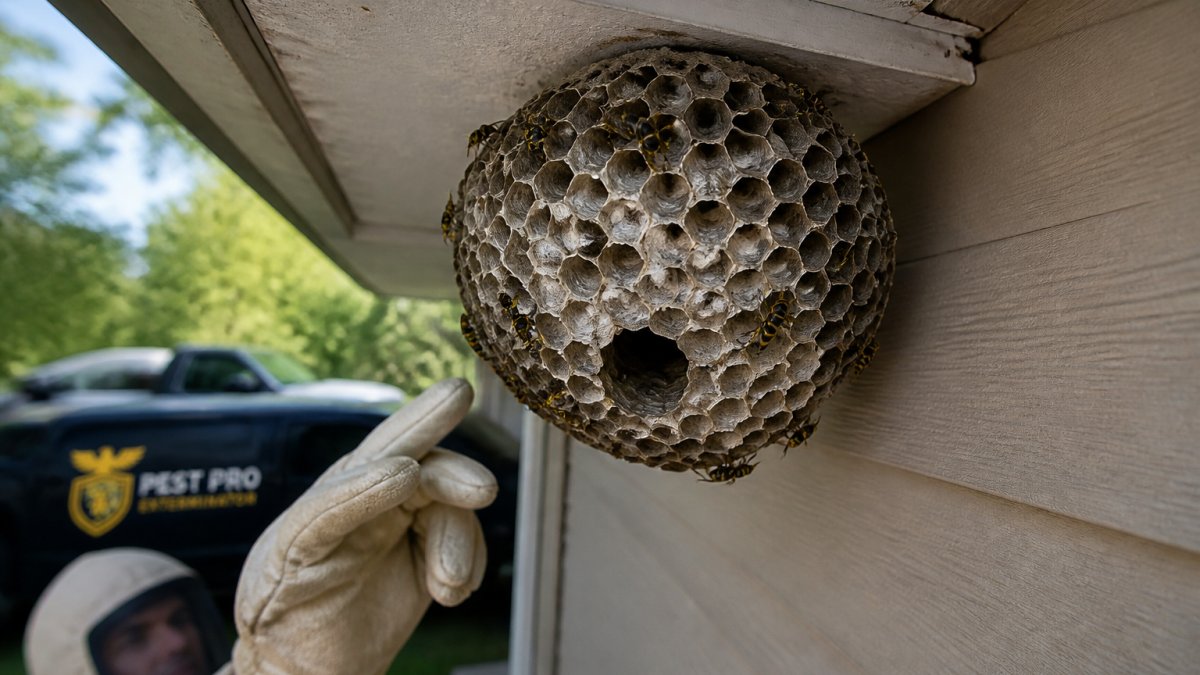
Aerial nests are papery, gray, upside-down-umbrella structures built by paper wasps and bald-faced hornets, usually in plain sight on your home’s exterior.
Ground nests are harder to detect, look for small holes in soil or lawn made by yellow jackets and other ground-dwelling wasps. They’re aggressive when disturbed, so keep your distance.
Spotting hidden nests in wall voids and eaves
Hidden nests are the trickiest to find. Wasps squeeze into cracks and crevices you can’t easily see. Check these spots:
- Wall cavities behind siding or trim
- Attic spaces and roof vents
- Soffits and fascia boards
Listen for buzzing inside walls, a sign of an active colony. You may also see wasps entering and exiting the same small opening repeatedly.
Assess Nest Activity and Entrance Points
Before you act, determine how active the nest is.
Watch the nest in daylight and count wasps entering and exiting over 5-10 minutes.
Look for the nest entrance, the opening where wasps come and go. Mark it clearly.
Wasps are most active in warm daylight, slow at dusk, and nearly inactive at night when temperatures fall.
DIY Wasp Nest Removal Methods and Limitations
Many homeowners try DIY removal first. Some methods work. Most don’t, and some are dangerous.
Boiling water is common for ground nests: pour it into the entrance and step back.
Soap and water spray kills wasps on contact, mix dish soap and water, then spray wasps or the entrance directly. It requires close proximity and doesn’t eliminate the colony.
When nighttime treatment is most effective
Nighttime is the best time for DIY removal. Wasps are sluggish in cold darkness, cluster inside the nest, and fewer are active to defend.
Treat between dusk and dawn when temperatures drop below 10°C. Wear protective clothing, move quickly, and don’t linger near the nest.
Even at night, DIY carries real risk. One angry wasp can sting multiple times, life-threatening if you’re allergic.
Using insecticidal sprays and dusts safely
Insecticidal sprays from hardware and garden stores coat the nest and kill wasps on contact.
Residual dust products work better for hidden nests: the dust clings to surfaces inside wall voids and cavities, and wasps walking through it die.
Apply dust or spray at dusk.
The real limitation of DIY: you can’t safely reach hidden nests.
Wasp Nest Removal Safety: Protective Clothing and Precautions
Safety comes first. Wasps sting when threatened, and multiple stings are dangerous.
Wear these protective items:
- Long sleeves and long pants in light colors (wasps see dark colors as threats)
- Closed-toe shoes with thick soles
- Gloves rated for pesticide use
Avoid perfumes, scented lotions, and bright clothing. Wasps are attracted to sweet smells and vibrant colors.
Risks of disturbing or approaching an active nest
Never approach an active nest without protection. Wasps see you as a threat and attack in groups.
A single sting injects venom that causes pain, swelling, and redness, for most people, symptoms fade in hours.
Disturbing a nest panics the colony, and wasps pour out to defend, you can be stung dozens of times in seconds.
First aid for stings and allergic reactions
If stung, scrape the stinger off immediately with a card or fingernail, don’t squeeze, which injects more venom.
Wash the area with soap and water. Apply ice for 15 minutes.
Get A Free Pest Control Quote Today →
Allergic reactions are serious. Symptoms include difficulty breathing, swelling of the throat or lips, rapid heartbeat, or dizziness.
Know your allergy status before you encounter wasps.
When to Call a Wasp Exterminator
Most guides say to “call a professional if it’s dangerous”, that’s a shrug, not a decision. Use the thresholds below to sort your situation into DIY, borderline, or hands-off before buying any spray.
A practical DIY-versus-professional decision tree
Work through these questions in order. Stop at the first one that applies to you.
- Has anyone in the household had a systemic reaction to a sting, hives away from the sting site, throat tightness, wheezing, dizziness, or a prior epinephrine prescription? If yes, stop. This is not a DIY situation at any nest size.
- Is the nest inside a wall void, attic, soffit, or other enclosed cavity? Enclosed nests are the strongest signal to call someone. You cannot see the colony, confirm kill, and opening the cavity yourself can release hundreds of wasps into a living space.
- Is the nest within about 3 meters of a door, play area, pet run, or walkway? Proximity matters more than size. A golf-ball nest by the back door is a bigger problem than a soccer-ball nest at the far fence line.
- Is the nest larger than roughly a dinner plate, or is traffic heavy? Count wasps entering and leaving for 60 seconds in warm daylight. More than about 10-15 entries per minute points to a mature colony with a large worker population.
- Is the nest in the ground, and do you have pets or small children? Ground nests are easy to step on accidentally, which is how most serious multiple-sting incidents start.
- Have you already tried a treatment that didn’t work? A nest that survived one attempt is now agitated and often has multiple entrances you haven’t found.
If you answered no to all six, a small exposed aerial nest on a cool evening is a reasonable DIY candidate. If you answered yes to even one of items 2 through 6, get quotes. If you answered yes to item 1, treat it as a professional job with no exceptions.
Never plug a nest entrance. Sealing the hole traps the colony inside and forces wasps to chew a new exit, often into the interior of the building. This is one of the most common ways a manageable exterior nest becomes an indoor emergency.
What a professional assessment actually involves
A competent technician doesn’t just spray and leave. Expect an assessment covering:
- Nest identification and count. There is often more than one nest on a property, especially in late summer when colonies peak. A technician should walk the perimeter and check likely cavity entries, not just treat the one you found.
- Entry-point mapping. For cavity nests, the visible hole is rarely the only opening. Mapping all of them prevents a failed treatment.
- Method selection. Dusts are generally preferred for enclosed voids because the particles stay suspended and transfer onto wasps moving through the space. Directed liquid applications suit exposed nests and immediate knockdown.
Questions worth asking before you book
- Are you licensed to apply pesticides in this province or territory, and can you show the applicator certification?
- Will you treat the nest itself, or only the visible entrance?
- What product class will you use, and what is the re-entry time for people and pets?
Timing your call
Book sooner rather than later. Colonies grow through late summer, so a nest treated in early September is a fraction of the size and risk of the same nest in mid-October. Wasps indoors in fall signal a cavity nest that’s been building for weeks, move it to the top of your list.
Health Canada pest control product and applicator information
Wasp Nest Prevention Around the Home
Once you’ve removed a nest, prevent new ones.
Seasonal monitoring and early detection
Fall is peak wasp season. Start monitoring in late August for new nests, early detection means smaller colonies and easier removal.
Inspect these areas monthly:
- Eaves and soffits
- Roof corners and vents
- Deck railings and posts
Catch nests when they’re small, just a few cells. At this stage, a single wasp spray can destroy them.
Removing food sources and sealing entry points
Wasps hunt for food. Remove their reasons to visit.
- Keep garbage cans sealed and away from the house
- Don’t leave pet food outside
- Cover compost bins
Caulk cracks in siding and trim, seal gaps around pipes and vents, and screen attic vents and chimney openings. These simple steps cut wasp activity dramatically.
After Treatment: Nest Destruction and Timeline
Treatment isn’t the finish line. What happens in the two weeks after is where most people relax too early or panic unnecessarily. Here’s what to expect and how to tell a working treatment from a failed one.
What normal post-treatment activity looks like
Foraging wasps that were away during treatment will still return. That’s expected and doesn’t mean the treatment failed.
- Days 1-2: Activity at the entrance may briefly increase, then drop sharply. Returning foragers mill around a nest they can no longer enter.
- Days 3-7: With dust treatments, activity tapers as workers track particles through the colony. You may see sluggish, disoriented wasps near the entrance.
- Days 7-14: Activity should be near zero in warm daylight. A few stragglers are normal.
Direct liquid application on an exposed nest knocks down much faster, often within a day, but the residue doesn’t persist like dust inside a cavity.
How to confirm the colony is actually dead
Don’t judge by a single glance. Instead:
- Pick a warm, sunny afternoon, peak wasp activity time.
- Watch the entrance for a full 10 minutes from a safe distance.
- Repeat on a second day, ideally 3-4 days apart.
- Zero traffic on both checks, with no live wasps on the nest surface, is a reasonable all-clear.
For cavity nests, also listen. Buzzing inside a wall that continues past the expected window is a signal to call the applicator back.
Troubleshooting: when to stop doing it yourself
| What you’re seeing | What it usually means | What to do |
|---|---|---|
| Steady traffic 5+ days after treatment | Nest was missed, or there are multiple entrances | Stop treating. Call a professional. |
| Wasps appearing inside the home | Colony is in a cavity with an interior opening | Do not seal anything. Call a professional. |
| Activity drops, then returns 2-3 weeks later | A second nest nearby, or a new colony moved in | Re-inspect the full perimeter before treating again |
| Live wasps on the nest after two treatments | Product, method, or timing is wrong for this nest type | Stop. Repeated DIY attempts raise your sting risk each time. |
Two failed DIY attempts is the practical cutoff. After that, the risk of a multiple-sting incident outweighs any savings, and a professional can usually resolve it in one visit.
Removing and disposing of the nest
Once you’ve confirmed no activity for several days:
- Wait at least a week past your last sighting before touching the nest. Nests can hold newly emerged wasps longer than expected in mild fall weather.
- Wear gloves and long sleeves even for a dead nest. Old nests can harbor other insects, and the paper structure crumbles into irritating dust.
- Aerial nests: knock the nest into a sealed bag, tie it off, and put it in outdoor garbage. Scrape away any remaining attachment point and wipe the surface.
Preventing a repeat next season
Wasps generally don’t reuse an old nest, but the same sheltered spot is attractive year after year. After removal:
- Seal the gap or cavity that hosted the nest, using appropriate exterior sealant or screening.
- Check the same location in late spring and again in mid-summer, when new queens are scouting.
- Keep the area free of the food and moisture sources that drew wasps in the first place.
A nest treated properly in early fall, before the colony peaks, is far easier to resolve than one found in October when the population is highest.
Frequently Asked Questions
What is the fastest way to get rid of a wasp nest?
Nighttime treatment is fastest because wasps are dormant and less aggressive. Professional technicians use insecticidal dust or spray at dusk to eliminate the colony quickly. The nest entrance should be treated first, then the nest itself. Results typically appear within 24-48 hours. DIY methods work slower and carry higher risk of stings, making professional removal the fastest, safest option for active nests.
How can you tell whether a wasp nest is active?
Active nests show constant wasp traffic, especially during daylight hours. Look for wasps entering and leaving the nest entrance repeatedly. Listen for buzzing sounds inside wall voids or cavities. An inactive nest appears abandoned with no insects present for several days. Timing matters: nests are most active in late summer and early fall as colonies grow. Never assume a nest is inactive without professional confirmation.
When should you call a professional to remove a wasp nest?
Call a professional if the nest is in a wall cavity, high on a building, near a door or window, or if you have a known sting allergy. Underground nests and nests in hard-to-reach spaces require professional equipment and expertise. If DIY treatment fails or the colony returns, professional removal is necessary. Professional technicians assess risk, use appropriate protective equipment, and guarantee treatment effectiveness with follow-up inspections.
How can you prevent wasps from nesting around your home?
Remove food sources by securing garbage, cleaning up fallen fruit, and covering outdoor eating areas. Seal cracks and gaps in walls, eaves, and foundation where wasps enter. Trim tree branches away from the house and remove debris piles. Install screens on vents and openings. Monitor your property weekly during spring and early summer for new nest activity. Early detection of small nests makes removal easier and prevents colony growth before fall.